
FRAME BY FRAME · ISSUE 39
I Am Legend Visual Analysis
2007 · Drama / Thriller / Science Fiction · Directed by Francis Lawrence
Spoilers below, including the theatrical ending.
Francis Lawrence’s I Am Legend makes an emptied New York feel larger than Robert Neville can occupy. Streets built for millions become hunting ground for one man and his dog, while his fortified home preserves the habits of a vanished family. The theatrical ending resolves his search for a cure through sacrifice, but its logic begins in the divide between exposed daylight and barricaded night.
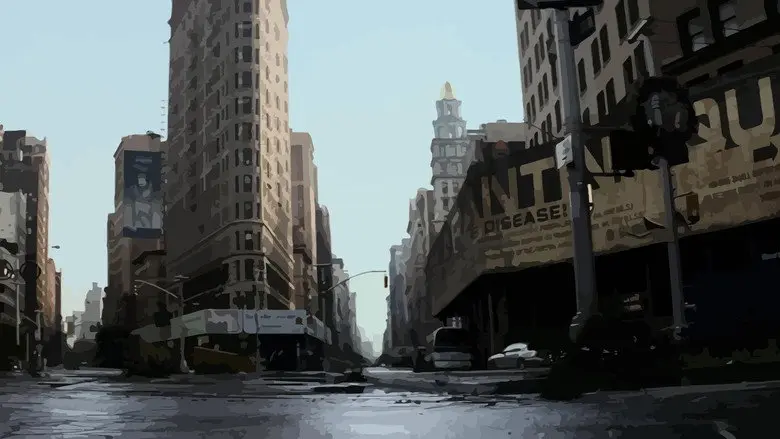
Empty Manhattan turns scale into isolation
The most distinctive recognition cue is the absence of ordinary city life. Tall buildings still define the avenue, but traffic and pedestrians have disappeared. Abandoned cars and encroaching vegetation make the familiar grid look usable and dead at once.
That scale shapes Neville’s routine. By day, he gathers supplies, hunts and broadcasts to anyone who might be alive. The city appears open, yet every trip is governed by the sun. Dark interiors are dangerous thresholds because the infected hide inside them.
Crowded Manhattan usually gives a character anonymity; Neville has no crowd in which to disappear. His red vehicle and his German shepherd, Sam, stand out against stone, glass and empty road. Wide shots measure how little human presence remains.
Domestic space holds a life Neville cannot restore
Neville’s home is both laboratory and memorial. Heavy shutters and nighttime procedures make it a defensive machine. Family photographs and remembered meals keep his wife and daughter present in a place they can no longer inhabit.
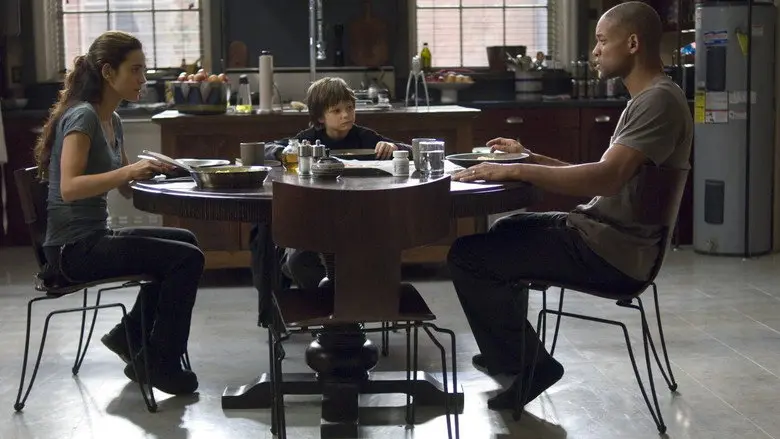
The dining-table image is warmer than the ruined city outside. Three people share the frame, with plates and household objects between them. Its calm gives the memory weight. Neville’s survival is also an attempt to give purpose to the loss of his family.
His laboratory work follows the same tension between care and control. Neville tests treatments on infected subjects and records the results. Yet isolation limits what he recognizes in the infected, including their bonds and organized behavior. The theatrical cut emphasizes his cure while showing how solitude has narrowed his world.
Sam makes survival personal rather than abstract
Sam gives the daylight sequences a human scale. Neville talks to her, works beside her and depends on her alertness. In the street frame, both are exposed among wrecked vehicles. Her position beside Neville makes their routine a partnership.
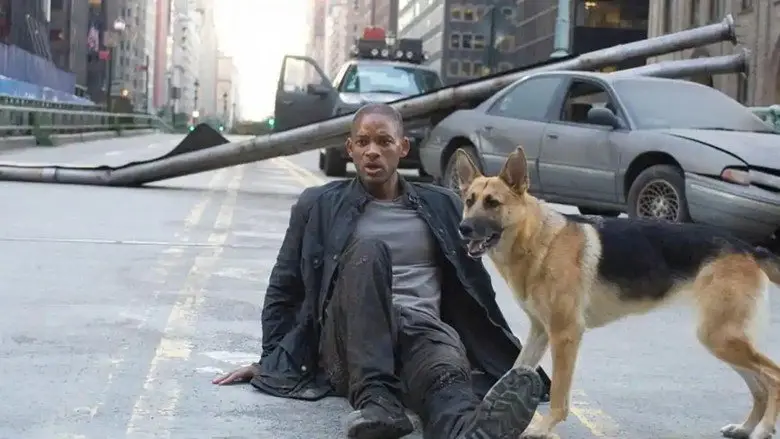
When Sam is infected and Neville has to kill her, the film removes his last continuous relationship. His later attack on the infected is reckless because survival no longer feels like a sufficient purpose. Anna and Ethan arrive after that collapse, bringing evidence that Neville’s assumption of total solitude was wrong.
For MovieWordle players, this relationship is a stronger cue than a generic post-apocalyptic skyline. An empty Manhattan street, Neville’s daylight routine and the German shepherd identify this film. On a rewatch, notice where Sam looks, when Neville speaks to her, and how the film changes after she is gone.
The daylight and darkness divide controls the suspense
The film builds tension through space before confrontation. Sunlit streets provide long sightlines; dark buildings hide depth and movement. Neville’s watch alarm, the lowering sun and the closing shutters turn time into a physical boundary.
The home invasion crosses into Neville’s most controlled space, forcing him, Anna and Ethan into the basement laboratory. The house no longer protects the memories upstairs or the experiment below. Every boundary organizing Neville’s life fails at once.
I Am Legend ending explained: what Neville saves
In the theatrical ending, Neville discovers that his latest treatment is working. As the infected enter the laboratory, he gives Anna a vial of the subject’s blood. He hides Anna and Ethan in a protected compartment, then uses a grenade to kill himself and the attackers. They later reach a survivors’ colony in Vermont and deliver the cure.
Neville’s choice completes the theatrical cut’s definition of his “legend.” He does not survive to rebuild society. What survives is the result of his work, carried by people whose existence he initially refused to trust. The cure turns his private routine into something useful beyond the walls of his house.
The sacrifice also changes the meaning of the film’s empty spaces. For most of the story, Neville behaves as though New York is the whole remaining world and he is its only responsible human inhabitant. Anna’s arrival disproves that closed picture. The colony at the end confirms that survival was never limited to the life he could see from Manhattan.
This article addresses the original theatrical ending. Other released versions change the final confrontation. The central craft argument remains visible: Neville’s tragedy grows from a life divided into safe and unsafe spaces until another person forces him to imagine a future outside them.
Conclusion
I Am Legend ending explained is a story of scale narrowing and opening again. Empty avenues make Neville look like the last person alive; the fortified house turns grief into routine; Sam keeps that routine emotionally legible. In the theatrical ending, Neville saves the cure rather than himself, and Anna carries it beyond the city. His final act matters because it gives up the sealed world he has built and accepts that humanity continues elsewhere.
Keep playing
Ready for another film? Browse the MovieWordle 6 Frames archive and choose a recent puzzle to solve.