
FRAME BY FRAME · ISSUE 38
Source Code Visual Analysis
2011 · Thriller / Science Fiction / Mystery · Directed by Duncan Jones
Spoilers below, including the ending.
Duncan Jones’s Source Code begins like a resettable mystery: Captain Colter Stevens wakes on a Chicago-bound train in another man’s body and has eight minutes to identify a bomber. Its ending changes the rules. The repeated journey is not only a reconstruction of dead passengers’ final memories. Colter’s choices open a continuing reality, which is why the last train ride does not disappear when the timer reaches zero.
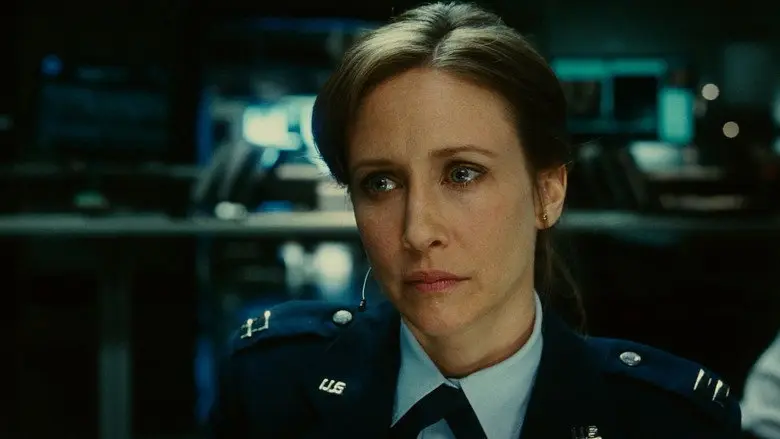
Source Code traps Colter inside someone else’s point of view
The film keeps Colter disoriented by splitting his world into two closed spaces. On the train, he occupies the body of teacher Sean Fentress and sees Sean’s face in reflective surfaces. Between runs, he wakes in a damaged capsule and speaks to Captain Colleen Goodwin through a monitor. Neither space gives him a complete account of what has happened to him.
Dr. Rutledge describes Source Code as access to a dead person’s final eight minutes, insisting that Colter can gather information but cannot change the past. Colter must work under that rule before he has enough evidence to question it. Goodwin knows more about his condition and can see the human cost of sending him back.
The close-up of Goodwin is a strong MovieWordle cue. Her uniform, cool monitors and the darkness around her contrast with the warmer, busier train. It also points to the film’s moral hinge: the person apparently running the mission must decide whether following orders is the same as doing right.
The train loop changes as Colter learns how to look
Each return uses the same basic geography—carriages, platforms, washrooms and passengers—but Colter’s attention changes the meaning of the space. Early on, every odd gesture looks suspicious. Later, he stops reacting to the explosion as an unavoidable deadline and starts treating the passengers as people whose lives might continue.
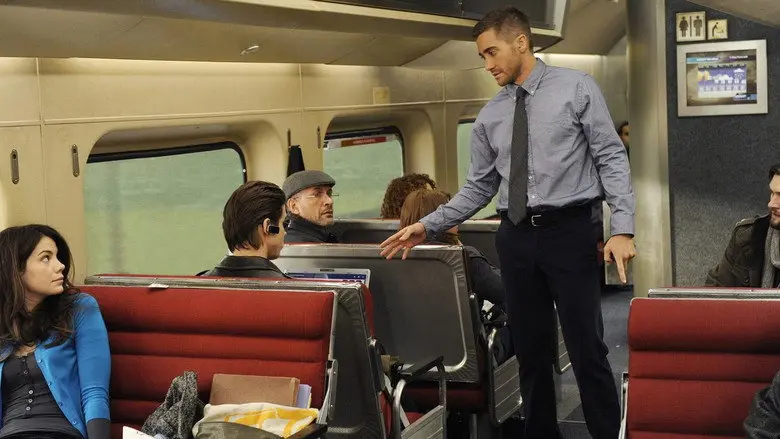
The train image is useful precisely because it is ordinary. Red seats, luggage racks and commuters give Colter a narrow field full of possible clues. Unlike a broad science-fiction spectacle, the repetition depends on small differences: where someone sits, what a phone contains, when a door opens, and how Christina Warren responds to Colter’s increasingly urgent behavior.
Once Colter identifies Derek Frost as the bomber, the original mission is complete. Frost can be stopped before launching a second attack in Colter’s reality. Yet solving the case does not answer Colter’s personal question. His damaged body is being kept alive outside the train scenario, and Rutledge plans to erase his memory for future missions. Colter asks Goodwin for one final run and for his life support to be ended after the eight minutes expire.
The explosion frame reveals the film’s real choice
An approved frame places Colter and Christina on the carriage floor with fire behind them. It condenses the apparent rule of Source Code: no matter what Colter changes, the bomb still turns the train into a fixed endpoint. The ending matters because he finally prevents that image from becoming inevitable.
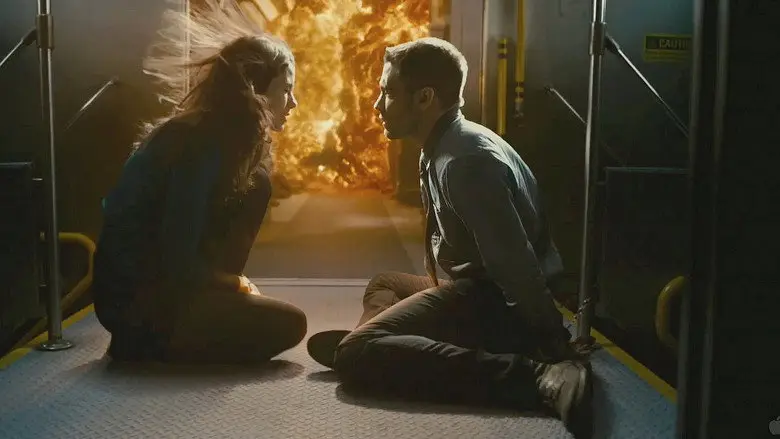
This is where the film moves beyond a bomber hunt. Colter wants the last run not only to catch Frost earlier, but to give the passengers a good final eight minutes. He calls his father, repairs a damaged relationship and arranges a comic performance for the carriage. These choices have no tactical value in the original timeline. They matter because Colter has stopped accepting Rutledge’s claim that the people around him are only residual data.
Source Code ending explained: the freeze does not end the world
In the final run, Colter disarms the bomb, captures Frost and saves the train. Goodwin keeps her promise and disconnects Colter’s life support in the original reality when the eight-minute window ends. On the train, time appears to freeze as Colter kisses Christina. The stillness initially looks like the final image of a simulation that has reached its limit.
Then the world resumes.
Colter and Christina leave the train and visit Cloud Gate in Chicago. In its mirrored surface, Colter still sees Sean Fentress. He sends Goodwin a message explaining that Source Code creates alternate realities rather than merely replaying the past. The film then shows Goodwin at the facility in this new branch, where that reality’s Colter is still on life support and has not yet begun the mission.
The ending therefore separates two outcomes. In the original reality, Colter dies after helping authorities identify Frost and prevent another attack. In the new reality, the saved train continues, Colter lives in Sean’s body, and another version of Colter remains connected to the program. The film does not fully resolve the ethical cost of Colter occupying Sean’s life. It closes on possibility, but that possibility carries an unresolved identity problem.
The message to Goodwin is the decisive proof. Colter knows details she has not yet experienced in the new branch, so his email reaches her as information from a parallel outcome. Source Code is not a closed recording. Under the film’s final rule, intervention produces a world that can keep going.
Conclusion
Source Code ending explained comes down to a rule change earned through Colter’s behavior. The control room treats eight minutes as stored evidence; the train teaches him to treat them as lived time. By preventing the bombing and contacting Goodwin across realities, he proves that the last run is neither a memory nor a temporary simulation. It is a branch—with saved passengers, a second Colter, and consequences the film deliberately leaves open.
Keep playing
Ready for another film? Browse the MovieWordle 6 Frames archive and choose a recent puzzle to solve.