
FRAME BY FRAME · ISSUE 47
The Godfather Visual Analysis
1972 · Drama / Crime · Directed by Francis Ford Coppola
Spoilers below, including the ending.
Francis Ford Coppola’s 1972 The Godfather is a film about succession disguised as a family crime story. Don Vito Corleone begins as the centre of a crowded network, surrounded by relatives, clients, and men who wait for his decision. Michael begins outside that network, insisting that his family’s business is separate from his own life. The film’s visual language follows the distance between those positions until it disappears.
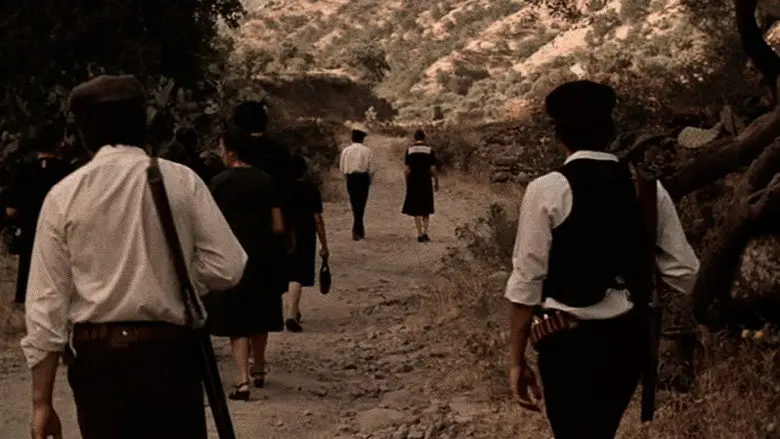
The Godfather makes family and power share the same frame
The first selected image shows a procession moving along a dry Sicilian road. Men carry weapons and families walk together, so the landscape reads as both community and threat. The scene’s distance matters. Michael’s exile in Sicily gives him space from New York, but the film never lets him escape the structures that made his family powerful.
Coppola often places ceremony beside violence. Weddings, funerals, baptisms, and family meals create the public surface of the Corleone world. Beneath that surface, decisions are being negotiated and loyalties measured. The result is not a simple opposition between home and crime. The family is the institution through which power is inherited, justified, and hidden.
For MovieWordle players, the useful cue is the combination of formal clothing, earth-toned light, and bodies arranged in a group rather than a lone action pose. The Godfather makes authority look social before it makes it look violent.
Michael’s face changes the film’s centre of gravity
Michael’s early scenes keep him visually separate from the family business. He sits beside Kay at the wedding and tells her that his father’s work is not his work. After the attacks on Vito and the restaurant meeting in which Michael kills Sollozzo and Captain McCluskey, that separation cannot hold.
A later approved frame shows Vito and Michael facing each other in a dark interior. The older man’s profile and the younger man’s turned face share the same low light, making resemblance and conflict visible at once. It is not a literal claim that Michael becomes identical to his father. The composition shows that Michael has entered the position he once described from the outside.
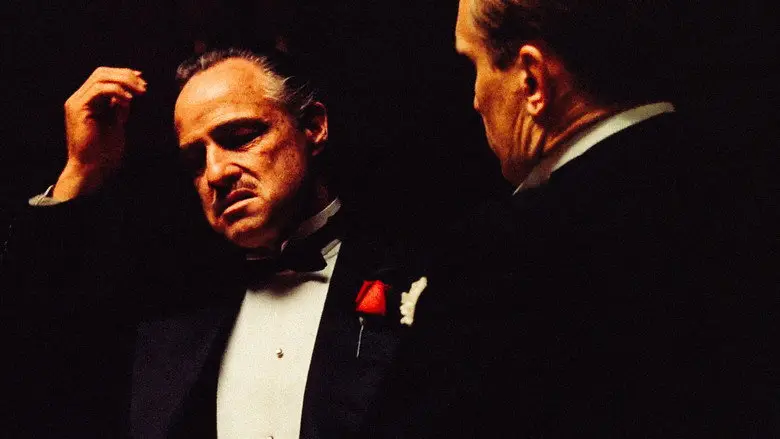
The film’s colour and framing support that shift. Michael’s return to New York is not staged as a triumphant homecoming. He is increasingly enclosed by rooms, curtains, and the people who wait for his instructions. Power gives him control over the frame, but it also narrows the life he can still inhabit.
The Godfather ending explained: the door closes on Kay
At the end, Michael becomes the new Don. He denies his involvement in the killings when Kay asks him directly, and then the men around him address him as their leader. The door closes between Michael and Kay while she remains outside the room.
The plot fact is simple: Michael has completed his transformation into the head of the Corleone family. The interpretation is darker. The closing door separates Kay from the private explanation she wants and seals Michael inside a public identity that now controls his marriage, family, and future. His rise protects the family’s authority, but the film presents that protection as a loss of intimacy and accountability.
The ending also returns to the film’s opening idea of social power. Vito’s office was full of people asking for favours; Michael’s office is now full of men recognising his authority. The difference is that Michael once believed he could stand apart from that room. By the final shot, the room has become his definition.
Conclusion
The Godfather explained through its visual system is a story of inheritance. The Sicilian road, the shared dark interior, and the closing door chart Michael’s movement from observer to ruler. Coppola makes the transformation legible without reducing it to one decision: every family ritual, room, and silence helps build the position Michael finally accepts.
Keep playing
Ready for another film? Browse the MovieWordle 6 Frames archive and choose a recent puzzle to solve.