
FRAME BY FRAME · ISSUE 50
The Godfather Part II Visual Analysis
1974 · Drama / Crime · Directed by Francis Ford Coppola
Spoilers below, including the ending.
Francis Ford Coppola’s 1974 The Godfather Part II tells two stories across different times: Vito Corleone’s rise from Sicilian immigrant to New York power broker, and Michael Corleone’s effort to protect and expand the family empire. The parallel structure is not only a narrative device. It lets the film compare two versions of inheritance—one built through arrival and community, the other through isolation and control.
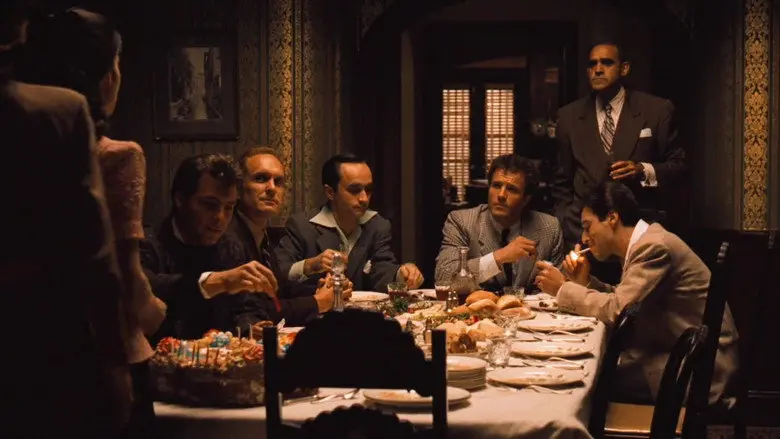
The Godfather Part II makes family history a visual argument
The dinner-table frame places a crowded family inside a warm, patterned room. Food, glasses, and overlapping conversations make the scene feel social rather than strategic. This is the visual world of Vito’s early family life: power begins as a network of neighbours, relatives, and people who recognise one another.
Michael’s rooms are different. They are larger, darker, and more controlled. The family still gathers, but the gathering no longer guarantees intimacy. The film cuts between the two timelines so that an old gesture can echo in a new setting while its meaning changes.
For MovieWordle players, the useful cue is the contrast between the formal dinner table and the darker interiors around Michael. The film’s identity lies in that movement between family warmth and institutional power, not in a single gangster prop.
Silence and empty space reveal Michael’s isolation
A later approved frame shows Michael alone at a long dinner table. The room remains carefully arranged, but the empty chairs and lowered light make the arrangement feel like evidence of absence. Michael has achieved control over the family business, yet the image suggests that control has removed the people who could speak to him without fear.
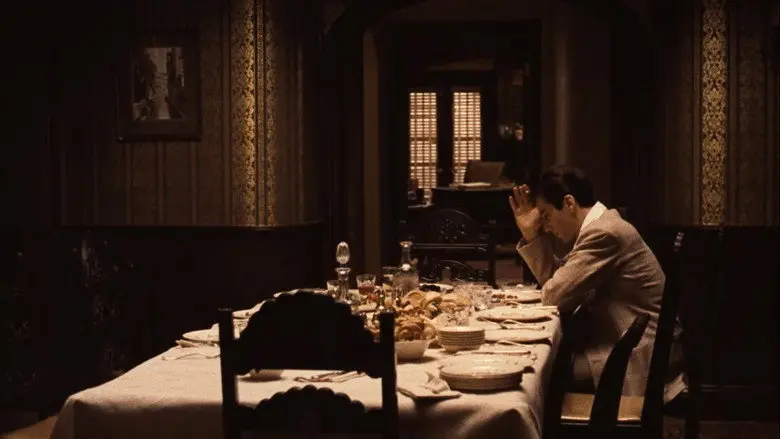
The parallel with Vito is deliberate without being simple. Vito’s rise involves violence, but it also includes the creation of a household and a community identity. Michael’s rise protects the family name while breaking the trust inside his own home. He treats loyalty as something to test, measure, and punish.
The film’s dark palette makes this change visible. Faces emerge from shadow for a conversation, then disappear again when the decision is made. The rooms look secure, but security has become another word for separation.
The Godfather Part II ending explained: why Michael is left alone
Michael orders the deaths of Fredo and other rivals after the attempted assassination at Lake Tahoe. Fredo’s betrayal and death complete the break between Michael’s idea of family loyalty and the emotional obligations that once gave the word meaning. Kay has already lost faith in the marriage, and the children are being raised inside a house shaped by suspicion.
The ending returns to the past, showing the Corleone family waiting for Vito’s birthday in 1941. Sonny, Fredo, Michael, Tom Hagen, and Vito’s other associates gather before Michael arrives. When the younger Michael announces that he has enlisted in the Marines, Sonny attacks the choice, while Vito’s return brings the family briefly into one room.
The cut back to the older Michael sitting alone turns that memory into judgment. The plot does not say that Vito’s past was innocent. It shows Michael remembering a moment when the family was together before his decisions transformed its meaning. The final image is therefore not a victory portrait. It is the cost of inheriting power while losing the relationships that made the inheritance matter.
Conclusion
The Godfather Part II explained through its parallel images is a film about inheritance without continuity. The family dinner, the empty table, and the birthday memory show two men building power in different ways. Vito’s story creates a family network; Michael’s story preserves its authority while leaving him alone inside it.
Keep playing
Ready for another film? Browse the MovieWordle 6 Frames archive and choose a recent puzzle to solve.