
FRAME BY FRAME · ISSUE 43
Gremlins Visual Analysis
1984 · Fantasy / Horror / Comedy · Directed by Joe Dante
Spoilers below, including the ending.
Joe Dante’s 1984 Gremlins is easy to recognise because it keeps two visual worlds in the same frame. Billy Peltzer carries a small, fur-covered creature through a soft Christmas scene; later, the same holiday lights surround red barrooms, broken glass, and a swarm of monsters. The film’s craft depends on that collision. It uses the colours and objects of a family Christmas film, then lets them behave like horror props.
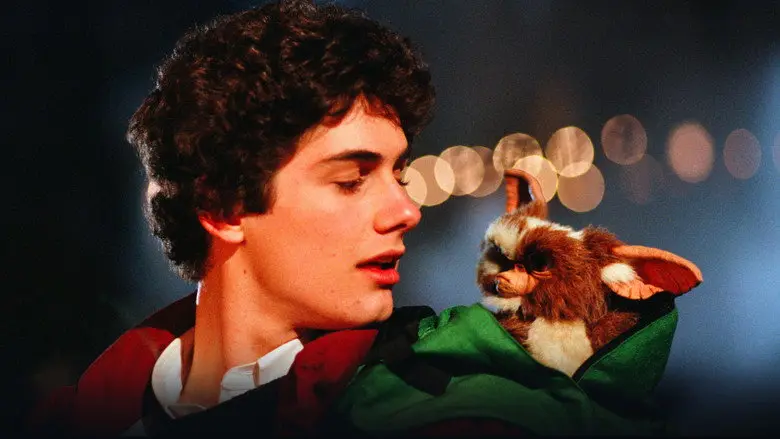
Gremlins makes the cute image a warning
The first approved frame shows Billy looking toward Gizmo, who sits inside a green coat while blurred lights glow behind them. The shot is warm and intimate, but Gizmo’s large ears and watchful eyes make the creature unusually legible. For MovieWordle players, that pairing is the key: a young man, a small Mogwai, and holiday bokeh suggest a family fantasy before the film has shown its darker side.
Dante does not abandon that softness when the rules become dangerous. He lets the house remain recognisably domestic—kitchen counters, stairs, bedrooms, a Christmas tree—while the scale of the threat changes. The result is funnier and more unsettling than a separate monster world would be. A familiar room can become a trap without changing its wallpaper.
Colour and performance move the film from toy to threat
A close frame of the Mogwai shows brown fur, folded ears, and red-rimmed eyes against a dark background. The face is still small enough to read as a toy or pet, but the lighting removes the safe holiday glow. The film repeatedly asks the audience to decide whether a creature is adorable, mischievous, or dangerous, sometimes within the same scene.
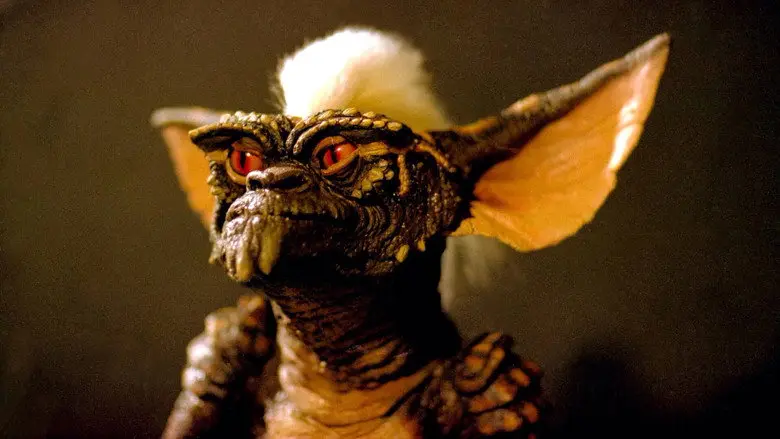
That instability is part of the film’s practical recognition system. A player should look for the contrast between Christmas decoration and creature-feature texture: coloured bulbs beside wet fur, a family living room beside a jagged silhouette, or a tiny face framed like a horror close-up. The image does not need a famous prop to belong to Gremlins. Its tone is already doing the work.
The bar scene makes the transformation public. Gremlins sit among bottles, neon, and red light, turning a cheerful seasonal palette into a crowded night of slapstick violence. Their bodies are animated for attitude as much as menace. One sings, another drinks, another handles a weapon. The film lets the monsters perform human bad habits, which keeps the horror comic without making it harmless.
Gremlins explained: what the rules are doing
The Mogwai rules—keep it away from bright light, water, and food after midnight—give the film a simple mechanical structure. Each rule converts an ordinary action into a possible disaster. Water is a household accident, midnight food is a temptation, and light is both a practical danger and a way to expose the creatures.
Those rules also explain why the film’s ending does not erase the chaos. After Billy defeats the gremlins in Kingston Falls, Gizmo is returned to Mr. Wing. Mr. Wing refuses to let Billy keep him, warning that people may not be ready to care for a Mogwai. The final exchange restores the creature to its original owner, but it leaves the warning intact: the problem was never only one bad night. It was the human desire to possess something mysterious without accepting its limits.
Conclusion
Gremlins explained through its visual craft is a story about tonal contamination. Christmas lights, family rooms, and a cute face remain on screen while horror keeps entering the frame. For MovieWordle players, the strongest cue is that mixture of seasonal warmth and creature menace—the film looks like a holiday movie until its ordinary spaces start obeying monster rules.
Keep playing
Ready for another film? Browse the MovieWordle 6 Frames archive and choose a recent puzzle to solve.