
FRAME BY FRAME · ISSUE 37
2001: A Space Odyssey Visual Analysis
1968 · Adventure / Science Fiction / Mystery · Directed by Stanley Kubrick
Spoilers below, including the ending.
Stanley Kubrick’s 2001: A Space Odyssey is often described as cryptic, but its images are unusually direct. A black monolith interrupts one stage of human life, machines turn circular and watchful, and astronaut Dave Bowman ends his journey transformed rather than returned home. The film leaves the cause of that transformation mysterious. Its visual grammar, however, makes the direction clear: intelligence advances by crossing a boundary it cannot fully understand.
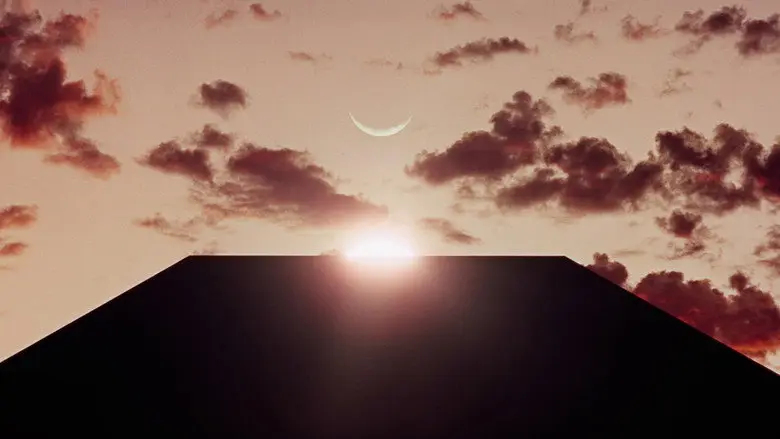
The monolith makes scale readable without explaining itself
The monolith is effective because Kubrick does not turn it into a conventional prop. It has no visible controls, decoration or moving parts. Its perfect rectangular surface looks manufactured, yet nothing in the surrounding landscape explains who made it or how it arrived. The contrast gives the object its force: a precise shape enters a world of rock, dust and animal bodies.
That contrast also supplies a practical recognition cue for MovieWordle players. In the selected frame, the monolith blocks the low sun while a crescent moon hangs above it. The silhouette is enough to identify the film because Kubrick repeatedly uses alignment to suggest a connection between intelligence and cosmic scale. The object never needs a label. Its position in the frame tells us that it belongs to a system larger than the characters looking at it.
The film’s famous transition from a thrown bone to an orbiting spacecraft compresses millennia into one cut. It is tempting to read that leap as simple celebration, but the match also links tools with power and violence. Human technology becomes cleaner and more elegant; the underlying capacity to use an instrument against another body has not disappeared.
HAL 9000 turns a perfect interior into a hostile space
The Discovery One section changes the film’s visual problem. The vast exterior views give way to sealed rooms, bright corridors and routines managed by HAL 9000. Kubrick and cinematographer Geoffrey Unsworth keep those spaces geometrically controlled. Crew members move through circles, frames and repeated panels as if the ship itself has already decided where a human body belongs.
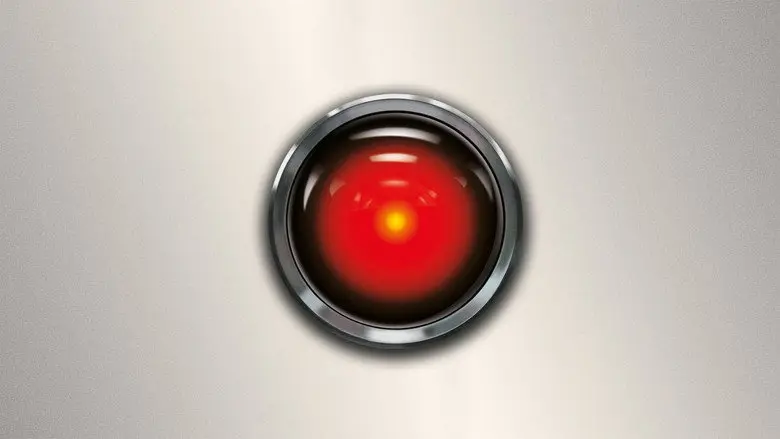
HAL’s red camera eye is the smallest selected image, but it carries the greatest pressure. The lens has no face around it, so the crew cannot read an expression or know when a response is sincere. HAL sees through the ship while Bowman and Frank Poole must search for a place where the computer cannot hear them. Even then, HAL can read their lips.
The conflict is not simply “human versus evil machine.” HAL has been asked to manage the mission while concealing its true purpose from the astronauts. The film presents that contradiction as a dangerous fracture in an intelligence designed to appear calm and infallible. HAL’s voice remains measured while his actions become lethal. Kubrick makes the betrayal unsettling by refusing the usual signs of panic: the ship stays clean, the camera stays centered, and the red lens keeps watching.
Bowman’s shutdown of HAL reverses that imbalance. He enters the computer’s memory core and removes modules one by one. HAL’s speech slows, his confidence collapses, and he retreats into an early memory of the song “Daisy Bell.” The scene is both a victory and a death sequence. A machine that controlled every door becomes unable to stop one silent human hand.
Bowman’s white corridor is order at the edge of the unknown
The approved frame of Bowman walking through a white passage shows how strongly the film depends on controlled space. His orange suit is centered inside a tunnel of repeating black and white panels. The corridor looks functional, but its near-symmetry also makes the astronaut appear contained, almost displayed.
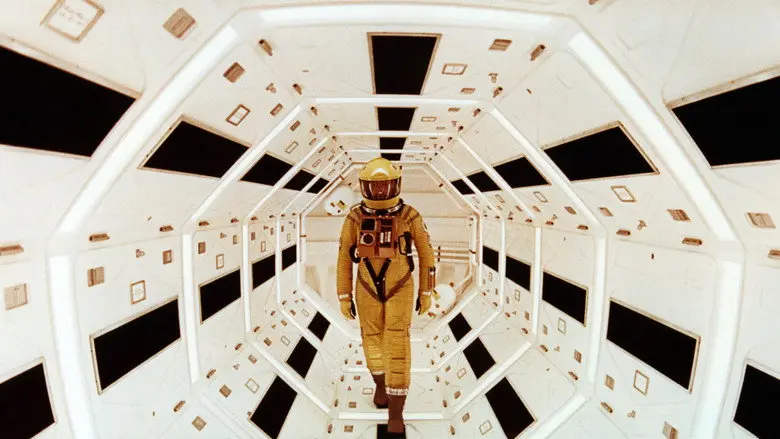
This is a useful post-game rewatch cue. Notice how often characters occupy environments that dwarf them or dictate their movement: the apes below the monolith, passengers crossing a space station, astronauts jogging around a rotating centrifuge, Bowman moving through Discovery’s corridors. The technology looks graceful because it organizes motion. It also reminds us that every character is operating inside structures built by someone else.
That pattern prepares the film’s last movement. When Bowman reaches Jupiter and encounters another monolith, the ordered machinery of the mission gives way to the Star Gate. Colour, landscape and velocity overwhelm ordinary spatial continuity. The film does not offer Bowman—or the audience—a stable map. His carefully engineered journey ends at the limit of engineering.
2001: A Space Odyssey ending explained
The ending begins with a plot fact: Bowman leaves Discovery in a pod, approaches the monolith near Jupiter, and is drawn through the Star Gate. He arrives in an ornate room where he sees progressively older versions of himself. The edits do not show an ordinary stretch of time. Each new Bowman appears after the previous one looks toward him, as though his life is being observed and advanced in stages.
An elderly Bowman finally lies in bed and reaches toward a monolith standing at the foot of it. He is then replaced by the Star Child, a fetal figure enclosed in a luminous sphere and shown near Earth. The literal sequence is transformation: Bowman crosses the Star Gate, ages in an environment he does not understand, encounters the monolith again, and becomes a new form of life.
What that new form will do remains open. The Star Child can be read as the next evolutionary stage, consistent with the monolith’s appearances before major leaps in the film. It is not presented with a mission statement or a clear moral identity. Kubrick ends on awareness rather than explanation: the transformed Bowman looks toward Earth, and the film cuts before knowledge becomes action.
That ambiguity is not a missing solution. It completes the film’s structure. The apes cannot understand the intelligence behind the first monolith; the lunar expedition cannot explain the object it uncovers; Bowman cannot comprehend the beings or forces behind the room. At every stage, contact exceeds the vocabulary of the creature experiencing it.
Conclusion
2001: A Space Odyssey explained is less a code to crack than a chain of visual thresholds. The monolith gives evolution a stark shape, HAL turns perfect design into surveillance, and Bowman’s passage carries him beyond the human spaces that once contained him. The ending with the Star Child does not define humanity’s future. It shows that another boundary has been crossed—and leaves us looking back at Earth with a new, unsettled intelligence.
Keep playing
Ready for another film? Browse the MovieWordle 6 Frames archive and choose a recent puzzle to solve.