
FRAME BY FRAME · ISSUE 54
The Good, the Bad and the Ugly Visual Analysis
1966 · Western · Directed by Sergio Leone
Spoilers below, including the ending.
Sergio Leone’s The Good, the Bad and the Ugly (1966) makes a western showdown feel like a piece of geometry. Blondie, Tuco, and Angel Eyes chase the same Confederate gold, but the film does not reduce them to a simple moral chart. Its craft is more revealing than the labels. Extreme close-ups, empty landscape, delayed movement, and Ennio Morricone’s score turn suspicion into a physical experience.
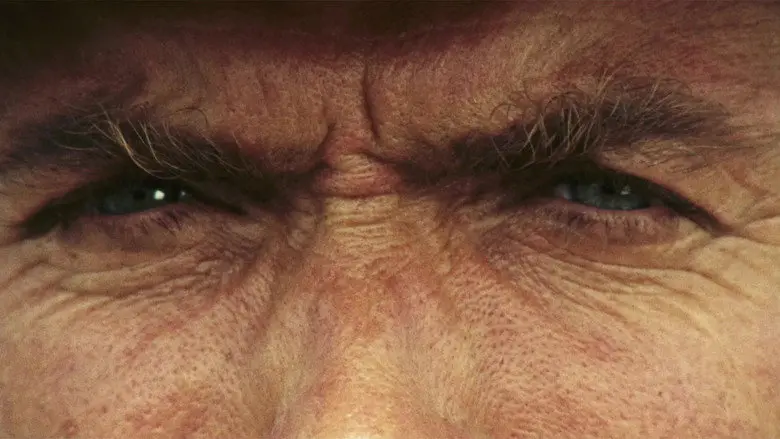
Leone makes the western showdown about looking
The film repeatedly cuts from a huge landscape to a single eye. That scale change denies the comfort of a stable viewpoint. A rider can seem insignificant against the desert, then dominate the screen when Leone isolates a face. The close-up is not simply a portrait. It is a question: who has seen the danger first, and who is pretending not to be afraid?
This method also makes the trio’s partnership unstable. Blondie and Tuco cooperate when the arrangement benefits both men, then turn on each other when the balance shifts. Angel Eyes is more openly calculating, but the other two also lie, bargain, and abandon people. The title’s categories remain useful as shorthand, yet the images keep showing their overlap.
Landscape, silence, and the recognition cue
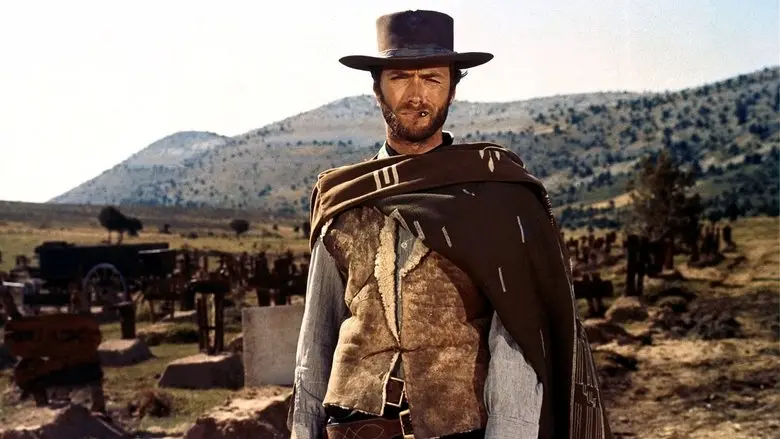
A second approved frame places Blondie outdoors against a broad cemetery landscape. He is small in the frame, but the space gives his stillness weight. Leone lets distance do dramatic work: before anyone draws, the audience reads the ground, the exits, and the positions of the other men. The landscape is not a neutral backdrop. It is a diagram that tells us where trust can fail.
For MovieWordle players, the strongest recognition cue is the contrast between the extreme eye close-up and the open western space. One frame compresses the world into a stare; the other stretches it into a field of possible betrayal. Together they point to a film where tension comes from waiting long enough to see every angle.
The silence matters as much as the dialogue. Leone withholds movement until it becomes an event. A hand near a holster, a glance across the dirt, or a pause before the score returns can carry more information than a speech. The film’s visual system makes patience feel dangerous.
The Good, the Bad and the Ugly ending explained
The three men reach Sad Hill Cemetery while searching for the Confederate gold. Blondie reveals the name on the grave, but he has already unloaded Tuco’s revolver. The final circular staging gives each man a place in the frame and makes the draw feel inevitable. When the guns come out, Blondie shoots Angel Eyes, while Tuco discovers that his weapon cannot fire.
Blondie and Tuco then dig up the gold and divide it. Their partnership survives because it has always been transactional, but it also contains a rough form of loyalty: each man knows the other’s tricks and keeps returning to the arrangement. The ending’s final joke, in which Blondie restores Tuco’s loaded ammunition only after the hanging ritual is complete, turns humiliation into their familiar language.
The gold is the plot’s prize, yet the real resolution is the exposure of the labels. Blondie is not purely good, Tuco is not only ugly, and Angel Eyes is more than a cardboard villain. The cemetery makes those moral names temporary positions in a game of power.
Conclusion
The Good, the Bad and the Ugly explained through its craft is a film about visual control. Eyes, distance, silence, and circular staging make the western duel feel both ritualistic and absurd. The gold changes hands, but Leone’s lasting point is that character is always being renegotiated under pressure.
Keep playing
Ready for another film? Browse the MovieWordle 6 Frames archive and choose a recent puzzle to solve.