
FRAME BY FRAME · ISSUE 51
Forrest Gump Visual Analysis
1994 · Drama / Comedy / Romance · Directed by Robert Zemeckis
Spoilers below, including the ending.
Robert Zemeckis’s 1994 Forrest Gump moves through American history by keeping its attention on ordinary acts: sitting beside a stranger, writing a letter, running across a field, waiting for a child. The film’s approved frames show how that movement works. A large tree, a dark lake, and a football field become visual anchors for a life that keeps changing around Forrest while his way of looking remains direct.
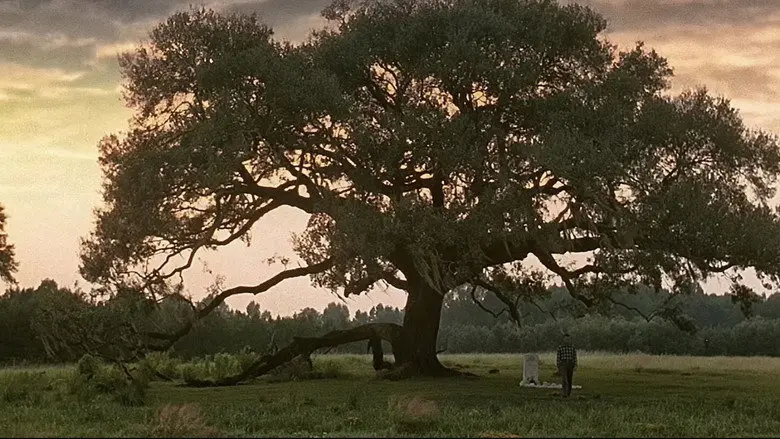
Forrest Gump makes landscapes hold memory
The first selected frame places Forrest and Jenny under a broad tree in an open field. The branches fill the upper part of the image, while the two children sit small beneath them. The composition makes the tree feel like a shelter and a marker in time. It is a place where the characters can return, even as the rest of their lives move away from childhood.
Zemeckis uses landscapes to keep the film’s historical movement personal. Forrest may be sent through the army, college football, the Vietnam War, and national politics, but the film returns to roads, water, trees, and fields. The locations give a changing country a physical shape without asking Forrest to become a historian of it.
For MovieWordle players, the cue is the mixture of wide American scenery and a simple figure at its centre. Forrest Gump often frames a person against a landscape that seems larger than any single event, then lets a small gesture carry the emotion.
The film’s movement is simple, but its meanings change
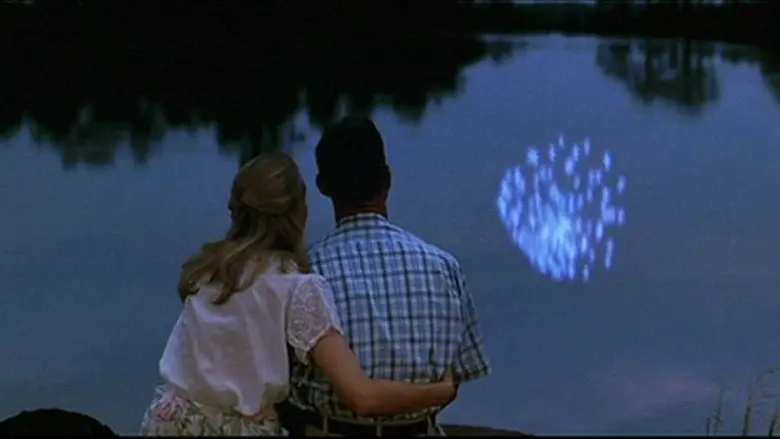
A second approved frame shows Forrest and Jenny from behind as they look across a dark lake. The water holds a pale reflection, and the pair are linked by the way Jenny’s arm rests around him. The image is quiet, but it gathers the film’s recurring ideas about distance and return. Jenny is always moving toward another life; Forrest keeps moving forward without needing to rename what he feels.
The film’s famous running passages work the same way. Forrest runs because running is what he knows how to do, but other people attach causes and slogans to the movement. The camera can turn a private action into a national image while keeping the character’s reason stubbornly personal.
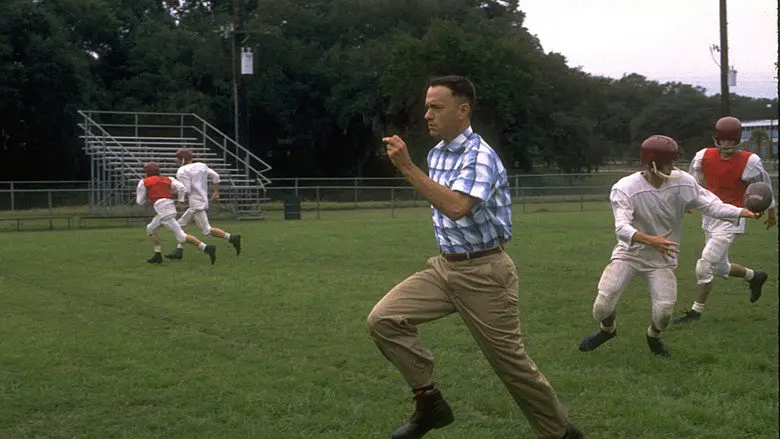
The football frame offers a practical recognition cue from another stage of his life. Forrest runs through a green field in a blue plaid shirt while players chase the play behind him. The image is energetic, but the visual joke is that his direct path is clearer than the game’s official strategy. The film repeatedly finds freedom in movement before institutions decide what that movement means.
Forrest Gump ending explained: what remains after the story
Forrest becomes a father to young Forrest, whose mother is Jenny. Jenny dies after telling Forrest that their son is smart and asking him to care for the boy. The final scenes return to the bus stop and the feather image, connecting the story’s present to the film’s larger pattern of chance, memory, and movement.
The ending does not say that Forrest’s life is random or that every event was destined. It shows how he gives meaning to what has happened by telling it as a sequence of encounters and returns. The people at the bus stop hear a version shaped by his memory, while the film lets the audience see the wider history around him.
Conclusion
Forrest Gump explained through its visual themes is a story about memory making a path through change. The tree, the lake, and the football field hold different versions of Forrest and Jenny without turning them into symbols with only one answer. For MovieWordle players, look for wide landscapes, direct movement, and a small human gesture that survives the passing of time.
Keep playing
Ready for another film? Browse the MovieWordle 6 Frames archive and choose a recent puzzle to solve.