
FRAME BY FRAME · ISSUE 48
The Shawshank Redemption Visual Analysis
1994 · Drama / Crime · Directed by Frank Darabont
Spoilers below, including the escape and ending.
Frank Darabont’s 1994 The Shawshank Redemption is often remembered through one image: Andy Dufresne standing in the rain with his arms open after crawling through the prison sewer. The film earns that image by building a visual system around enclosure, routine, and small acts of patience. Hope is not a mood that arrives at the end. It is a practice Andy and Red keep alive inside a place designed to make the future feel impossible.
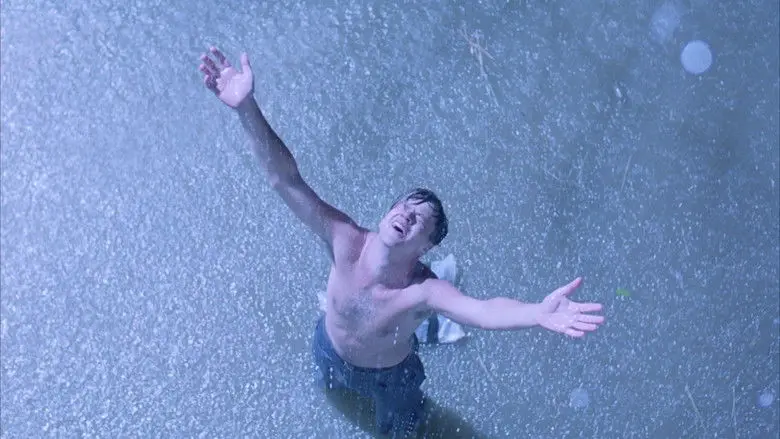
The Shawshank Redemption makes space measure time
The rain frame is a strong recognition cue because the sky, water, and open posture reverse the prison’s usual geometry. Shawshank is made of walls, bars, corridors, and schedules. Andy’s body in the rain is suddenly horizontal rather than contained by a cell or yard. The image is cathartic, but it also completes a spatial argument the film has been making for years.
Earlier scenes turn the prison into a set of repeated routes. Inmates move from cells to the yard, the library, the workshop, and the roof under supervision. A third approved frame shows prisoners working on a roof while guards watch from above. The men are exposed, yet the shared labour gives them a brief view beyond the walls. Andy’s offer to help with the guards’ taxes becomes a small exchange of dignity inside a coercive system.

For MovieWordle players, look for work clothes, brick, sunlit yards, and the contrast between group movement and solitary confinement. The film’s images are recognisable because hope is always placed against an architecture that seems stronger than the people inside it.
Friendship gives the institution another scale
Red’s narration supplies the film’s emotional scale, but the friendship is built through practical exchanges. Andy asks for a rock hammer. Red finds music, books, and eventually money. Their conversations give the prison a human rhythm that the official routines lack. A selected yard frame shows Andy and Red speaking together in daylight, with the prison buildings behind them. The background remains, but the friendship changes what the space means.
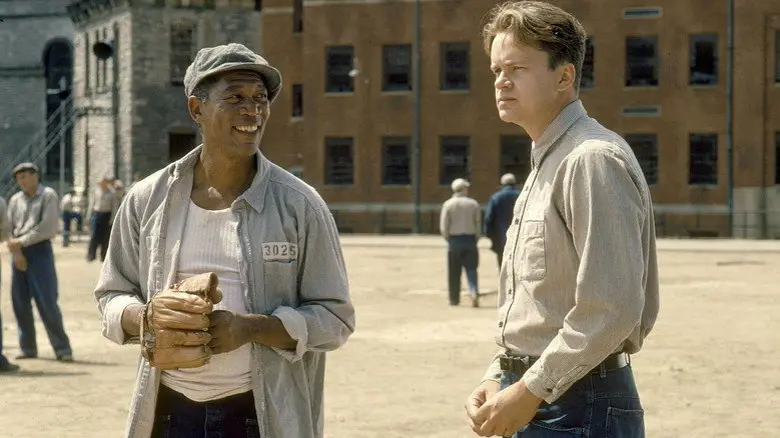
That distinction matters when the warden uses Andy’s financial skills. The institution rewards his usefulness while denying his freedom. Andy’s work helps him survive, but it also makes him vulnerable to a system that wants his labour without acknowledging his personhood. His hope remains practical: he saves money, builds the library, and prepares for a future no one else can see.
The Shawshank Redemption ending explained: escape and reunion
Andy escapes through the tunnel he has been widening behind the poster in his cell. He uses the warden’s records and the identity of Randall Stephens to expose the corruption that Shawshank has hidden. The warden’s death and the prison’s investigation follow, but the ending does not present revenge as Andy’s main achievement. His escape gives him the ability to live according to the future he and Red once imagined.
Red is eventually paroled. After breaking the conditions that have governed his life for decades, he travels to the Mexican beach where Andy has been waiting. Their reunion answers the film’s central promise: hope becomes real when it is attached to a place, a plan, and a relationship strong enough to survive time.
Conclusion
The Shawshank Redemption explained through its frames is a story about turning enclosure into direction. The roof, the yard, and the rain each give the characters a different scale of freedom. Andy’s escape matters because it is the final result of years spent practising patience, friendship, and belief in a world outside the walls.
Keep playing
Ready for another film? Browse the MovieWordle 6 Frames archive and choose a recent puzzle to solve.