
FRAME BY FRAME · ISSUE 53
The Dark Knight Visual Analysis
2008 · Action / Thriller / Crime · Directed by Christopher Nolan
Spoilers below, including the ending.
Christopher Nolan’s The Dark Knight (2008) turns a superhero crime story into a study of public trust. Batman, Lieutenant Jim Gordon, and district attorney Harvey Dent begin with the same civic hope: Gotham can replace criminal networks with lawful institutions. The Joker attacks that hope by making every symbol unstable. The film’s visual craft makes the conflict visible through colour, barriers, fire, and faces that refuse to stay fixed.
The Dark Knight uses symbols as battlegrounds
The film’s most important objects are public signs. Dent is the “white knight,” a clean legal alternative to Batman’s illegal methods. Batman’s emblem promises protection, yet it also marks a masked figure who operates outside the law. The Joker understands that symbols only work when a city agrees on what they mean, so he turns them into dares.
Nolan’s colour design supports that argument. Gotham’s blue night scenes suggest an ordered urban system, while orange fire and sodium light break into the frame whenever that system is under pressure. The palette never makes chaos purely abstract. It gives chaos a physical temperature: hot, dirty, and close to the characters’ skin.
Bars, graffiti, and the frame’s unstable faces
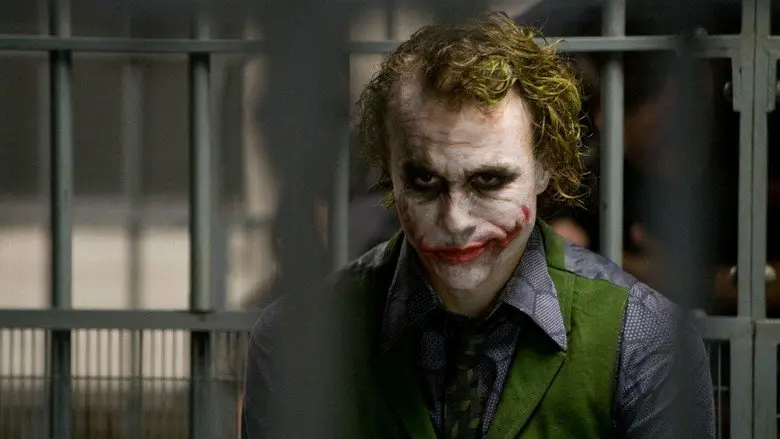
One approved MovieWordle frame shows the Joker behind bars. The bars make him look contained, but the composition also reverses the usual prison image: he appears to own the room because the camera follows his performance rather than the cell’s authority. His painted face is another unstable sign. A smile can be makeup, a threat, or a mask over pain, and the film keeps those possibilities active at once.
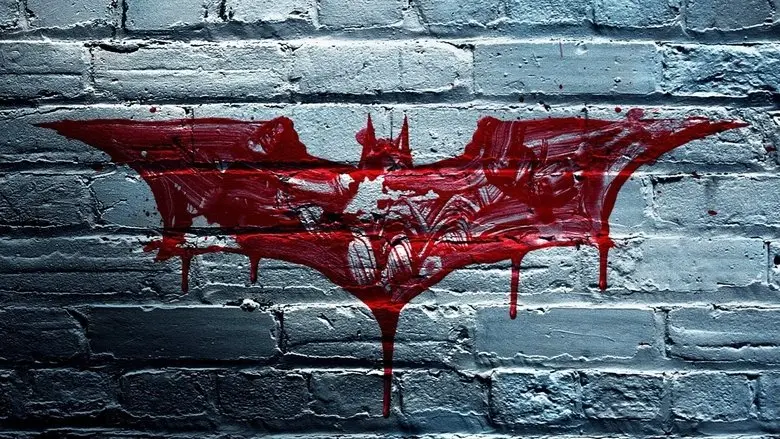
A second frame shows a red bat symbol painted on brick. It is a rougher, more vulnerable version of Batman’s polished logo. The mark belongs to a wall and a neighbourhood, not to a private arsenal. That distinction matters because the movie keeps asking who owns Batman’s image: Bruce Wayne, the police, the criminals, or the citizens who need someone to stand for order.
These visual cues help identify the film in a frame puzzle. Look for the collision between hard urban surfaces and expressive colour, then ask whether the symbol in view is protecting people or provoking them.
The Dark Knight ending explained: why Batman takes the blame
The Joker’s ferry experiment is meant to prove that ordinary people will kill when survival is reduced to a deadline. The passengers refuse to detonate the other boat, so the experiment fails as a demonstration of universal corruption. The Joker still succeeds in breaking Harvey Dent. After Rachel’s death and his own disfigurement, Dent becomes Two-Face and uses a coin to turn revenge into a procedure.
Batman stops Dent at the construction site, but Dent dies in the fall. Gordon and Batman then choose a public lie: Gotham will remember Dent as a fallen hero, while Batman accepts responsibility for the murders Dent committed. Gordon’s final speech describes Batman as a guardian who can endure hatred so the city can preserve a lawful ideal. The closing chase makes that choice literal. Batman runs from the police, becoming the “dark knight” of the title.
The ending is not a clean victory. Gotham keeps its symbol of hope by sacrificing the truth, and Bruce Wayne gives up the possibility of public recognition. The film’s moral question remains uncomfortable because the lie protects civic trust while damaging the person who carries it.
Conclusion
The Dark Knight explained through its images is a film about who gets to define justice. Bars, fire, graffiti, and masks show a city trying to keep meaning intact while the Joker turns every symbol into a test. Batman wins the immediate fight, but the cost is that Gotham must believe a story that is useful, incomplete, and deliberately false.
Keep playing
Ready for another film? Browse the MovieWordle 6 Frames archive and choose a recent puzzle to solve.