
FRAME BY FRAME · ISSUE 49
12 Angry Men Visual Analysis
1957 · Drama · Directed by Sidney Lumet
Spoilers below, including the verdict.
Sidney Lumet’s 1957 12 Angry Men turns one jury room into a map of pressure, prejudice, and attention. Twelve men begin with the expectation of a quick guilty verdict. Juror 8 asks them to talk first. The film’s power comes from watching a fixed room change as small details are tested, voices rise, and certainty becomes harder to perform.
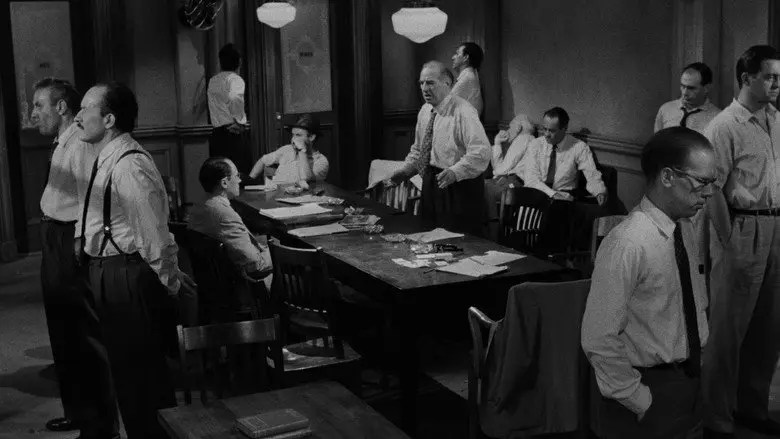
12 Angry Men makes the room an argument
The selected frame shows the jury room from a distance. Men stand, sit, and move around a long table, but no one has a stable visual position for long. The room is crowded with furniture and bodies, so the argument has to be read through movement: who leans in, who turns away, who remains seated, and who claims the centre.
Lumet’s theme-led design depends on that shared space. The jurors cannot leave the evidence behind or retreat into separate scenes. Every opinion has to survive in front of the group. The room begins as a place that seems to confirm the men’s confidence, then becomes a pressure chamber where their assumptions are exposed.
For MovieWordle players, the useful cue is the combination of black-and-white photography, a long table, summer shirts, and men arranged in a tight interior. The film’s visual identity is not one heroic face. It is the changing geometry of a group that must decide together.
Faces and framing expose certainty as performance
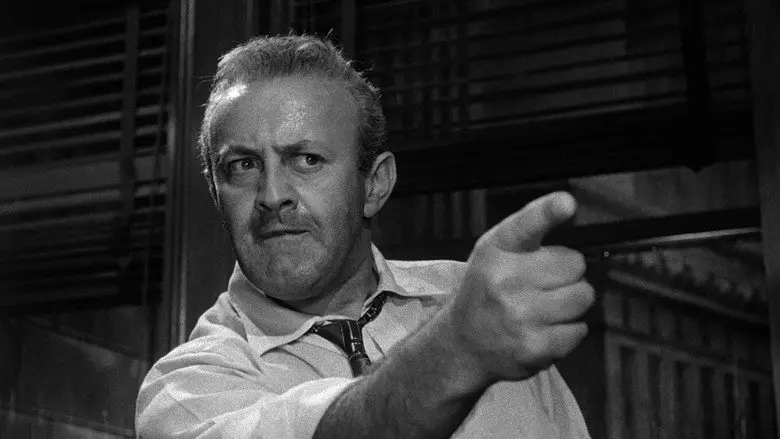
A second approved frame isolates Juror 10 in close-up as he points across the room. His face is tense, his finger cuts into the foreground, and the dark background gives the accusation nowhere to soften. Later, Lumet’s camera moves closer to the jurors and lowers the ceiling’s apparent height, making the room feel hotter and more enclosed.
The film does not treat every disagreement as equally valuable. Some objections are careful; others reveal racism, anger, or the need to finish quickly. Juror 8’s method is to separate the possibility of doubt from the claim that the boy is innocent. That distinction changes the conversation. The jury does not need to invent a perfect alternative story. It needs to decide whether the prosecution has removed reasonable doubt.
As the temperature rises, the room’s visual order breaks down. Jackets come off, papers move, rain arrives, and the camera finds faces that had been hidden in the group. The physical changes do not prove the arguments, but they make the cost of staying certain visible.
12 Angry Men explained: why the verdict changes
The jurors change their votes after discussing the eyewitness testimony, the knife, the old man’s account, and the woman who says she saw the killing. Each point is not a magical revelation. The group recognises that memories, angles, timing, and personal motives can weaken testimony that initially sounded conclusive.
The final not-guilty verdict does not establish what happened in the apartment. It establishes that the evidence does not justify a unanimous guilty decision beyond reasonable doubt. That is the film’s civic argument: justice depends on people willing to slow down when a fast answer would be easier.
The ending is quiet. The jurors leave the courthouse, and Juror 8 and Juror 9 exchange names before going their separate ways. The room has produced a decision, but the film leaves the men as ordinary citizens rather than turning them into permanent heroes. Their duty was to take the question seriously.
Conclusion
12 Angry Men explained through its visual design is a film about making doubt public. The table, the close-up, and the shifting arrangement of bodies show how a group can move from social pressure toward responsible judgment. For MovieWordle players, remember the room first: every face and argument belongs to the same enclosed civic space.
Keep playing
Ready for another film? Browse the MovieWordle 6 Frames archive and choose a recent puzzle to solve.