
FRAME BY FRAME · ISSUE 52
GoodFellas Visual Analysis
1990 · Drama / Crime · Directed by Martin Scorsese
Spoilers below, including Henry’s exit.
Martin Scorsese’s 1990 GoodFellas presents organised crime as a rhythm before it presents it as a moral system. Henry Hill enters the world through entrances, meals, cars, jokes, and quick access. The approved frames show that rhythm changing: three men lean together in a restaurant, a gun lowers into a room, and the faces that once made belonging look effortless begin to look trapped by the same network.
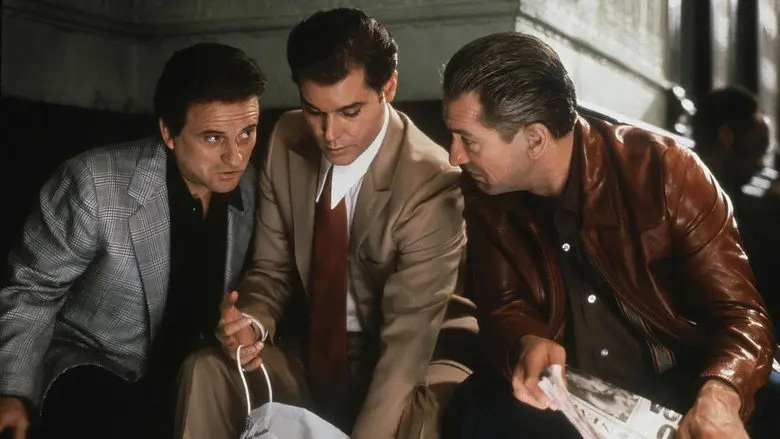
GoodFellas makes belonging look like choreography
The first selected frame places Henry, Jimmy, and Tommy close together at a restaurant table. Their clothes, posture, and shared attention make the group look practiced. The men do not need to explain their hierarchy; the composition lets the viewer read who is listening, who is performing, and who expects to be obeyed.
Scorsese builds the film around those social movements. A door opens before an ordinary customer reaches it. A table is found when everyone else is waiting. A car arrives, a drink appears, and a stranger is moved aside. These privileges make the criminal world feel attractive because it changes the speed of daily life.
For MovieWordle players, the cue is the combination of tailored clothes, crowded interiors, and faces arranged in a group that seems both friendly and dangerous. GoodFellas is recognisable through social confidence before the violence becomes the dominant image.
The camera keeps moving until the world stops feeling secure
A second approved frame shows Henry holding a gun in a house. The weapon points downward, but the posture is not calm. The room’s familiar decoration sits beside the threat, making the domestic space feel like another extension of the crew’s unstable rules.
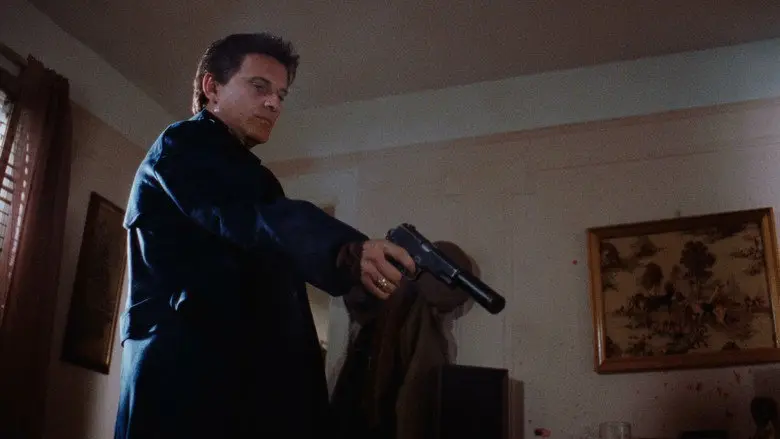
Scorsese’s movement has a similar effect. The long tracking shot through the nightclub makes Henry’s access look effortless, while the later cocaine sequence breaks time into phone calls, errands, helicopters, and sudden paranoia. The style does not merely celebrate speed. It lets the audience feel how a life built on momentum becomes impossible to control when the momentum turns against Henry.
The restaurant frame returns as a contrast. In the beginning, the group’s closeness signals protection. Later, the same closeness can mean surveillance, suspicion, or the fear that someone at the table is about to decide your fate.
GoodFellas ending explained: why Henry becomes an ordinary man
Henry survives the final police operation by cooperating with the authorities and entering witness protection. He leaves Karen and the criminal world behind, then complains that he now lives like an ordinary person. The ending is deliberately flat. There is no grand moral speech and no heroic escape into a better identity.
The plot fact is that Henry avoids prison by testifying. The interpretation is that he has lost the social world that made him feel exceptional, even though that world also made his life dangerous. His complaint reveals how deeply the gangster system shaped his idea of pleasure, status, and belonging.
The final image of Henry in suburban anonymity completes the film’s movement from access to isolation. He once entered rooms as if they belonged to him. Now he is outside the old story, watching it become a memory he still wants to perform.
Conclusion
GoodFellas explained through its visual themes is a story about belonging as performance. The restaurant table, the gun in the house, and the ordinary suburb show how the same network can feel like family, threat, and prison. For MovieWordle players, look for fast social movement and crowded frames before looking for the violence itself.
Keep playing
Ready for another film? Browse the MovieWordle 6 Frames archive and choose a recent puzzle to solve.