
FRAME BY FRAME · ISSUE 44
Home Alone Visual Analysis
1990 · Comedy / Family · Directed by Chris Columbus
Spoilers below, including the ending.
Chris Columbus’s 1990 Home Alone is built around a child learning to read his own house. Kevin McCallister begins as the overlooked youngest member of a crowded family, then wakes to an empty home and has to turn familiar rooms into a defence system. The approved frames point to the film’s player-led pleasure: bright winter space, a clear silhouette, and traps that can be remembered as a route through the house.
Home Alone turns domestic space into a playable level
Columbus stages the story so that the audience can learn the geography with Kevin. A door opens onto a hallway; a stair leads to a basement; a rope or line connects one point to another. The traps are comic because the film explains their placement before the burglars trigger them. Watching Home Alone is close to watching a game level: remember the route, anticipate the hazard, then wait for the timing.
The film’s winter palette keeps danger readable
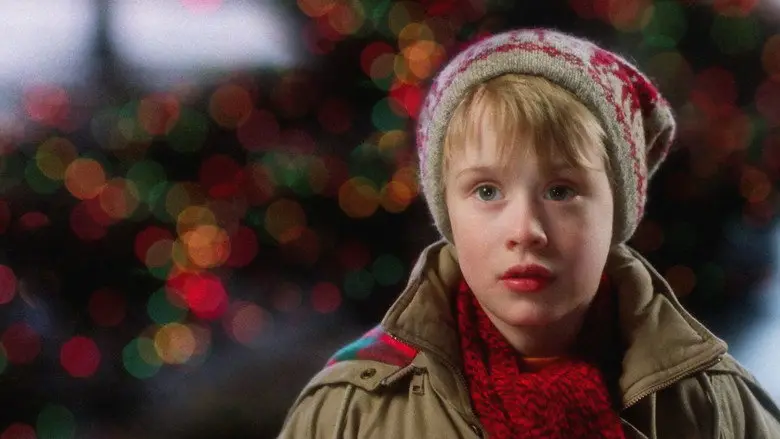
The selected frame shows Kevin in a knit hat and winter coat with coloured lights blurred behind him. The background is soft, but his face is still sharply visible. That balance is useful for guessing the film. Home Alone uses warm reds and greens inside Christmas spaces, then places Kevin against blue snow and white exteriors. The palette separates safety, loneliness, and the threshold between them without becoming gloomy.
The burglars are also framed for recognition rather than realism. Their dark coats and tools stand out against the house, and their reactions give every impact a readable beat. The violence is exaggerated, but the spatial logic is precise. For a post-game rewatch, track the doors and stairs first; then notice how each trap changes Kevin’s relationship to a room he initially treated as ordinary.
Kevin’s first victories are also acts of rehearsal. He tests the house, hears the noises that frighten him, and learns which parts of the building he can control. By the time Harry and Marv enter, the audience knows the route well enough to anticipate the joke, but Kevin is still improvising inside it.
The film also gives Kevin a second kind of map: the emotional one. He thinks he wants to be alone, but the empty house makes the absence of his family visible. His conversation with Marley, the neighbour he fears, creates a parallel between physical defence and emotional trust. Kevin becomes brave enough to ask for help because he stops treating every unfamiliar adult as a threat.
Home Alone ending explained: what Kevin actually wins
By the climax, Kevin has delayed the burglars long enough for the police to arrive. His family returns on Christmas morning, and the reunion resolves the immediate problem without pretending the earlier conflict never happened. Kevin has learned that independence is useful in an emergency, but it is not the same as wanting permanent isolation.
The ending also completes Marley’s smaller story. Marley helps Kevin when the burglars corner him, then reconnects with his family. That parallel matters because the film’s victory is not only that Kevin protects the house. He helps repair a neighbour’s separation while finding his own way back to the people he thought had forgotten him.
Conclusion
Home Alone explained as a player-led film starts with the map. The house, the winter palette, the visible tools, and the burglars’ entrances tell you how to recognise the movie and why its set pieces work. Kevin wins by making the domestic world legible, then discovers that the people he missed are part of that world too.
Keep playing
Ready for another film? Browse the MovieWordle 6 Frames archive and choose a recent puzzle to solve.