
FRAME BY FRAME · ISSUE 35
Donnie Darko Visual Analysis
2001 · Fantasy / Drama / Mystery · Directed by Richard Kelly
Spoilers below, including the ending.
Richard Kelly’s 2001 Donnie Darko makes its strange logic feel intimate before it makes it cosmic. A suburban house sits under a dark sky. A book about time travel rests beside an object that looks like a model of the solar system. A school trampoline turns an ordinary backyard into an overhead pattern of bodies and shadows. This Donnie Darko explained guide follows those recognition cues before addressing what the film says happens at the end.
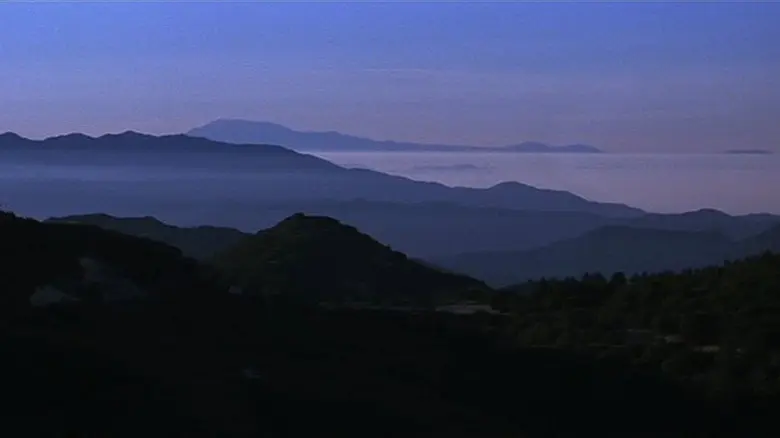
Donnie Darko makes suburbia feel slightly out of time
The opening landscape is quiet, blue, and distant. It establishes a mood rather than a location the viewer can easily name. That is central to the film’s visual approach. Donnie Darko keeps recognizable places—bedrooms, classrooms, a movie theater, front lawns—while giving them an uneasy sense of separation from normal sequence and cause.
Donnie is a troubled high-school student in Middlesex, Virginia, when a jet-engine fragment crashes into his home. Frank, a figure in a rabbit costume, tells him the world will end in 28 days, 6 hours, 42 minutes, and 12 seconds. The film lets that countdown hang over scenes that might otherwise be read as ordinary adolescent conflict. A conversation, a party, or a walk home can feel charged because the audience knows the clock is running even when the characters do not.
That pressure gives the soundtrack and the period setting a particular function. Familiar songs and school rituals do not establish nostalgic comfort so much as a world Donnie cannot fully rejoin. The film keeps inviting a conventional coming-of-age reading, then interrupts it with a detail that seems to arrive from somewhere else: a sleepwalking route, an impossible warning, or a gesture whose consequence will only become clear later.
The book is a clue, not a shortcut to the whole answer
An approved frame shows the title The Philosophy of Time Travel on a worn red book beside a metal orrery. It is one of the most direct MovieWordle clues in the set, but it should not be treated as a complete explanation. The book gives Donnie language for the film’s Tangent Universe, the temporary reality created when the engine arrives, and for his role as the Living Receiver.
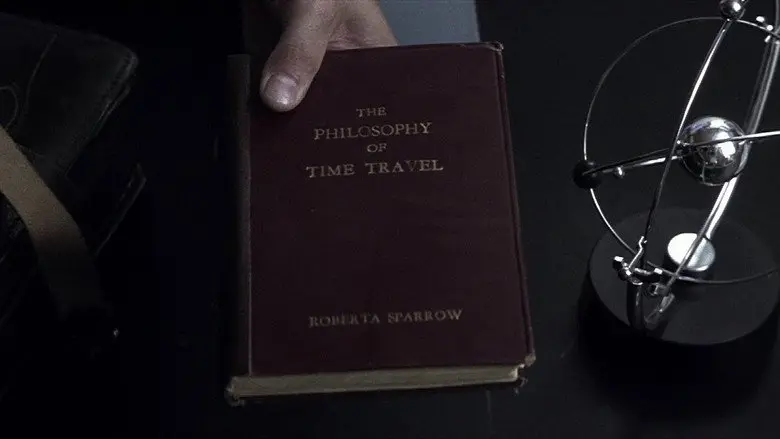
What makes the image effective is the contrast between its calm arrangement and the film’s instability. The book is readable. The device beside it is orderly. Yet the story around them is full of actions whose meaning Donnie cannot entirely control. On a rewatch, the best question is not whether every image has a coded answer. It is how the film uses ordinary explanations—school lessons, therapy, religious certainty, self-help language—to make uncertainty feel more intense.
Circles and shadows give the film a practical visual signature
The overhead trampoline frame looks almost playful: two teenagers move around a circular mat while their shadows stretch across it. The composition is also a concise recognition cue. Donnie Darko often places people inside patterns that are larger than their choices: a school dance line, a family house, a suburban road, or a countdown set in motion before Donnie understands it.
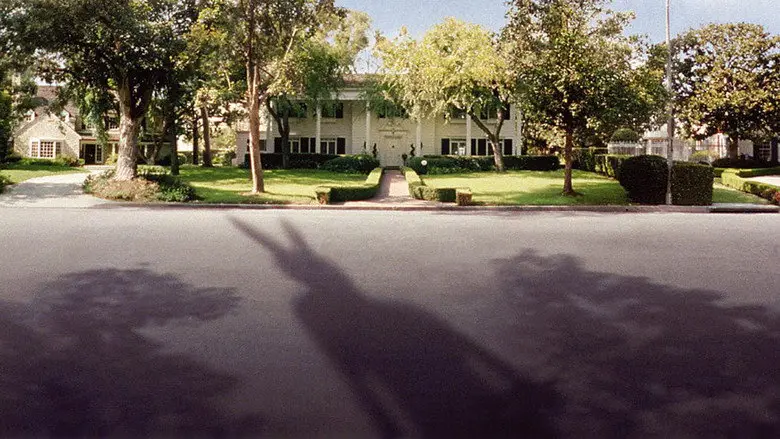
That visual order is never as reassuring as it first appears. Circular objects, repeated routes, and neatly composed suburban spaces make room for the film’s unease because they suggest a system that has started to turn on its own. For a player, the palette is equally helpful: dusky blue exteriors, dim interiors, and small pockets of light that do not fully make a scene safe.
Donnie Darko ending explained: why Donnie stays in bed
At the end, Donnie understands that the Tangent Universe must collapse and that the engine has to return to its origin point. The film shows him sending it back through a time portal. He chooses to remain in his bedroom, where the engine falls and kills him in the restored Primary Universe.
That is the plot-level answer. The people around him wake with fragments of feeling rather than a shared memory of the alternate chain of events. Gretchen, who dies in the Tangent Universe, survives in the restored timeline. Frank’s role in Donnie’s fate also changes because the events that led to his death no longer occur.
The ending does not turn Donnie’s death into a tidy proof that suffering has been solved. Its force comes from his choice to accept an outcome he has begun to understand, even though the people he has affected will not retain the same knowledge. The final laughter is unsettling because it belongs to a character who can see the consequence while the film leaves the emotional meaning deliberately open.
The film is therefore careful about the difference between explanation and consolation. The restored timeline clarifies why several characters live or die differently, but it cannot give them a common account of what was avoided. The ending lets the audience keep that knowledge while returning the characters to a world where it can only survive as an unexplained feeling.
Conclusion
The most useful Donnie Darko explained approach starts with its visible systems: dusk, circles, books, suburbia, and a countdown that alters how every ordinary place feels. The Tangent Universe supplies the plot mechanics, but the film endures because it makes a private fear of being out of step with the world look both specific and vast. Those same visual cues make it a strong MovieWordle rewatch.
Keep playing
Ready for another film? Browse the MovieWordle 6 Frames archive and choose a recent puzzle to solve.