
FRAME BY FRAME · ISSUE 55
The Green Mile Visual Analysis
1999 · Fantasy / Drama / Crime · Directed by Frank Darabont
Spoilers below, including the ending.
Frank Darabont’s The Green Mile (1999) places a supernatural story inside a strict prison routine. Paul Edgecomb and the other guards work on E Block, where condemned men walk a green corridor toward the electric chair. John Coffey arrives as a massive man convicted of killing two girls, yet his gentleness and healing ability force Paul to question what the institution calls justice. The film’s craft turns that question into a matter of corridors, faces, and light.
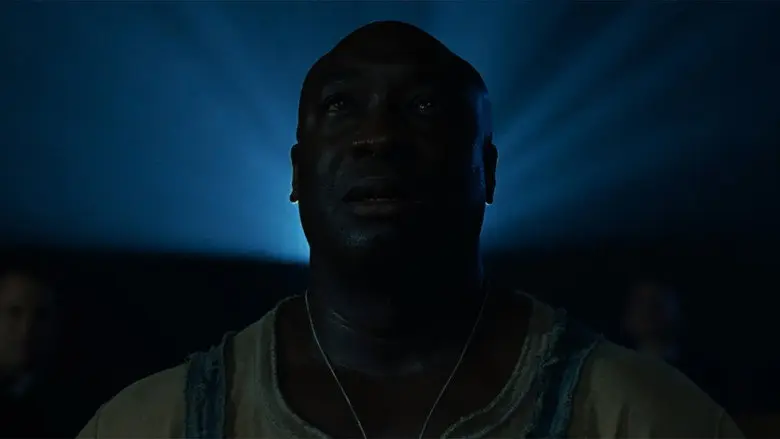
The Green Mile makes routine feel moral
The prison corridor is narrow, repetitive, and easy to understand. Guards move bodies through a system with numbered cells, scheduled meals, and a fixed destination. That clarity is part of the film’s unease. Procedure can look orderly even when the person inside it is innocent, and the camera keeps returning to the same path to show how little room the institution leaves for revision.
Darabont’s colour palette separates the block’s green floor from the warmer light around moments of care. The contrast is not a simple code in which one colour is good and another is evil. It shows two kinds of attention: the cool observation of a workplace and the warmer recognition of a person in pain.
Faces carry the film’s recognition cues
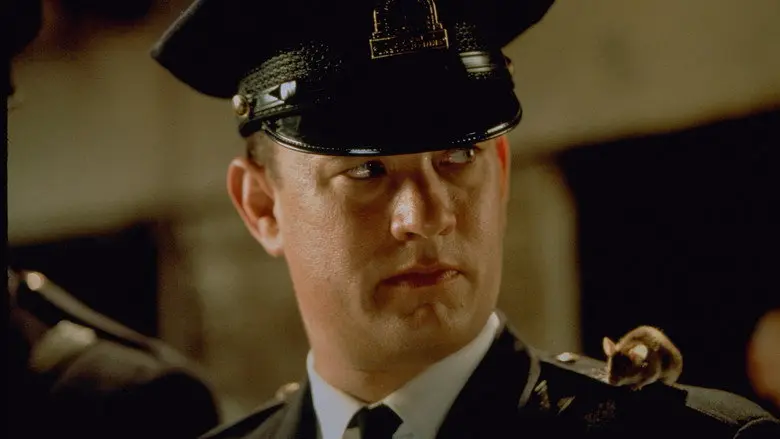
One approved frame holds on Paul’s close-up in his prison uniform. His expression is controlled, but the close framing makes his discomfort visible. He is not only a guard explaining rules; he is a man whose body has been touched by Coffey’s power and whose certainty has begun to erode.
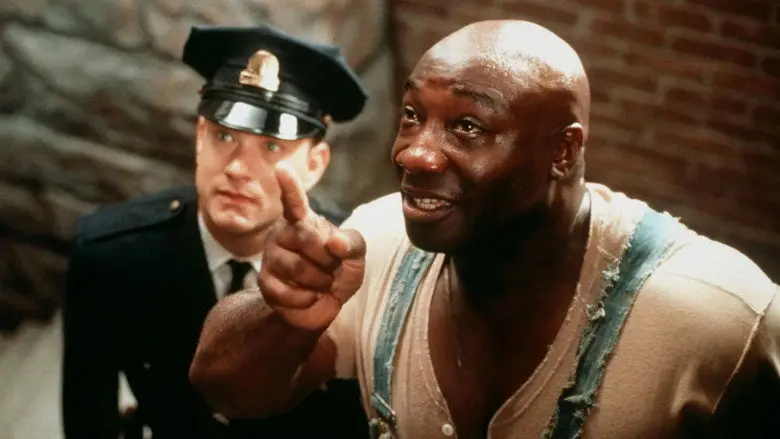
Another frame places Paul and Coffey together. Their different sizes are obvious, yet the composition does not make Coffey threatening. Coffey’s lowered posture and quiet face redirect the viewer from physical danger to moral vulnerability. For MovieWordle players, the useful clues are the institutional green, the corridor scale, and the contrast between Paul’s procedural uniform and Coffey’s exposed stillness.
Coffey’s gift changes how the prison is seen. When he heals Paul’s infection and later helps the warden’s wife, the touch connects separate rooms and bodies. Illness becomes something that can move between people, while compassion becomes an action rather than a speech. The same system that carries men to death also contains people who can choose to slow down and look again.
The Green Mile ending explained: why Paul lets Coffey die
Paul eventually learns through Coffey’s vision that Wild Bill Wharton, not Coffey, killed the two girls. Coffey’s innocence is therefore clear to Paul and the guards who believe him. Coffey can also heal, but he is exhausted by the cruelty he absorbs from the world. He refuses Paul’s offer to help him escape and asks not to wear a hood because he is afraid of the dark.
Paul still carries out the execution. His decision is a moral failure within the law’s routine, even though the film presents it as an act Coffey accepts. The later frame story deepens the punishment: Paul lives far beyond a normal lifespan, and Mr. Jingles, the mouse Coffey healed, also survives for decades. Paul understands this longevity as a burden, a life extended until everyone he loves is gone.
The ending does not make Paul’s remorse a substitute for justice. It makes remorse the only honest response left to him. The green corridor ends at the chair, but the memory keeps walking with him.
Conclusion
The Green Mile explained through its visual craft is a film about compassion trapped inside procedure. Corridors, close-ups, and shifting light show how Paul moves from performing a job to recognising a person. Coffey’s miracle cannot repair the execution, so the final punishment is memory: Paul must carry the knowledge of what the institution allowed him to do.
Keep playing
Ready for another film? Browse the MovieWordle 6 Frames archive and choose a recent puzzle to solve.