
FRAME BY FRAME · ISSUE 36
Inside Man Visual Analysis
2006 · Drama / Thriller / Crime · Directed by Spike Lee
Spoilers below, including the ending.
Spike Lee’s 2006 Inside Man is recognizable because it treats a bank robbery as an exercise in controlled visibility. A masked figure stands in the round mouth of a vault. Hostages wear matching coveralls and masks. A phone call is made from a small, shadowed room. Those images turn a crowded Manhattan heist into a question of who can be identified, who can be trusted, and what the police are actually looking for.
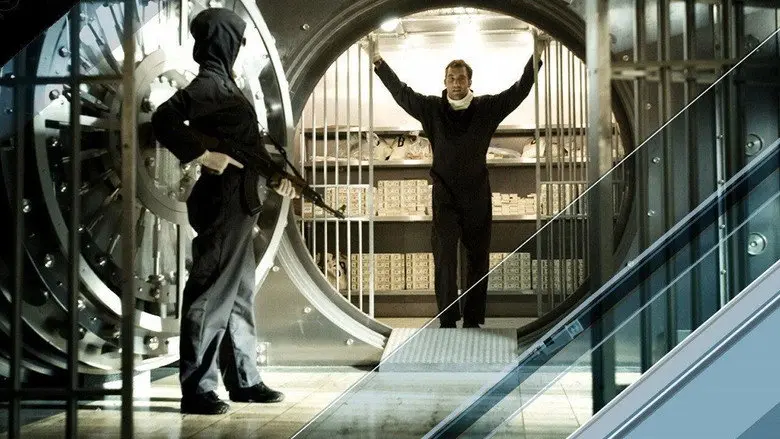
Inside Man uses the vault as a trap for certainty
The first selected frame makes the vault door feel less like a backdrop than a frame within the frame. A masked robber stands inside it with his arms raised while another armed figure occupies the foreground. The image seems to offer a clear suspect and a clear crime scene. The film spends the rest of its running time making that clarity unreliable.
Dalton Russell leads the robbery at a Manhattan Trust bank, while Detective Keith Frazier negotiates outside. The robbers force hostages into similar clothes and masks, making it difficult for the police to tell them apart. That strategy is not merely a clever plot turn. It shapes the visual system of the film: faces disappear, voices travel through barriers, and the authorities must act on incomplete information.
Matching masks make the audience work like the police
An approved frame places three masked figures behind vertical bars. The composition is clean but hard to read. The figures share dark hooded clothing, sunglasses, and white face coverings, so individual identity is almost beside the point. For MovieWordle players, that combination of industrial metal, bright bank light, and obscured faces is a particularly strong cue.
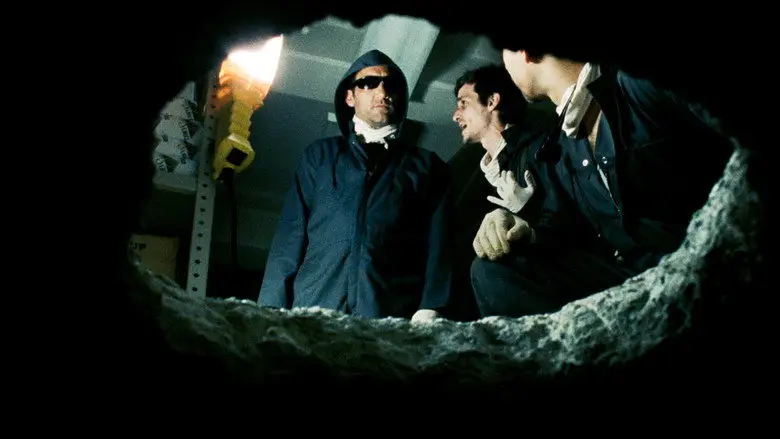
The disguise also places the viewer in Frazier’s position. We want to sort people quickly into robber, hostage, witness, and officer, but the film keeps denying a stable visual distinction. That tension lets Inside Man stay brisk without becoming a simple puzzle box. The robbery has a practical objective, yet the scenes keep asking which version of the event will be believed once the masks come off.
The phone booth frame brings the heist down to voice and pressure
In the third selected image, Dalton holds a phone in a close, dimly lit space. His sunglasses and white glove preserve the disguise even in an intimate shot. The contrast matters: a robbery can look public and spectacular from outside, but much of the film’s pressure comes through talk—negotiation, accusation, and the careful withholding of detail.
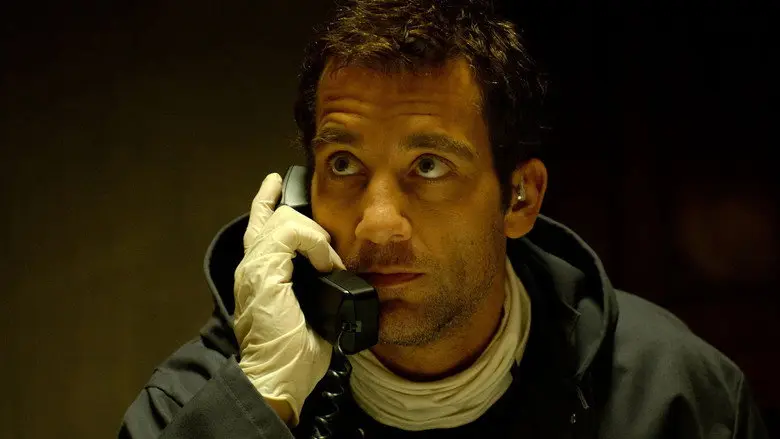
Lee and cinematographer Matthew Libatique keep moving between the crowded bank, the police perimeter, and private conversations where characters try to control the story. The film’s visual distinction is not simply “inside” versus “outside.” It is the difference between being seen and being understood.
Inside Man ending explained: how Dalton gets away
Dalton’s crew does not leave the bank in a dramatic escape. They blend in with the hostages after changing everyone into matching clothing and masks. Dalton himself remains hidden inside a concealed space in the bank while the police clear the scene, then walks out later carrying diamonds from Arthur Case’s safe-deposit box.
The robbery is therefore not primarily about taking the bank’s general cash reserves. Case’s box contains diamonds and documents connected to his past as a Nazi collaborator. Madeleine White is brought in because she knows Case and wants the material kept quiet. Frazier eventually understands that Case’s real vulnerability is not just the theft but what the box reveals about him.
That ending resolves the mechanics without giving Case full control of the aftermath. Dalton gets the diamonds, but he also removes the evidence Case wanted buried. Frazier’s final encounter with Case shows that the detective now has enough knowledge to challenge him, even if the film does not turn that knowledge into an immediate public reckoning.
Conclusion
Inside Man ending explained comes down to a heist built around misdirection, not firepower. The vault door, matching masks, and close phone call make the film’s method visible before the ending spells it out: hide the robbers among the hostages, then make the true target a secret in plain sight. For MovieWordle players, those visual controls are the best route back to the film.
Keep playing
Ready for another film? Browse the MovieWordle 6 Frames archive and choose a recent puzzle to solve.