
FRAME BY FRAME · ISSUE 41
Mulholland Drive Visual Analysis
2001 · Drama / Thriller / Mystery · Directed by David Lynch
Spoilers throughout, including the film’s ending.
David Lynch’s 2001 Mulholland Drive is built from recognisable images that refuse to stay in one stable story. Two women walk through a dark Los Angeles night. A wounded woman loses her name and finds the word “Rita.” A red-lipped singer performs in a blue-lit theatre while insisting that everything is recorded. A blue box opens, and the film’s apparent reality folds back on itself.
The film is often discussed as a mystery to solve, but its craft is more precise than a list of clues. Lynch uses colour, performance, doubled identities, and abrupt changes in space to show how desire can edit a life. The approved MovieWordle frames make that system visible before the ending explains why the images keep echoing one another.
Mulholland Drive makes identity a visual effect
The first selected frame shows Betty and Rita walking together at night. Betty wears a red top; Rita wears a black dress with a pale bob. The background is almost swallowed by darkness, leaving the women and their contrasting silhouettes sharply legible. The image looks like the beginning of a conventional detective story: one woman is helping another discover who she is. Lynch quietly makes the pair look like a designed opposition instead.
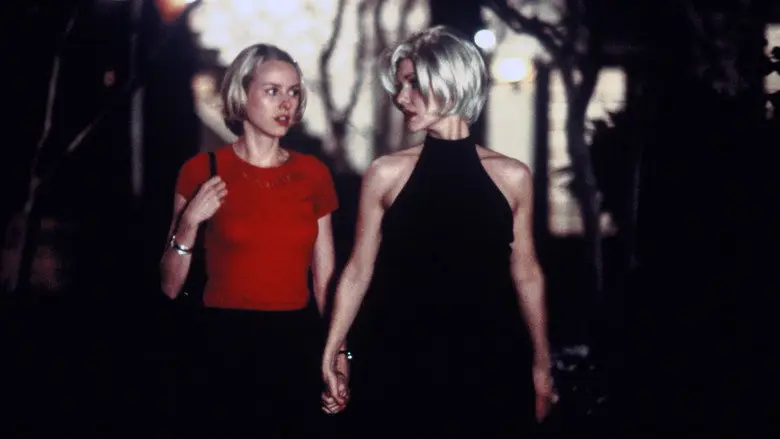
Colour keeps carrying that tension. Red can signal performance, danger, or desire; black can suggest secrecy, glamour, or a role being inhabited. Those meanings are not a code that produces one answer, but they help the viewer notice how often the film builds a person through surfaces. Hair, clothes, names, and rooms seem to tell us who someone is, then change their meaning when the story changes register.
The film’s famous doubling works the same way. Betty and Diane are not simply two unrelated characters, and Rita and Camilla are not just aliases in a thriller plot. The second set of names and relationships reframes the first. Lynch asks the audience to watch the same emotional material under different lighting.
Club Silencio turns performance into the film’s rule
The blue-lit theatre frame is one of the strongest recognition cues in the approved set. Betty and Rita sit side by side, their faces washed in blue while the auditorium falls away around them. At Club Silencio, the performer says that there is no band and no orchestra, yet the music continues. A voice can be real as an experience even when its visible source is absent.
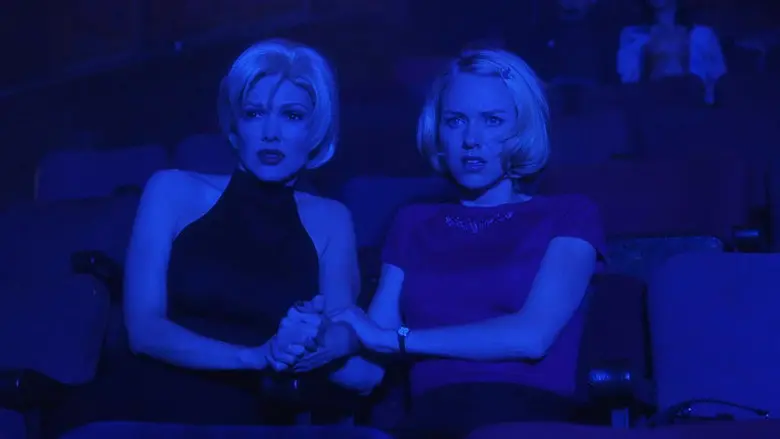
That scene is not a puzzle instruction telling us how to decode every shot. It is a statement of method. Mulholland Drive separates sound from source, performance from person, and emotion from the event that supposedly caused it. The theatre gives the film a place where the split becomes explicit, but the same separation has been operating in Hollywood auditions, bedroom conversations, and the women’s changing names.
A third frame, in which the blonde women appear together in a close, warm embrace, carries the same instability. The image is intimate, but the saturated gold light makes it feel staged, almost like a memory edited for effect. For a post-game rewatch, follow transitions rather than objects: notice when a look becomes a performance, when a name becomes a role, and when a location feels more emotionally true than factually secure.
Mulholland Drive explained: the dominant reading of the ending
The film does not provide a single official key, but the ending supports a strong, evidence-based reading. The first long section is a dream or fantasy constructed by Diane Selwyn, a failed actor who is consumed by jealousy and guilt after her former lover, Camilla Rhodes, succeeds and leaves her. In the fantasy, Diane becomes Betty, an unusually gifted newcomer; Camilla becomes Rita, a vulnerable woman who needs Betty’s help; and the humiliations of Diane’s real life are rearranged into a story in which she can still be admired and desired.
The blue key and blue box mark the point where that fantasy can no longer hold. When the box opens, the film’s space and identities shift. Betty disappears into Diane’s waking life, and the people who seemed to be friends, lovers, or threats reappear in altered roles. This is a plot fact about the film’s structure: names, relationships, and scenes are repeated with changed circumstances. The interpretation is that Diane’s mind has been using cinema’s tools—casting, editing, glamour, and repetition—to postpone responsibility for what she has done.
The factual event behind the dream is brutal. Diane hires a hitman to kill Camilla. The blue key signals that the murder has been completed. Tormented by guilt and by the collapse of the fantasy, Diane kills herself in her apartment. The film then returns to the images and sounds that have governed it: the blue light, the theatre’s warning about illusion, and the whispered “Silencio.”
That reading explains the ending’s emotional logic without pretending every detail has one fixed translation. The Cowboy, the elderly couple, and the strange figures around the blue box can be read as parts of Diane’s fear, memory, or cinematic imagination. Their exact symbolic roles remain open. What the film makes clear is that the dream cannot protect Diane from the consequences of the life it has rewritten.
Conclusion
Mulholland Drive explained is less a matter of finding one secret code than of seeing how the film turns identity into performance. The night walk, the blue theatre, and the doubled embrace all make the same idea tangible: a person can be recast through desire, but the suppressed reality returns through sound, objects, and repeated faces. The ending closes Diane’s story while leaving Lynch’s method productively unresolved.
Keep playing
Ready for another film? Browse the MovieWordle 6 Frames archive and choose a recent puzzle to solve.