
FRAME BY FRAME · ISSUE 33
Primal Fear Visual Analysis
1996 · Drama / Thriller / Crime · Directed by Gregory Hoblit
Spoilers below, including the ending.
Gregory Hoblit's 1996 Primal Fear begins like a courtroom thriller about whether Martin Vail can defend Aaron Stampler, a young altar boy accused of murdering Archbishop Rushman. It gradually becomes a story about what a courtroom needs in order to believe someone. This Primal Fear ending explained guide uses the approved MovieWordle frames to follow the film's competing presentations—lawyer, defendant, evidence—and the final disclosure that changes how Vail's victory has to be read.
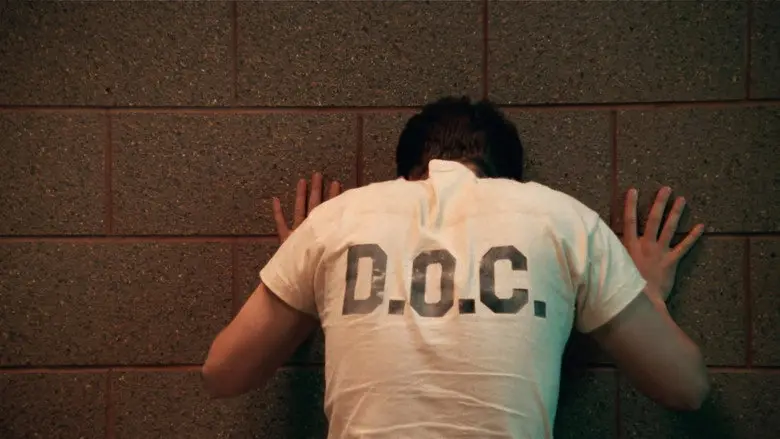
Primal Fear makes advocacy part of the drama
The approved frame of a man in a white D.O.C. shirt facing a cinderblock wall makes confinement physical before the legal argument begins. It is a useful recognition cue because the film's courtroom strategy is always tied to what institutions can see, label, and contain.
Vail initially takes Aaron's case with the appetite of a public defender who enjoys a difficult stage. As the investigation broadens, the film asks him to act as advocate, investigator, and interpreter of a frightened young man. Those roles are not cleanly compatible. The closer Vail gets to Aaron, the more his professional skill depends on deciding which version of Aaron he is watching.
For MovieWordle players, the film often announces itself through late-1990s legal interiors, close faces under controlled light, and evidence arranged for inspection. The visual system is not about flashy courtroom scale. It is about the pressure created when an expression, an object, or a statement may change the entire case.
Evidence is arranged to be read
The selected courtroom frame shows the machinery of judgment at work: witnesses, lawyers, jurors, files, and the raised bench all share the image. The arrangement makes the film's central problem visible without revealing its solution. A court can bring people and evidence into the same room, but it cannot decide what lies behind a face.
That is why the thriller works best when it stays close to process. Testimony, recordings, medical claims, and the lawyers' competing accounts do not automatically reveal a private truth. They become persuasive because institutions have rules for accepting some forms of evidence and discounting others. The film keeps the viewer alert to those rules while also making the relationship between Vail and Aaron emotionally immediate.
Primal Fear ending explained
At the trial, Aaron's more aggressive alternate personality, Roy, emerges and describes killing Rushman. The court finds Aaron not guilty by reason of insanity and commits him for psychiatric care. Vail believes that he has saved Aaron from a death sentence and has also exposed a case larger than the accusation that first drew him in.
The final private conversation overturns that confidence. Aaron tells Vail that Roy was not an alternate personality after all. He says that he has been faking, and that the vulnerable Aaron persona was part of the performance. Vail then realizes that he helped secure the outcome for someone who had manipulated him and the court.
The ending is powerful because it does not turn Vail into a fool who failed to care. His willingness to listen and advocate is real. What changes is his belief that careful attention gave him special access to his client. The film turns his professional strength—reading a room, building a story, finding a persuasive angle—into the channel through which he is deceived.
The final reveal also explains the title's concern with primal fear. It is not simply a label for violence. It is the fear that a face, a confession, and a system of procedures can all be convincing without giving anyone the truth they need. The film lets the court produce a verdict, then shows the personal cost of mistaking that result for certainty.
The last frame keeps the judgment unsettled
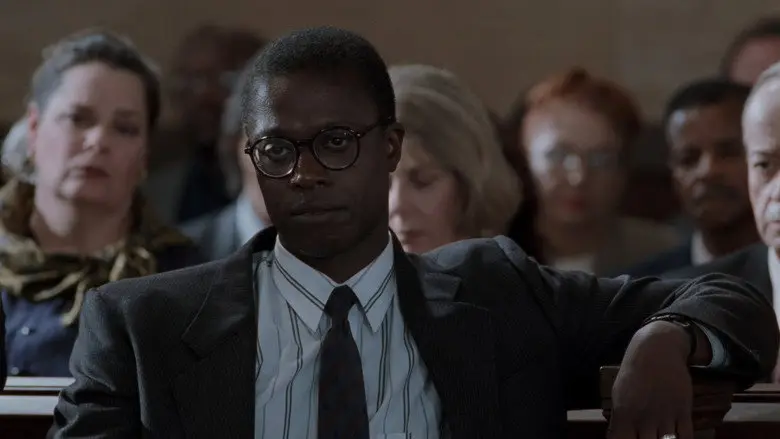
The third selected frame shows a lawyer in glasses seated among courtroom spectators. Its poised stillness is useful after the reveal: the image does not name a hidden motive, but it keeps attention on the professionals whose confidence in testimony and procedure has been tested.
On a rewatch, look for how often the film uses courtrooms, holding spaces, and close faces to ask you to decide whether a character is sincere. The approved frames give three practical clues: confinement, the public machinery of testimony, and a lawyer's measured attention. Together, they make the final scene land not as an arbitrary trick but as a reversal of the viewing habit the film has encouraged.
Conclusion
The clearest Primal Fear ending explained reading is that the final performance does not erase the courtroom story; it exposes how much that story depended on Vail's trust. The approved frames show why the film is memorable in a MovieWordle game: it is a thriller of faces, files, and institutions that can judge a case without fully knowing the person at its center.
Keep playing
Ready for another film? Browse the MovieWordle 6 Frames archive and choose a recent puzzle to solve.