
FRAME BY FRAME · ISSUE 32
No Country for Old Men Visual Analysis
2007 · Western / Thriller / Crime · Directed by Joel Coen, Ethan Coen
Spoilers below, including the ending.
Joel and Ethan Coen's 2007 No Country for Old Men is built from a simple pursuit that keeps becoming harder to see. Llewelyn Moss takes money from the aftermath of a failed drug deal; Anton Chigurh follows; Sheriff Ed Tom Bell tries to understand the violence gathering around them. This No Country for Old Men explained guide uses the approved MovieWordle frames to show how the film makes consequence visible in money, distance, and faces while refusing the reassuring finish of a conventional chase thriller.
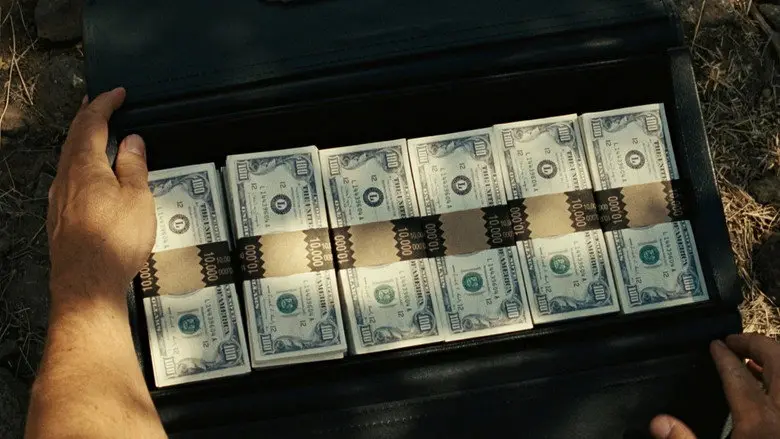
The money is an object, not a solution
The open case of cash is a strong recognition cue because it contains the premise in one overhead image. Hands hold the black case open over dry ground; the bundles are arranged with unnerving neatness. The money is not filmed as a prize. It is evidence of a system already in motion, and Moss's decision to take it turns the film's vast landscape into a narrowing route.
The Coens and cinematographer Roger Deakins repeatedly make open ground feel exposed rather than freeing. Roads, scrubland, motel lots, and hotel corridors give characters space, but that space rarely offers safety. Moss has practical skills and makes quick decisions; the film respects his alertness without promising that alertness can control a chain of events already larger than him.
For MovieWordle players, look for the combination of hard ground, contained objects, and a palette that makes human activity feel small against its surroundings. The film's visual tension often begins before anyone speaks.
No Country for Old Men uses darkness as distance
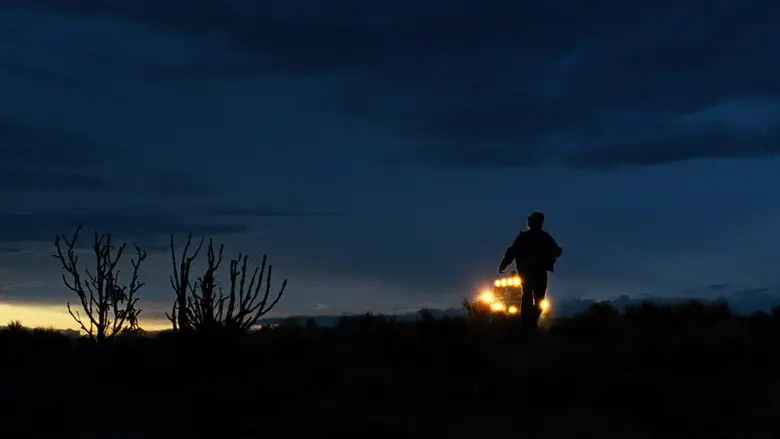
The night frame reduces a person to a silhouette between scrub trees and headlights. It is not a decorative western landscape. The image makes pursuit legible as a problem of distance: one person can be visible, moving, and still impossible to reach in time.
That spatial logic runs through the film's suspense. Chigurh's tools and rituals matter because they turn ordinary rooms into search spaces. A door, a coin, a motel corridor, or a light under a threshold becomes information someone may read too late. The filmmaking stays remarkably restrained about it. Rather than using a constantly emphatic score to announce danger, the film asks viewers to listen to footsteps, locks, engines, and pauses.
The result is dread with a practical texture. Characters are not trapped in an abstract nightmare; they are trying to decide where another person is, what he can hear, and which route remains open. That clarity is why the eventual absence of a grand confrontation feels deliberate rather than incomplete.
Bell experiences that same problem from the other side of the investigation. He arrives at sites after decisions have already been made, reading what remains in a room or on a road. The film does not present him as careless; it gives him the knowledge to understand what he is seeing and the sorrow of knowing that understanding has not made him fast enough. His distance from Chigurh is therefore not just a police-procedural delay. It is the emotional distance that the ending will make explicit.
The broad compositions keep that feeling from becoming melodrama. A character can stand in the center of a frame and still be dwarfed by dark sky, a blank corridor, or empty land. That visual refusal of easy dominance prepares the viewer for a film in which no one receives a climactic moment large enough to settle the damage.
No Country for Old Men ending explained
The ending moves away from the chase before it offers the kind of payoff a chase normally promises. Moss is killed offscreen. Chigurh later visits Carla Jean, keeps the promise he made to Moss, and leaves her home; the film does not show the killing directly. Soon afterward, Chigurh survives a car crash and walks away with a broken arm, still outside the reach of any final reckoning.
Bell's final scene is not an extra riddle that solves those events. He tells his wife about two dreams of his father. In the second, his father rides ahead through darkness carrying fire, preparing a place farther on. The dream does not announce that Bell has found an answer. It gives him an image for a world in which he feels overtaken by violence and time.
That is why the ending can feel abrupt without being arbitrary. The film does not argue that Chigurh is supernatural or that Bell is simply weak. It shows Bell reaching the limit of the role he believed he could perform. He can investigate, remember, and mourn, but he cannot turn every consequence into a solved case. The closing dream holds onto a small possibility of guidance without pretending that it repairs what has happened.
The final face is a warning against easy answers
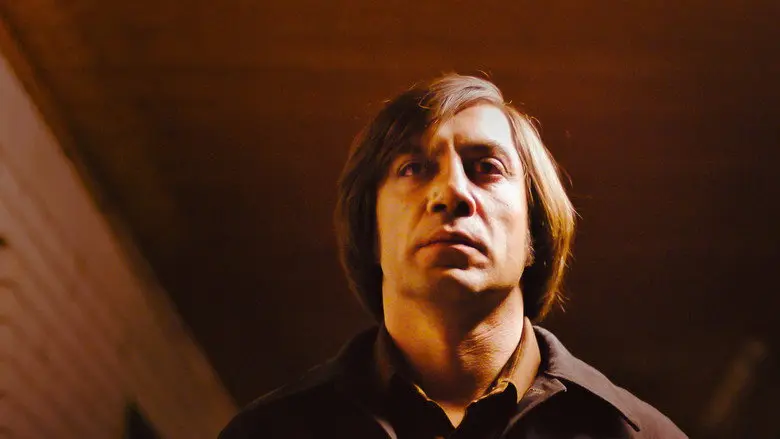
The selected close-up of Chigurh, seen from a low angle in amber light, gives players another reliable cue. His expression is unreadable and the frame gives almost no contextual comfort around it. That is central to the film's effect. Chigurh is frightening not because the image provides a mythic explanation for him, but because it withholds one while showing how efficiently he imposes his own rules on others.
On a rewatch, track the film's thresholds: doorways, hotel-room entrances, roadside stops, and places where a character has to decide whether to wait, run, or speak. They connect the landscape to the ending's moral pressure. The film keeps showing choices, then denies the audience the comforting belief that a correct choice guarantees a comprehensible outcome.
FAQ
Did Chigurh get the money in the end?
The film points to yes. After Moss's death, Chigurh traces the transponder signal to the Eagle Pass motel and removes the satchel from the ventilation space before the car crash. That plot point does not make his escape a triumph, though. The money is recovered as another object in a chain of damage, while the film's final attention has already shifted to Bell and the limits of his understanding.
Conclusion
The clearest No Country for Old Men explained reading is that the ending refuses closure because closure would misdescribe the film's world. The money case, the distant figure at night, and Chigurh's close-up all make danger visible without making it manageable. Bell's dream closes the film on memory and uncertainty, not a solved pursuit.
Keep playing
Ready for another film? Browse the MovieWordle 6 Frames archive and choose a recent puzzle to solve.