
FRAME BY FRAME · ISSUE 34
Interstellar Visual Analysis
2014 · Adventure / Drama / Science Fiction · Directed by Christopher Nolan
Spoilers below, including the ending.
Christopher Nolan’s 2014 Interstellar begins with things close to the ground: dust, a cornfield, a farmhouse, a watch held in a hand. The story eventually crosses galaxies, yet Interstellar explained is less a matter of decoding space science than of seeing how the film makes distance felt at a human scale. Its images keep returning to work, waiting, and objects that can be carried even when the people who care about them cannot stay together.
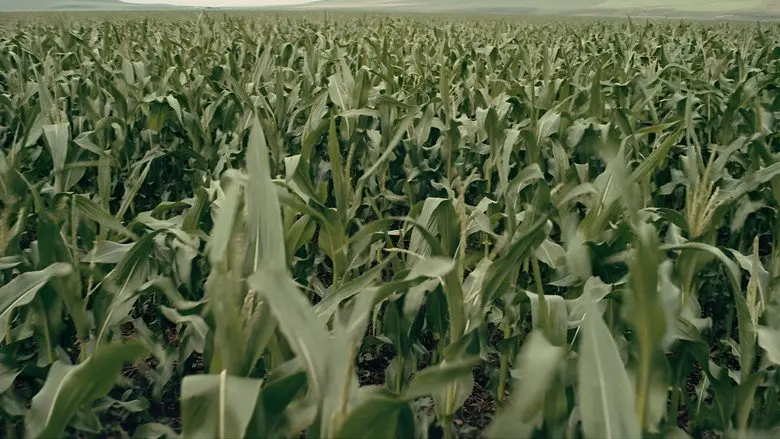
Interstellar starts by making the future feel local
The cornfield is a useful MovieWordle recognition cue because it does not look like a conventional space-adventure image. The plants fill nearly the whole frame, leaving only a thin line of land and sky. That density matters. Before the film asks its characters to leave Earth, it establishes a world where food, weather, and ordinary routines have become sources of pressure.
Cooper’s eventual departure therefore is not framed as an uncomplicated urge to explore. It is a decision that separates him from Murph and Tom at a moment when the family needs him. The film’s large scale has emotional force because Nolan first gives the audience a house, a field, and a family timetable to measure against it.
That choice also explains the film’s persistent attention to domestic labour. Cooper may be a pilot with the skills the mission requires, but he is first shown as a farmer and a parent trying to keep a household going. The film does not make that work incidental once the spacecraft appear. It lets the mission inherit the practical anxiety of the opening: every grand plan depends on someone accepting a loss in the present.
A watch gives Interstellar’s time problem a visible form
One approved close-up isolates a watch face in someone’s hand. It is a small image, but it expresses the film’s central dramatic problem more clearly than a technical diagram could. On Miller’s planet, the crew experiences time differently from people far away, and the return to the Endurance makes the cost immediate: Romilly has aged decades while only hours have passed for Cooper and Brand.
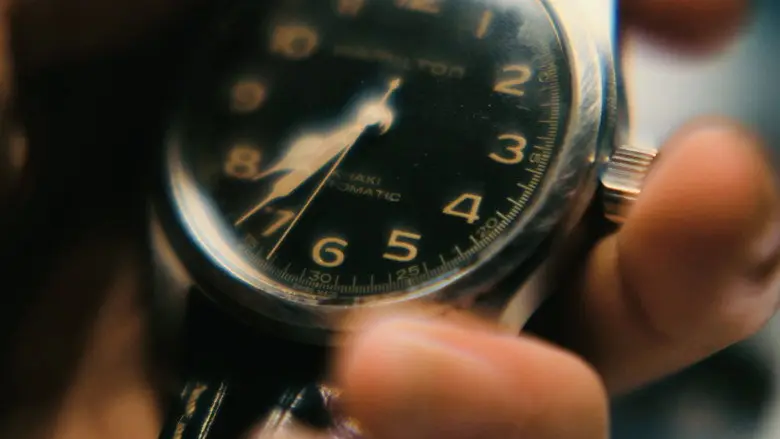
For players, the film’s most reliable cues are often these practical objects rather than a spacecraft silhouette: a wristwatch, a worn bedroom, a helmet visor, or a table set inside an immense machine. Interstellar repeatedly brings an abstraction back to something a person can touch. Time becomes not an equation to admire but missed years, recorded messages, and an unanswered promise.
Water and darkness make scale feel lonely
The selected water frame reduces a vehicle to a tiny white mark inside a wide field of blue and gold. It is not an image of triumphant discovery. It makes the machine look exposed, almost swallowed by the surface around it. That feeling runs through the film’s craft: the wider the setting becomes, the more carefully it isolates a body, a ship, or an object that could be lost inside it.
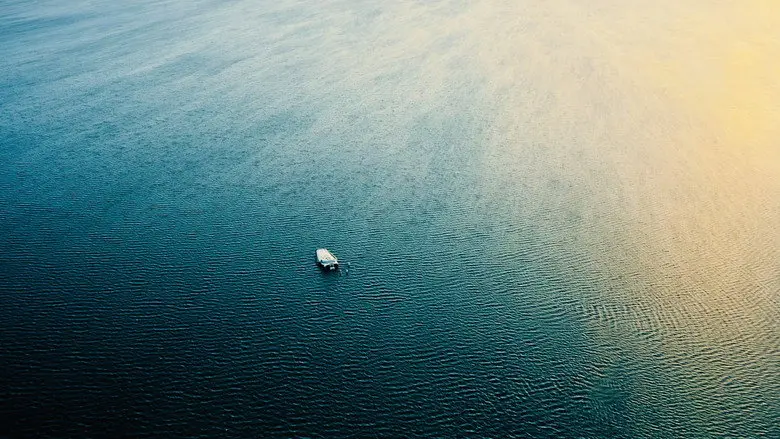
This is why the film remains recognizable after a MovieWordle round. Its spaces are vast, but its compositions rarely treat people as anonymous spectacle. A figure at a window, a hand on a watch, or a craft in open water gives the viewer a fixed point against which the scale can register.
Interstellar ending explained: what Cooper does in the tesseract
At the end, Cooper falls into Gargantua and enters the tesseract, where he can see Murph’s childhood bedroom across different moments in time. The film shows him using gravity to communicate information to Murph through the watch’s second hand. Murph later uses the data to help complete the work that allows humanity to leave Earth.
The plot is explicit about Cooper’s action, but its emotional point is simpler than a cosmic puzzle. The bedroom is the place he left, and the watch is a promise he could not keep in ordinary time. The tesseract lets the film turn absence into a form of contact without pretending that the lost years disappear. Cooper can send what Murph needs, but he cannot relive the life he missed with her.
The final reunion on Cooper Station stays brief for the same reason. Murph is now old, Cooper has not aged in the same way, and the film does not erase that mismatch. He leaves to search for Brand, carrying the story forward while leaving the father-daughter bond as the emotional measure of everything that came before.
There is a useful distinction here between solution and repair. The film solves the immediate survival problem in its fiction, but it does not restore a shared lifetime for Cooper and Murph. That limit keeps the ending from treating its speculative device as a clean emotional reset. It gives the final scenes their quiet, slightly painful texture.
A rewatch path for the MovieWordle frames
On a rewatch, track the objects that make the film’s impossible distances legible. Notice the watch before it becomes an ending device, the crops before the mission begins, and the repeated way a small machine or person is placed against a surface too large to master. Those cues connect Interstellar’s domestic opening to its farthest reaches without requiring the film to explain every image in dialogue.
Conclusion
The clearest Interstellar explained reading begins with scale but ends with care. Corn, a watch, and a small craft on water make the film’s extraordinary distances feel personal. For MovieWordle players, those ordinary anchors are often the fastest route back into Nolan’s space epic and its account of what time takes from a family.
Keep playing
Ready for another film? Browse the MovieWordle 6 Frames archive and choose a recent puzzle to solve.