
FRAME BY FRAME · ISSUE 42
The Dark Knight Rises Visual Analysis
2012 · Drama / Action / Thriller / Crime · Directed by Christopher Nolan
Spoilers below, including the ending.
Christopher Nolan’s 2012 The Dark Knight Rises is recognisable through scale and silhouette. A masked figure fills a dark frame. Catwoman rides a weaponised motorcycle through a concrete channel. Batman stands against fire, smoke, police lights, and a city that has become both battlefield and audience. The film’s craft turns public spectacle into a question about what Gotham needs to see and what Bruce Wayne must finally hide.
The Dark Knight Rises makes power visible through scale
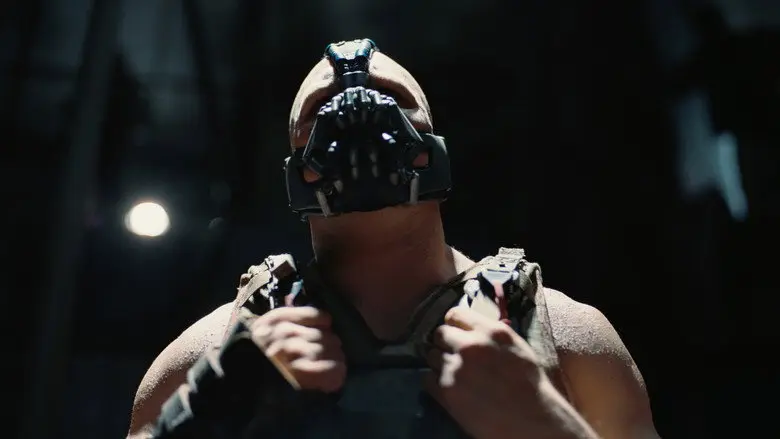
The Bane frame is shot from below. His mask dominates the image, while the surrounding architecture falls into shadow. It is a practical recognition cue for MovieWordle: the mask, heavy gear, and low angle identify a threat before the plot is available. Nolan repeatedly gives Bane this kind of physical authority, then places Batman in compositions that test whether a symbol can survive without overwhelming the people around it.
The film’s action spaces are designed for that test. Bridges, tunnels, rooftops, and the football stadium make bodies look small against systems of infrastructure. The city is not only a setting; it is the thing each character is trying to control. Bane wants to turn Gotham’s institutions against themselves, while Batman has to learn that a single heroic body cannot permanently carry the city’s moral burden.
Motion and frozen tableaux create the guessing cues
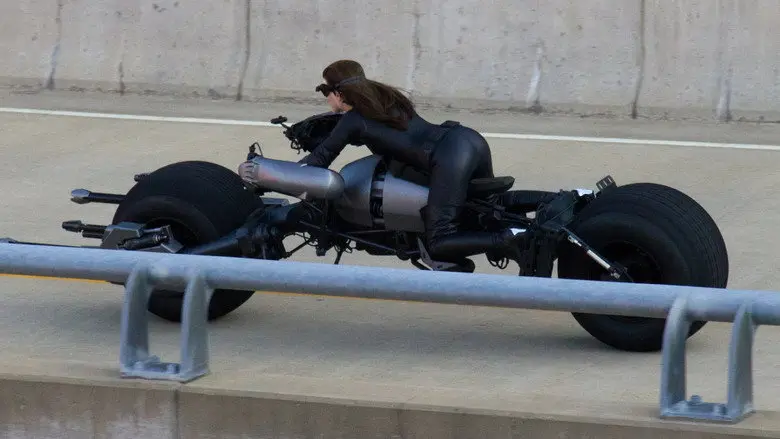
The approved Catwoman frame shows Selina Kyle leaning over the Batpod as it races beside a barrier. The horizontal vehicle and the concrete wall compress the image into a narrow corridor. Selina is moving at speed, but the frame is clean enough to read her posture, mask, and machine. That combination of motion and graphic clarity is typical of Nolan’s set pieces: the action is large, yet the silhouette remains legible.
The later Batman image reverses the relationship. He stands on a police car while the street behind him fills with smoke, emergency lights, and a crowd. The low horizon makes him a public emblem, but the damaged city keeps the emblem from feeling triumphant. For a rewatch, look at when the film places Batman alone in a frame and when it places him inside a network of vehicles, officers, and civilians. The visual argument shifts from solitary legend to shared civic memory.
The Dark Knight Rises ending explained: the sacrifice and the reveal
Near the climax, Gotham faces a nuclear bomb that will detonate unless it is carried away from the city. Bruce Wayne appears to take the bomb out over the bay in the Bat, and the explosion is treated by Gotham as his final sacrifice. Commissioner Gordon, John Blake, and the citizens of Gotham receive a public story in which Batman gives his life to save them.
The film later shows that Bruce survived. Before the flight, he repaired the Bat’s autopilot, allowing it to carry the bomb while he escaped. Fox notices the change and understands what Bruce has done. The public memorial and the repaired autopilot therefore work together: Batman’s death is a constructed event that lets Gotham keep the symbol while releasing Bruce from the role.
Alfred’s final scene confirms the private cost and the private reward. At the café in Florence, he sees Bruce alive with Selina Kyle. The moment is not presented as proof that every earlier event was imaginary. The plot establishes the repair, Fox’s discovery, and Alfred’s sighting as real events within the film. The interpretation is that Bruce has finally accepted a life outside the performance of Batman, while Alfred receives the future he had asked Bruce to imagine.
The ending also completes the trilogy’s argument about symbols. Batman’s identity is protected by the apparent death, but the idea of Batman is handed to Gotham and to John Blake, who discovers the entrance to the Batcave. Blake does not become Batman on screen. The closing image leaves his next step open, preserving the possibility that the symbol can continue without requiring Bruce to return to it.
Conclusion
The Dark Knight Rises ending explained comes down to a planned sacrifice that changes what Batman means. The mask, the Batpod, and the police-car tableau show a figure built for public reading; the repaired autopilot and Florence café show Bruce stepping outside that reading. Nolan closes the story by letting the city keep its legend and letting the man behind it live.
Keep playing
Ready for another film? Browse the MovieWordle 6 Frames archive and choose a recent puzzle to solve.