
FRAME BY FRAME · ISSUE 45
Love Actually Visual Analysis
2003 · Drama / Comedy / Romance · Directed by Richard Curtis
Spoilers below for the film’s interwoven stories.
Richard Curtis’s 2003 Love Actually is structured as a network rather than a single romance. Its characters meet in offices, kitchens, airports, school halls, and doorways, often carrying feelings that the person in front of them cannot fully see. The approved frames make that design visible: a child and an adult share a playful gesture, two people walk through a city together, and a woman stands in a doorway while a relationship hangs on what is said and what is withheld.
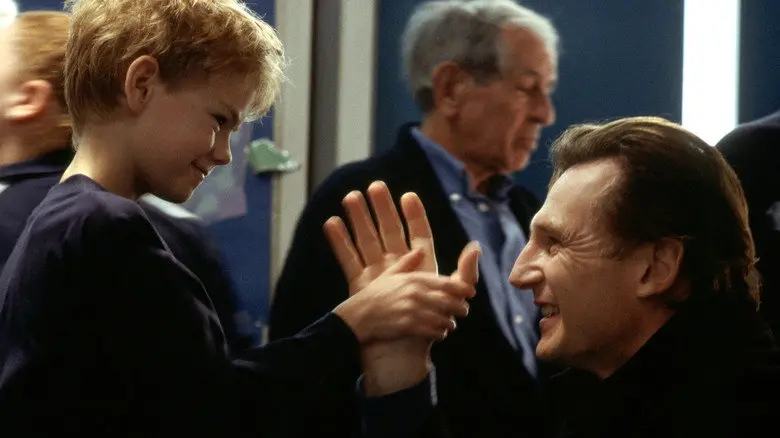
Love Actually makes connection a matter of timing
The first frame shows Daniel and Sam reaching toward each other in a bright interior. The gesture is small, but it carries the film’s central rhythm: affection becomes visible through a response. Daniel is grieving, Sam is trying to explain his own crisis, and the conversation becomes a shared project rather than a speech from one character to another.
Curtis builds several stories from these exchanges. A person enters a room at the wrong moment, misses a confession, or finds the courage to speak only after a relationship has already changed. The film’s editing keeps moving between storylines, but the visual grammar is consistent. Hands meet, doors open, and faces turn toward someone who may or may not return the feeling.
Doorways hold the film’s difficult choices
In another approved frame, Sarah faces Karl across a doorway. The warm room behind her is visible, while the foreground figure is reduced to a dark silhouette. The composition gives the encounter a clear boundary: one person is standing inside a possible future, and the other is looking at it from the threshold.
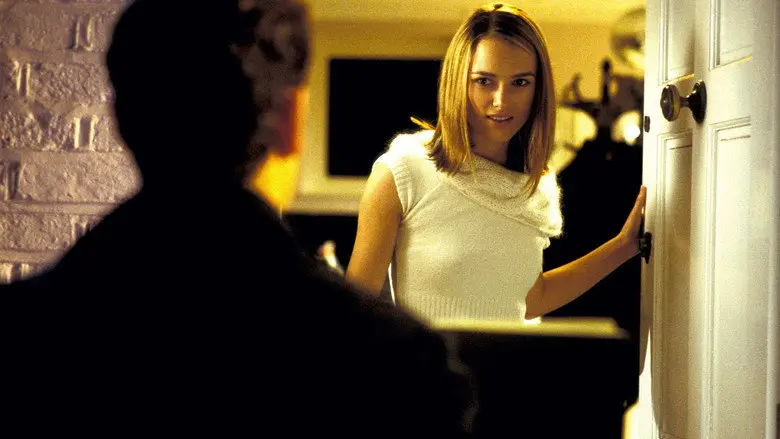
That doorway is a useful recognition cue because Love Actually repeatedly turns ordinary architecture into emotional punctuation. A stair, a corridor, or an airport gate can delay a decision for a few seconds, and those seconds matter. The film does not treat love as one stable reward. It includes marriage under strain, unreturned feeling, friendship, family care, and relationships that end without a grand speech.
The warm colour does not promise a happy resolution; the film uses cosy lighting for joy and discomfort alike. What changes is who is looking, waiting, or choosing not to interrupt.
The ensemble works like a chain, not a single answer
The film’s heart-shaped collage captures the broad structure, but the story is easier to understand through smaller links. Daniel’s care for Sam connects grief to parental love. Jamie’s new relationship begins after betrayal. Mark’s feelings for Juliet remain private even when they become visible. The Prime Minister’s romance is playful, while Sarah’s story is constrained by family responsibility.
These threads do not add up to one rule about how love should work. They create a range of consequences. Some characters act; some apologise; some accept that feeling does not create a right to be chosen. That variety lets the film be sentimental in one scene and uncomfortable in the next without losing its organising idea.
Love Actually explained: why the airport opening and ending matter
The film opens and closes at Heathrow Airport, where arrivals are greeted by embraces. Those shots are not proof that every relationship in the story has a happy ending. They are a frame around the film’s broader claim that connection is visible in repeated acts of welcome: family members, friends, lovers, and strangers moving toward one another.
The ending brings the storylines back into shared public space. Some couples reunite, some relationships remain unresolved, and some emotional truths are accepted without being acted on. The airport gives those different outcomes the same physical setting, but not the same meaning. A hug can mark romance, friendship, forgiveness, or simple relief.
Conclusion
Love Actually explained through its visual design is a film about attention moving between people. The high-five, the doorway, and the ensemble frame all show that love becomes legible through timing, response, and interruption. For MovieWordle players, look for warm interiors, overlapping stories, and a small gesture that turns a private feeling into something another person can finally see.
Keep playing
Ready for another film? Browse the MovieWordle 6 Frames archive and choose a recent puzzle to solve.