
FRAME BY FRAME · ISSUE 31
American Psycho Visual Analysis
2000 · Drama / Thriller / Crime · Directed by Mary Harron
Spoilers below, including the ending.
Mary Harron's 2000 film American Psycho makes Patrick Bateman's world look finished before it makes him look dangerous. White rooms, tailored suits, restaurant reservations, and carefully rehearsed preferences give him a ready-made identity. This American Psycho explained guide follows the approved MovieWordle frames to show why that polish is not proof of control. The film uses surfaces as a language that Bateman can speak fluently, then lets his account of himself collapse under the same pressure.
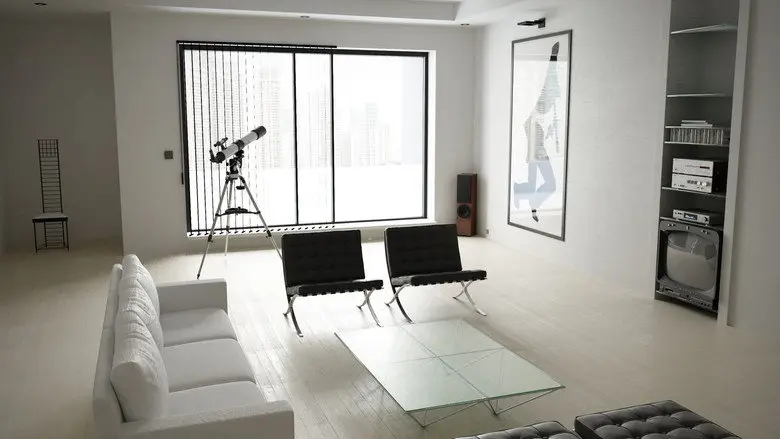
American Psycho turns good taste into a performance
The apartment frame is a useful place to start. Its pale furniture, large window, glass table, and telescope make the room read as spacious and expensive, but the image is also oddly unoccupied. Nothing in it identifies a person with a private life. It could be a showroom, and that ambiguity is part of the film's joke about status.
Bateman knows the codes of this setting: brand names, grooming rituals, reservations, and the right opinion of a musician. He treats those codes as if they can supply a self. Yet the people around him frequently confuse one colleague for another, including Bateman. The film lets that social blindness become frightening because recognition is the one kind of evidence Bateman cannot manufacture alone.
For a MovieWordle player, the white Manhattan interior is a strong early cue when it appears alongside sharp suiting and obsessively clean composition. The clue is not simply wealth. It is the gap between a room designed to be admired and a life that seems unable to inhabit it.
The surface can make a threat look like a routine
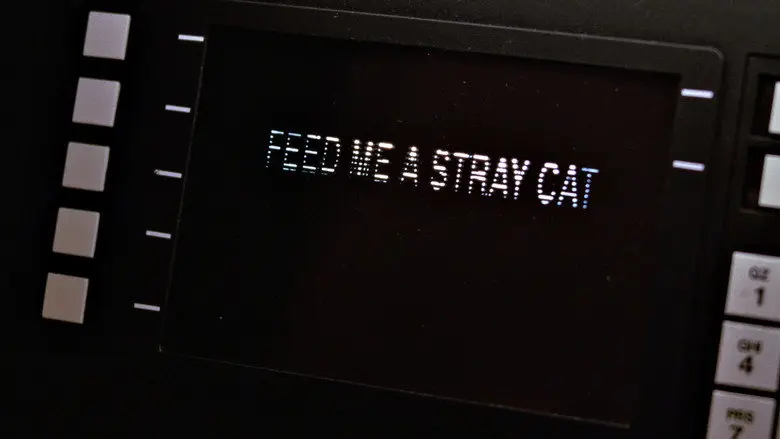
The approved monitor frame is almost aggressively ordinary: pale letters sit on a dark screen among buttons and keys. Yet its message, “Feed Me a Stray Cat,” brings a disquieting intrusion into the controlled routines that otherwise organize Bateman's world. It is a useful recognition cue because the film repeatedly lets technology, consumer objects, and polished interiors carry more emotional weight than the people using them.
That effort makes the film's comedy increasingly bleak. Bateman's peers compete over business cards and restaurant tables, but their judgments are shallow and interchangeable. Their certainty about status is not insight; it is group recitation. Bateman's violent fantasies and actions arrive inside a culture that notices typefaces and tailoring more readily than a person in distress.
This does not mean the film asks viewers to turn the surrounding characters into excuses for him. The point is narrower and more unsettling: their indifference makes a world in which a performance can continue after its performer has become impossible to trust.
The film also makes this social setting deliberately funny. A dinner-table argument about music or a scramble for the right reservation has the timing of a status comedy, but nobody in the scene is secure enough to laugh at it. Bateman keeps treating the smallest distinctions as existential ones because they are the few distinctions his circle agrees to recognize. The more elaborate the display becomes, the more precarious it feels.
That tension explains why the apartment matters beyond its décor. It is not evidence that Bateman is successful, or evidence that he is empty. It is an environment built for instant appraisal. He can arrange it, describe it, and use it as proof that he belongs. The frame's uneasy cleanliness suggests the limit of that strategy: an image can establish a look, but it cannot make anyone see the person doing the looking.
The ending of American Psycho explained
The ending does not neatly reveal that every violent event was imaginary. After Bateman returns to Paul Allen's apartment, he finds it orderly and empty rather than the scene of a crime he expects. He leaves a frantic confession for his lawyer, Harold Carnes, only to find that Carnes treats the confession as nonsense and says he recently had dinner with Paul Allen in London.
Those details refuse a single clean ledger of what happened. Bateman's perspective is plainly unstable by this stage, and Carnes himself belongs to the same network of mistaken identities that has run through the film. The ending therefore does not give the audience a reliable official who can certify either Bateman's crimes or his innocence.
What it does confirm is his failure to reach another person. A confession, which should interrupt the performance, is absorbed by the social world that has already failed to recognize him. Bateman expects disclosure to change the story; instead, it becomes another piece of speech that nobody can place. The final sense of punishment is not legal resolution but confinement inside an identity he cannot escape or make legible.
A final approved frame makes the film's split visible
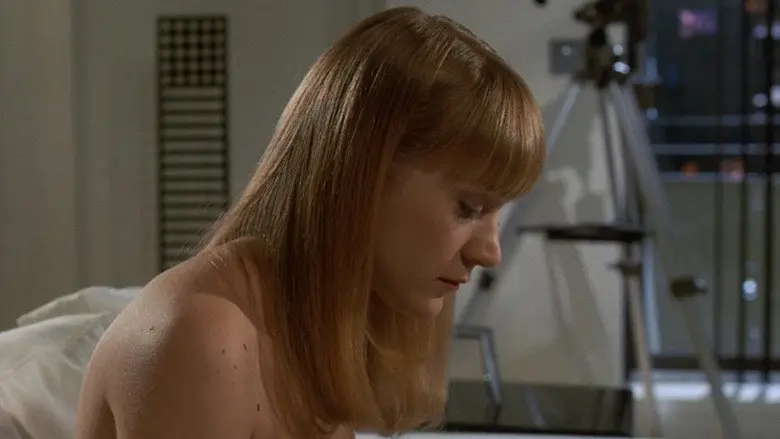
The third selected frame holds a red-haired woman in profile inside a bright apartment, with a telescope and city lights in the background. It works as a recognition cue because it returns to the film's central contrast: a carefully arranged lifestyle image that cannot contain the unease passing through it.
On a rewatch, notice how often American Psycho keeps Bateman in reflective surfaces, polished interiors, or carefully arranged medium shots. The film makes looking composed feel like an activity, not a state of being. Once that distinction is clear, the ending reads less like a puzzle with a missing answer than a portrait of someone whose available language is all presentation.
Conclusion
The strongest American Psycho explained reading is not that the ending gives a final count of Bateman's crimes. It shows a man whose status performance has become both his shelter and his trap. The approved frames—an immaculate apartment, a disturbing computer message, and a bright interior with a figure held apart from it—make the film recognizable because each image offers polish while withholding any secure proof of a person underneath it.
Keep playing
Ready for another film? Browse the MovieWordle 6 Frames archive and choose a recent puzzle to solve.