
FRAME BY FRAME · ISSUE 30
Life of Pi Visual Analysis
2012 · Adventure / Drama · Directed by Ang Lee
Spoilers below, including the ending.
Ang Lee’s 2012 Life of Pi makes survival look both immediate and impossible to hold in one image. A boy is stranded on a lifeboat with a tiger; the ocean shifts between tranquil, luminous space and a force that can erase every boundary. This Life of Pi explained guide looks at the film’s changing scale and its animal-human distance before addressing the two accounts Pi gives at the end.
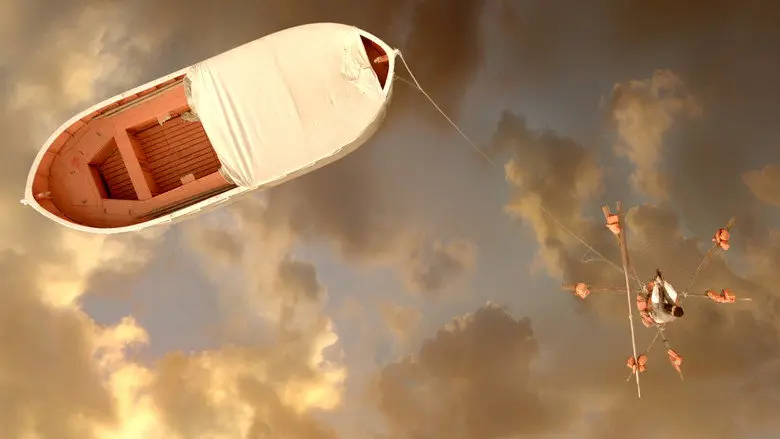
The boat makes scale personal
The lifeboat is the film’s central visual device because it is both shelter and exposure. It holds Pi’s few resources, separates him from the tiger, and becomes tiny whenever the ocean or sky opens around it. The approved image of a boat above clouds makes that contrast literal: a small practical object is suspended in a field too large for human control.
That is why Life of Pi works as more than a collection of beautiful seascapes. The film keeps returning to the work of making one small space livable. Pi measures distance, watches the animal’s position, finds ways to move, and learns the difference between a moment of calm and a guarantee of safety.
Richard Parker is a visible distance, not a metaphor the image can settle
The tiger is one of the film’s clearest recognition cues. In the approved close image, its face is partly enclosed by shadow and foreground bars. The animal is present, watchful, and physically distinct from Pi, which matters more than any one interpretation. Their relationship is structured by separation: the tiger is on the boat, close enough to dominate Pi’s choices, but never made harmless.
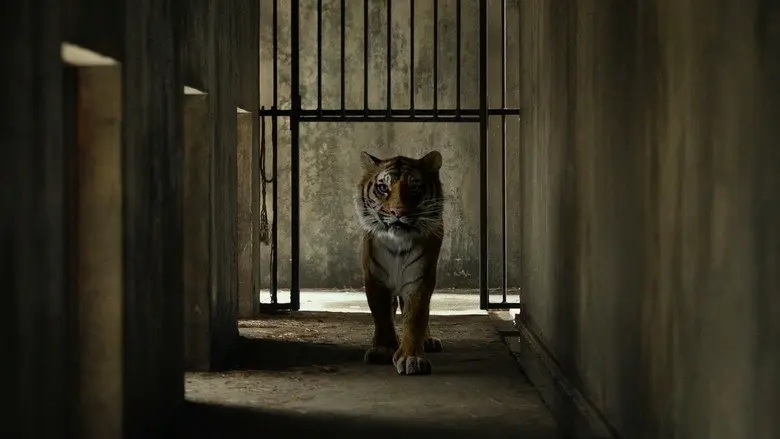
On a rewatch, notice how the film gives the tiger weight. Richard Parker is not filmed as a comforting companion. Pi has to observe feeding, territory, and proximity. The visual tension comes from the narrow boat line between them and the ocean line beyond it.
Light changes the ocean from route to ordeal
The film’s colour and light repeatedly reframe the same basic environment. A watery blue image can make Pi’s body look almost weightless; a dark horizon can reduce the boat to a silhouette; a field of candles can turn an exterior space into something ceremonial and overwhelming. Those variations are useful MovieWordle signals because the film returns to water without making it visually repetitive.
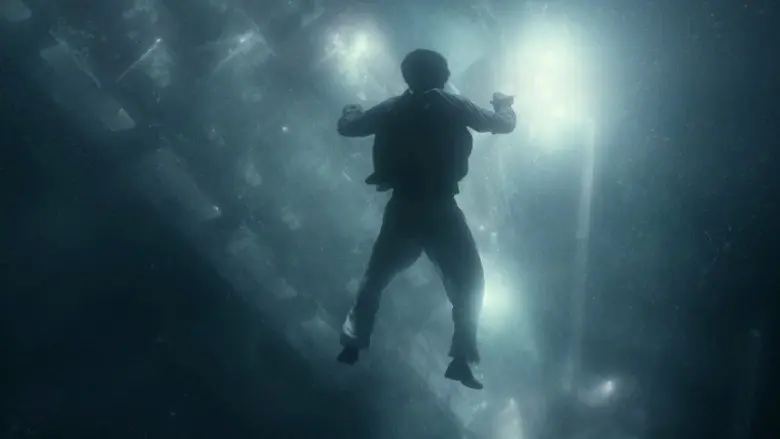
The underwater frame does not need to carry a fixed hidden message to do its job. It shows a body surrounded by light and depth, with no ordinary ground line. In the wider film, images like this make the ocean feel capable of changing scale and emotional temperature in an instant.
Life of Pi explained: why Pi gives two stories
At the end, Pi tells investigators a version of his survival in which animals occupied the lifeboat: the zebra, orangutan, hyena, and Richard Parker. When they doubt it, he tells a harsher account in which the human survivors correspond to those figures. The investigators cannot prove either version from what remains.
The film asks which story the listener prefers, but it does not force the question into a simple factual test. The animal story gives Pi a way to tell an experience that may otherwise be unbearable to narrate directly. The human story changes the emotional stakes by connecting violence and survival to people Pi knew. Both accounts make the same larger point: a story can be an attempt to make catastrophe communicable, not merely a report competing for literal victory.
Richard Parker’s departure sharpens that question. Pi reaches land, and the tiger walks into the forest without looking back. Whether viewers read the tiger literally, psychologically, or both, the scene registers an ending to the relationship that helped structure Pi’s survival. The film leaves Pi with the need to tell what happened, not with a final instruction about how every listener must interpret it.
The scene also changes the meaning of the boat. For most of the film, its narrow divisions force Pi to keep looking outward: toward the tiger, the weather, food, distance, and possible land. Once he reaches shore, that practical system vanishes quickly. The final conversation moves survival from action into narration. Pi can no longer demonstrate the journey; he can only choose how to describe it.
That is why the film’s most lavish images retain a tactile edge. Floating lights, blue depths, and enormous skies do not erase hunger, injury, fear, or the small work of staying alive. The visual scale creates room for wonder, but it also makes Pi’s boat look vulnerable. The ending returns that tension to language: a beautiful story may be chosen, but it is not automatically an easy story.
Conclusion
The strongest Life of Pi explained reading keeps the two stories in view rather than collapsing one into a neat answer. The boat, the tiger, and the mutable ocean make survival visible as a problem of distance, attention, and scale. Pi’s final account asks what kind of story can carry that experience when straightforward description no longer feels sufficient.
Keep playing
Ready for another film? Browse the MovieWordle 6 Frames archive and choose a recent puzzle to solve.