
FRAME BY FRAME · ISSUE 2
The Thing Visual Analysis
1982 · Horror / Science Fiction / Mystery · Directed by John Carpenter
Spoilers below, including the ending.
John Carpenter’s 1982 The Thing makes suspicion visible before it makes it explainable. The film is set in an Antarctic research station, but its real terrain is uncertainty: a doorway, a patch of light, or a figure at the far end of a room can become enough to make the viewer ask who is exposed and who is hidden.
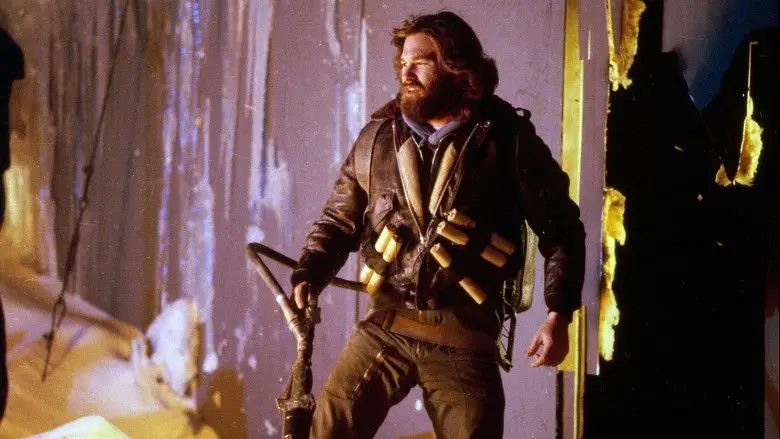
That is why the approved MovieWordle frames are useful clues. They do not need to show every transformation or name every character. A man held in a doorway and a body swallowed by fractured blue-white light already carry the film’s central visual problem: the base is small, the cold is outside, and no shape can stay trustworthy for long.
In The Thing, suspicion begins with the frame
The film’s tension does not wait for a creature to appear. It begins when the image limits what a person can know. A doorway separates one room from another. A window shows a body but not necessarily its intention. A distant figure becomes difficult to read because snow, darkness, or equipment has reduced the information available.
The doorway frame of MacReady is a compact example. He is visible, but he is not comfortably placed. The frame sets him against a cold interior and makes the opening behind or around him a possible point of entry. It is a simple compositional choice with a sharp effect: safety has edges, and every edge needs watching.
That visual discipline keeps the film from treating paranoia as an abstract theme. Suspicion has a location. It starts when someone crosses a threshold, disappears behind a wall, or comes back into view with too little context.
Doorways, silhouettes, and harsh light make the base readable
The station can look like a clutter of corridors, rooms, machinery, and snowbound exteriors. Yet the film repeatedly gives each space a readable boundary. Hard door frames cut up the screen. Lamps separate foreground from background. White exterior light makes a person’s outline stand out while also making detail disappear.
One selected image shows a human silhouette caught in broken, icy blue-white light. Its power comes from the conflict between exposure and concealment. The body is isolated enough to be seen, but the light does not make it fully knowable. The result is less a decorative color scheme than a way of rationing information.
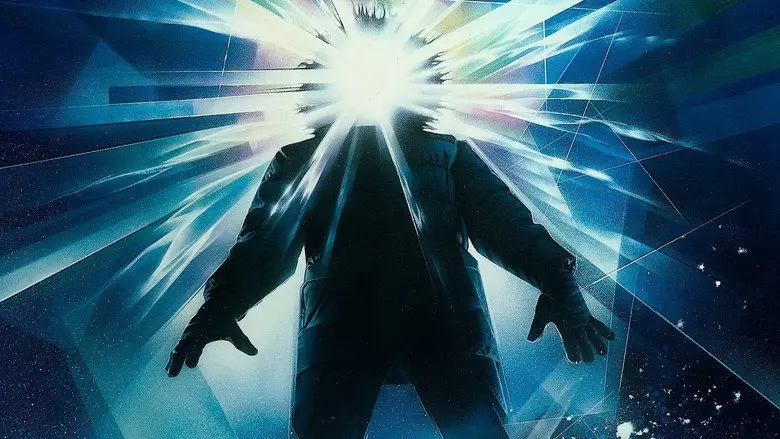
This is a useful recognition cue for players. The Thing often pairs human scale with hostile illumination: a figure, a hard boundary, a dark room, and cold light that seems to arrive from outside. The combination can identify the film without relying on a single famous shock image.
When a body stops being a reliable shape
The film’s most disturbing idea is visual before it is verbal. A body ordinarily lets us make fast judgments: this is a face, this is a person, this is someone we recognize. The Thing repeatedly attacks that shortcut. Familiar forms can become unstable, and the viewer is forced to inspect movement, proportion, and texture rather than simply accepting a silhouette.
That is why the creature imagery works even when a still image gives away little plot. The issue is not only what the viewer sees; it is the loss of a dependable visual category. A room full of people becomes tense because any one of them may look ordinary right up to the moment ordinary appearance fails.
The selected game frames mostly hold back from that reveal. This is a good restraint. A guessing game needs clues that connect to the film’s atmosphere without turning a major image into a spoiler. Here, thresholds and light carry enough of the film’s identity on their own.
The Thing ending explained: why the final uncertainty matters
At the end, MacReady and Childs sit outside the ruined station, facing the cold and each other. The film does not identify either man conclusively as human or as the Thing. It leaves the immediate question open while making the larger situation clear: neither survivor has a secure reason to trust the other, and neither has an easy path to safety.
MacReady’s laugh is often treated as a clue that solves the scene. It is more persuasive as a response to the situation’s bleak absurdity. The two men are exhausted, the station has burned, and certainty has become impossible. A definitive answer would reduce the very pressure the film has been building through doors, shadows, tests, and partial views.
The ending works because it does not suddenly change the film’s rules. From the beginning, The Thing has made viewers watch people through incomplete information. The final scene simply removes the last comforting assumption—that the camera will eventually tell us whom to believe.
How to spot The Thing in a MovieWordle round
Look for a small group or a solitary figure framed against Antarctic cold, interior equipment, or abrupt blue-white light. Then look at the spacing. The film often makes distance feel accusatory: a person is too far away to read, too close to ignore, or separated by a doorway that offers no real protection.
Those clues are more useful than hunting for a monster in every still. They preserve the film’s craft-led identity while respecting the game’s spoiler boundary. The Thing is recognizable because it makes the act of looking feel risky.
Conclusion
The Thing builds dread by controlling what the frame allows us to know. Doorways, silhouettes, cold light, and unstable bodies turn a remote station into a series of tests of attention. The selected MovieWordle frames capture that method without giving the game away: each asks whether seeing someone is the same as understanding them.
Keep playing
Ready for another film? Browse the MovieWordle 6 Frames archive and choose a recent puzzle to solve.