
FRAME BY FRAME · ISSUE 8
The Sixth Sense Visual Analysis
1999 · Drama / Thriller / Mystery · Directed by M. Night Shyamalan
Spoilers below, including the ending.
M. Night Shyamalan’s 1999 The Sixth Sense makes its twist feel fair by turning ordinary spaces into incomplete evidence. A dining room, a street, a watch, a theater, or a face in low light can carry two meanings at once. This The Sixth Sense explained guide focuses on how the film’s visual restraint prepares its revelation without reducing every image to a code.
The film makes absence look like a normal part of the room
Cole Sear’s encounters with the dead are frightening because the film does not turn every scene into a spectacle. The camera often stays at a human distance. Adults speak, doors open, and rooms retain their everyday layout. The disturbance comes from what one character knows that another cannot see.
That approach gives the film its visual grammar. A figure may occupy the edge of a frame without being acknowledged. A room can feel occupied while remaining quiet. The viewer learns to inspect reactions, gaps in conversation, and the direction of a glance rather than waiting for a special effect to announce the supernatural.
Objects become clues without becoming magic answers
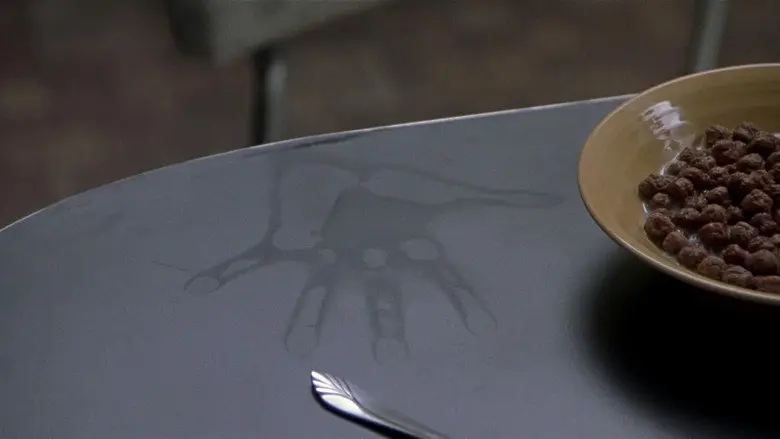
An approved frame of a hand-shaped mark on a table is a compact recognition cue. It is specific enough to evoke the film’s domestic unease, yet it does not explain the entire story. The mark belongs to a world where physical traces and emotional memories overlap. The film keeps asking whether an object is evidence of a ghost, a trauma, or both.
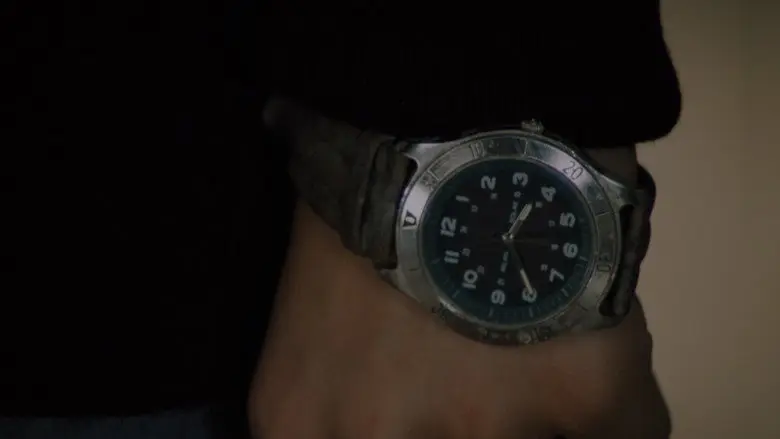
The watch frame works differently. It isolates a familiar object and gives it a private weight. In The Sixth Sense, time is never just background information. Malcolm Crowe’s life has stopped in a way he does not initially understand, while Cole is forced to live with experiences that other people dismiss. The object becomes a visual reminder that the characters do not occupy the same emotional present.
Restricted viewpoints make the twist feel earned
The film’s famous reveal depends on information withheld from Malcolm, but the camera does not cheat by hiding impossible facts. Scenes are staged so that Malcolm can appear to participate while the surrounding world quietly refuses to confirm him. Conversations are short, domestic, and often interrupted. The viewer can accept them on first watch because the film’s style is calm rather than suspiciously evasive.
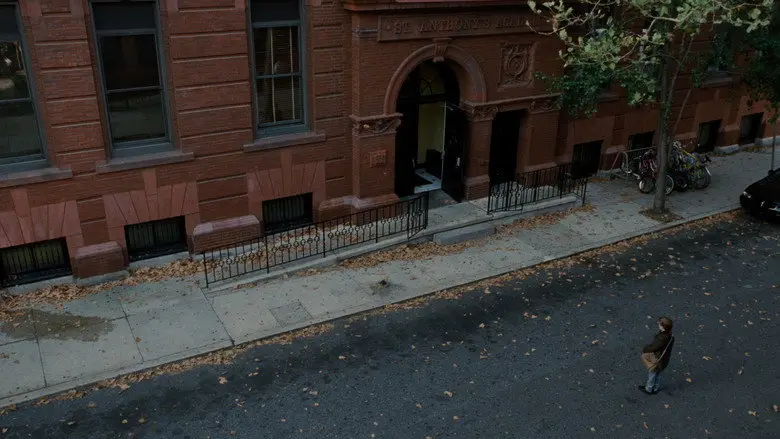
An overhead street image from the approved set shows how scale contributes to that effect. A person can be visible and still feel separated from the life around them. The film repeatedly uses distance, thresholds, and empty space to suggest that seeing someone is not the same as sharing their reality.
For MovieWordle players, the recognition pattern is therefore subtle: muted interiors, isolated faces, children framed against adult spaces, and small objects that seem to remember something. The clues are visual relationships, not a single ghost image.
The Sixth Sense ending explained: Malcolm’s last conversation
The ending reveals that Malcolm died after being shot by Vincent Grey at the beginning of the film. He has been a ghost throughout his work with Cole, unable to accept that his marriage and ordinary life have continued without him. When he finally listens to his wife speaking in her sleep, he understands what happened and says goodbye.
That is the plot fact. The interpretation comes from the film’s emphasis on attention. Malcolm believes he is helping Cole learn to live with the dead, but Cole also teaches Malcolm how to hear what he has refused to acknowledge. The twist is not only a change in the timeline. It is a change in whose perception counts.
The ending remains moving because it does not turn the revelation into a victory lap. Malcolm cannot return to his old life. He can only recognize it accurately and release it. The film’s quiet visual style makes that acceptance feel more important than a final shock.
Why the frame set works as a fair clue
The selected images preserve the film’s atmosphere without giving away Malcolm’s status. The tabletop mark suggests an unexplained presence. The watch turns time into an intimate object. The overhead street view makes separation visible. None of the three proves the twist, but all three belong to a film where ordinary spaces hold unfinished conversations.
Conclusion
The best way to understand The Sixth Sense explained is to follow its treatment of visibility. Shyamalan uses distance, quiet objects, and unacknowledged figures to make grief perceptible before the plot names it. The ending works because Malcolm’s final act is not solving a supernatural puzzle; it is accepting the life he can no longer inhabit.
Keep playing
Ready for another film? Browse the MovieWordle 6 Frames archive and choose a recent puzzle to solve.