
FRAME BY FRAME · ISSUE 1
The Shining Visual Analysis
1980 · Horror / Thriller · Directed by Stanley Kubrick
Spoilers below, including the ending.
Stanley Kubrick’s 1980 film The Shining makes a hotel feel less like a location than a rulebook nobody has been given. The Overlook has corridors, rooms, windows, carpets, snow, and familiar household objects. Yet the film arranges those ordinary things so insistently that they begin to feel as if they are arranging the people.
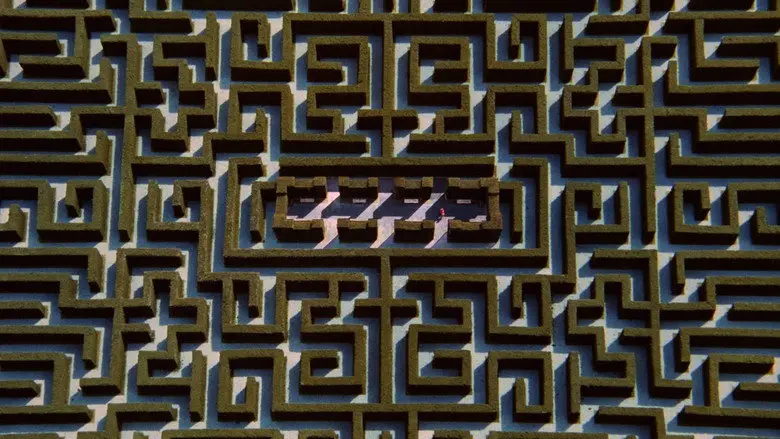
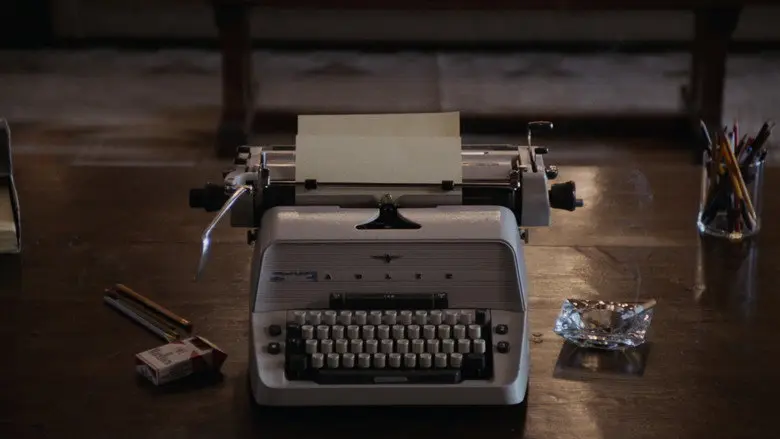
That is the most useful way into the film after a MovieWordle round. The approved frames are clues, not a complete visual record. Two figures moving through a hedge-maze corridor, a typewriter on a desk, and a child reduced to a small figure on a patterned floor all point toward the same experience: the Overlook turns space and repetition into pressure.
The Overlook works as a system
The hotel is frightening partly because it rarely has to announce danger. Its rooms are broad, bright, and carefully kept; its hallways are long enough to make a person seem misplaced. The visual tension comes from order that has become too complete. A room may appear calm, then the camera holds long enough for that calm to feel watchful.
The maze frame explains the principle in miniature. The people are held between tall hedge walls, and their route seems to narrow even though the path remains visible. The image does not need a monster to make movement feel constrained. It turns orientation into the problem.
That logic carries indoors. Doors, carpets, hallways, and windows divide the screen into regular shapes. Instead of offering refuge, those shapes make the family look measured and contained. The Overlook does not simply surround its visitors; it gives them patterns they cannot easily escape.
Repetition makes domestic objects ominous
The Shining is full of objects that should be reassuring because they belong to work or family life. A desk suggests concentration. A typewriter suggests a task that can be finished. A carpet ought to be background detail. Kubrick repeatedly lets those things remain recognizable while changing the emotional charge around them.
The selected typewriter frame is especially revealing. It is a quiet image: a machine, a dark surface, a little available light. But it asks the viewer to notice absence and duration. Who has been sitting here? What has the work become? By withholding a quick answer, the film makes a commonplace object feel like evidence.
This is why the film’s visual style lasts beyond its most famous shocks. It does not rely only on a sequence of alarming images. It teaches the eye to distrust repetition. Once that has happened, a familiar corridor or an orderly piece of furniture can carry as much unease as a startling event.
The carpet turns a child into part of the pattern
One approved game frame looks down on Danny as he sits or moves across the hotel’s strongly patterned carpet. The image offers a good recognition cue because the carpet is unusually specific. More importantly, it shows the film’s scale of concern. Danny is a person in the frame, but the pattern is almost a second subject.
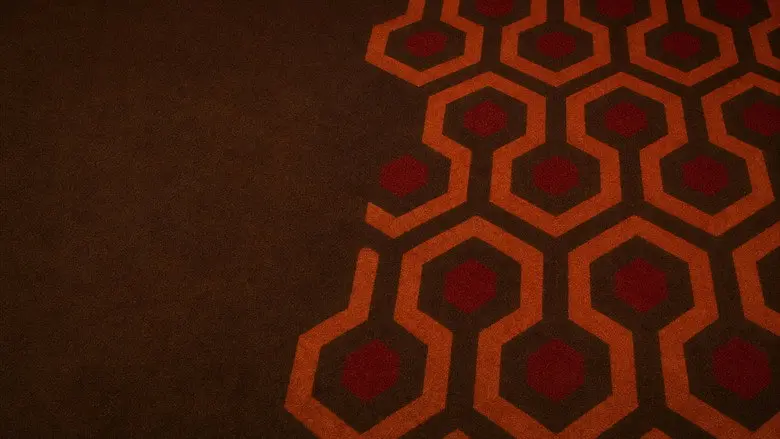
The overhead view denies the easy comfort of seeing at a character’s level. We look down as the hotel’s geometry spreads outward. The shot does not prove that the building has a single intention; that would be a claim about a fictional place rather than an observation about the image. It does show how often the film lets design compete with the people who must live inside it.
For players, that distinction matters. A still from The Shining is often recognizable not because it carries one famous face, but because it combines a body with a system of lines, colors, and enclosed space. The game frame is a fair clue when it preserves that relationship without giving away the scene.
The Shining ending explained: what the photograph leaves unresolved
The final photograph is powerful because it refuses to settle one neat explanation for the Overlook. It places Jack in an old hotel image, apparently tied to a past he could not literally have attended. The ending therefore makes the hotel’s influence feel larger than one winter and larger than one family.
There are several reasonable ways to read it. The photograph can suggest that the Overlook absorbs people into its own history. It can also suggest a circular pattern, in which the hotel keeps remaking a role rather than preserving a simple timeline. What the film does not do is supply a final speech that tells us which reading is official.
That uncertainty is the point of the image’s design. Earlier, the film made rooms, objects, and patterns feel as though they were carrying old pressure forward. The photograph ends by making history itself part of the décor. It is less a puzzle with a confirmed answer than a final refusal to let the hotel become ordinary again.
A better way to revisit The Shining after the game
On a rewatch, notice what the frame asks you to scan before the plot tells you how to feel. Is a person centered, isolated, or broken up by the room? Does a repeating surface make the space feel stable or trapping? Has an everyday object acquired the weight of a clue?
Those questions keep the analysis close to what is actually on screen. They also explain why three restrained MovieWordle images can evoke The Shining without summarizing it. The maze, the typewriter, and the carpet all make the same promise: in this hotel, the background is never merely background.
Conclusion
The Shining remains visually unsettling because it turns order into menace. Its most memorable spaces and objects are clear, symmetrical, and almost ordinary—until repetition makes them feel inescapable. That is why the selected MovieWordle frames work as recognition cues: each one carries a fragment of the Overlook’s system without pretending to explain the whole film.
Keep playing
Ready for another film? Browse the MovieWordle 6 Frames archive and choose a recent puzzle to solve.