
FRAME BY FRAME · ISSUE 21
The Prestige Visual Analysis
2006 · Drama / Science Fiction / Mystery · Directed by Christopher Nolan
Spoilers below, including the ending.
Christopher Nolan’s 2006 The Prestige is built around an argument between two stage magicians who turn rivalry into a way of life. This The Prestige explained guide follows the film’s visible logic—dark backstage spaces, electric light, masks, and figures that are hard to place—before moving to the reveal that gives those images their cost.
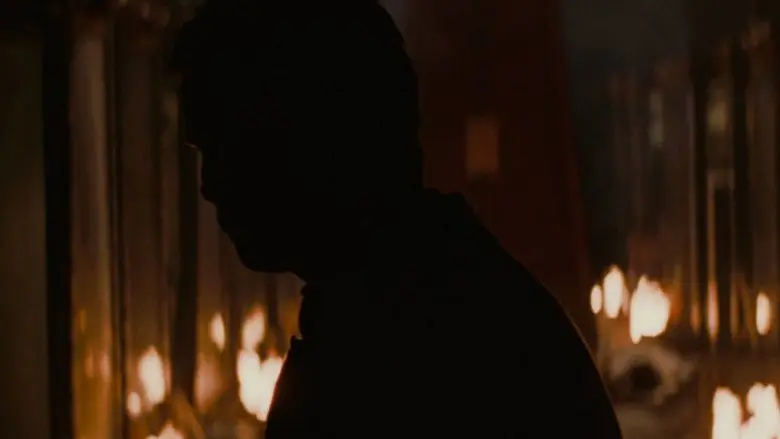
Every trick in The Prestige depends on what the audience overlooks
The film introduces its own vocabulary for a magic trick: the pledge, the turn, and the prestige. That structure also describes the rivalry between Robert Angier and Alfred Borden. Each man wants not only to fool an audience but to make the other man look ordinary.
The visual world keeps that contest material. A stage is only briefly a public space; the important work happens in wings, workshops, dressing rooms, and corridors where a costume or a shadow can conceal a second life. The opening frame’s silhouette and scattered flames make a useful MovieWordle cue because the image treats a person as an outline before it treats him as a character.
The rival magicians also approach that hidden labour differently. Borden’s act is rough, local, and protected by loyalty; Angier seeks a version that can be repeated with the polish of an event. The distinction matters because the film never lets an impressive performance remain merely a performance. Every success requires someone to keep a secret, make an exchange, or absorb a loss that the paying audience never sees.
That is why the film gives equal weight to notebooks, locks, costumes, and workspaces. They are not ornamental Victorian detail. They are the surfaces on which a performance becomes repeatable, and they invite the viewer to ask what has been prepared before the curtain rises. On first viewing, the objects can look like atmosphere. On a replay, they make the rivalry feel like a daily discipline rather than a series of isolated stunts.
Light, snow, and distance make the double feel physical
An approved frame places two small figures in a white field of electric bulbs. The shot is unusually bright for a film so often dominated by wood, smoke, and gaslight. Yet the light does not clarify anything. It turns the ground into a grid and makes both men look suspended inside a machine they cannot fully control.
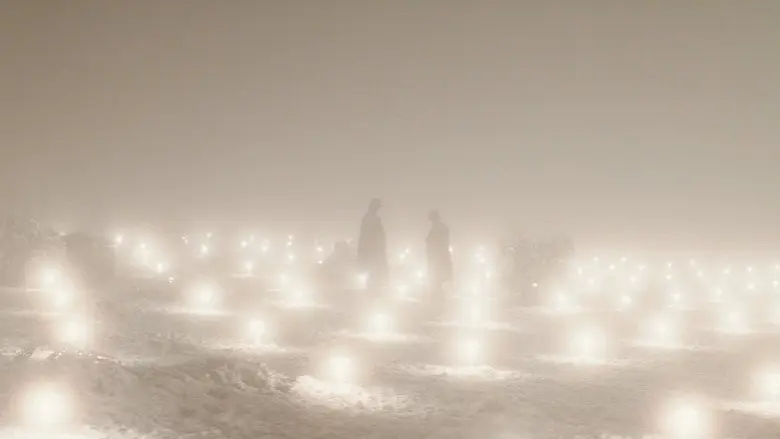
That contrast explains why the frame set works after a MovieWordle round. The film does not rely on a single prop to announce itself. Its recognition cues are repetition and division: a face half hidden, a body separated from the crowd, an apparatus that looks ceremonial, and pools of light that conceal as much as they show.
The cold Colorado Springs image changes the scale of the feud
The third selected frame shows a lone man and luggage outside a building marked Colorado Springs, with snow and a blue evening light around him. It does not reveal the final mechanism, but it grounds the film’s escalating competition in travel, work, and isolation. The rival magicians keep converting private loss into professional pursuit.
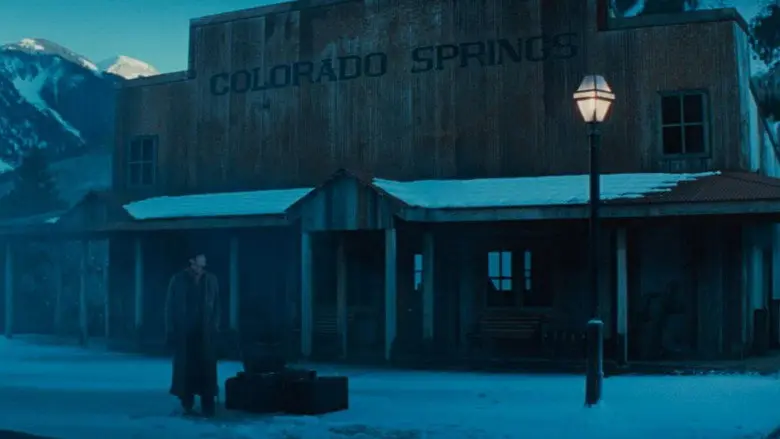
For players, those shifts between candlelit Victorian interiors and wintry industrial exteriors are more reliable than a line of dialogue. The film keeps asking the viewer to look at the arrangement of a scene: who is seen, who is missing, and what has been placed just outside a neat explanation.
The Prestige ending explained: what Borden and Angier each sacrifice
At the end, Borden reveals that “Alfred Borden” has been performed by identical twin brothers who have shared one life, including their act and its consequences. Angier’s transported-man trick has a different mechanism: Tesla’s machine creates a duplicate, and Angier kills one version after every performance so that the surviving version can appear across the stage.
Those are the plot facts. The film’s sting comes from the fact that neither man has found a harmless solution. The Borden brothers give up a stable individual identity to make their illusion possible. Angier makes every performance an act of self-destruction in pursuit of an effect no rival can copy. The final warehouse of water tanks does not merely solve a mystery; it shows how far Angier has turned spectacle into a private system of loss.
The ending also refuses to let technical explanation erase responsibility. Borden’s deception has wounded people close to him, and Angier’s triumph relies on an atrocity repeated in secret. The prestige is impressive because it works. It is devastating because the film makes its price visible at the same moment.
The film’s structure mirrors the stage act without asking the viewer to admire deception for its own sake. It first makes the explanation feel impossible, then offers a mechanism, then returns to the human cost that mechanism has hidden. That final return is why the water tanks are more than a surprise image: they reveal a pattern of choices that was designed to stay offstage.
A rewatch path for the MovieWordle frames
On a rewatch, look for scenes that make a person appear complete while withholding the labour that keeps the appearance intact. Watch entrances and exits, the use of hats and doors, and the way a crowd’s attention can hide an exchange occurring in plain view. The approved frames support that method without giving away the answer: silhouette, duplicated scale, and a solitary arrival all belong to a film where the image is never the whole act.
Conclusion
The clearest The Prestige explained reading is that obsession turns illusion into a demand for total sacrifice. Nolan’s stages, shadows, electric fields, and divided bodies make the reveal feel prepared rather than arbitrary. The final answer matters less as a clever solution than as proof that both men have made a life around hiding its cost.
Keep playing
Ready for another film? Browse the MovieWordle 6 Frames archive and choose a recent puzzle to solve.