
FRAME BY FRAME · ISSUE 13
The Exorcist Visual Analysis
1973 · Drama / Horror · Directed by William Friedkin
Spoilers below, including the ending.
William Friedkin's 1973 The Exorcist is frightening because it treats the supernatural as an intrusion into ordinary rooms, bodies, and routines. Its visual system moves between archaeological dust, suburban interiors, and severe pools of darkness. For MovieWordle players, the strongest clue is often the collision between a familiar domestic image and a frame that makes the familiar feel physically unstable.
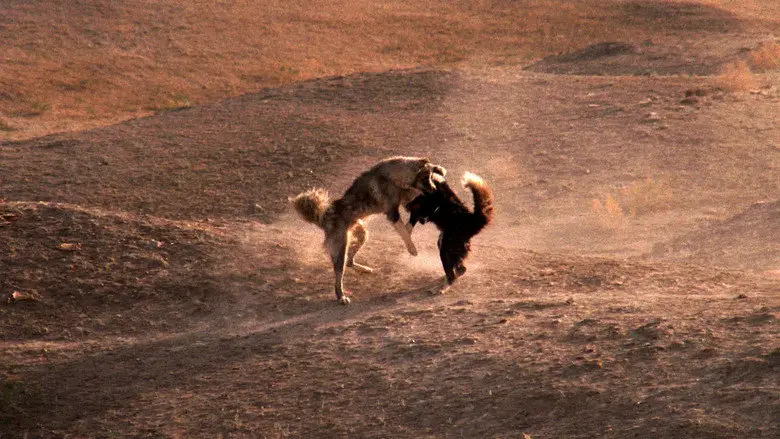
The film begins with disturbance before possession
The approved archaeological frame shows two dogs locked together on a dry, open field. There is no bedroom, crucifix, or green face in sight. That distance matters. The image gives the film a world of heat, dust, and animal violence before the story narrows into a Washington home.
This is a useful recognition cue because The Exorcist does not begin as a sealed haunted-house story. It establishes a material world first, then lets an unseen disturbance cross into it. The dogs form a compact visual sign of conflict, while the empty ground around them makes the disturbance look older and larger than any one character.
The film's horror gains force from that expansion and contraction. A wide landscape can suggest a threat without naming it; a close bedroom frame can make the same threat feel trapped inside a family. The change in scale is part of the film's craft.
Domestic space becomes a pressure chamber
Regan's bedroom is recognizable as a child's room, but the film gradually strips that familiarity of comfort. The approved close-up shows Regan lying on a pillow in very low light. Her face is visible, yet the surrounding space gives no stable sense of safety or distance.
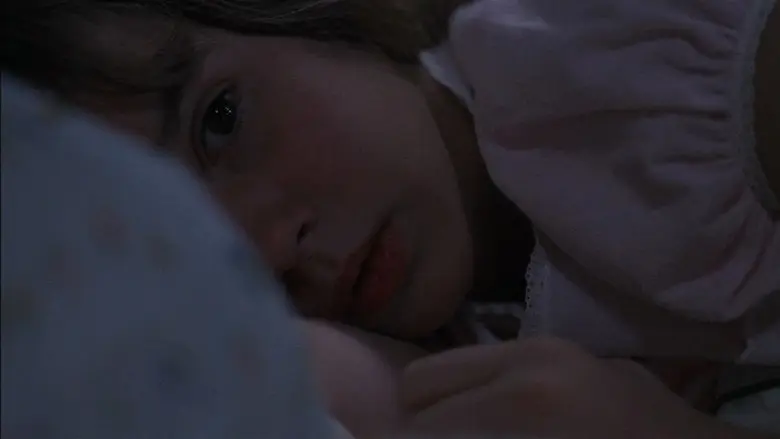
The frame is a strong game clue because the image is intimate rather than spectacular. The viewer is close to a child's face, but closeness does not produce reassurance. It creates a problem of access: Chris is physically near her daughter while losing the ability to understand what is happening to her.
That is why the film's interiors feel increasingly procedural. Doctors, tests, conversations, and religious consultation are all attempts to give the disturbance a name and a boundary. The room remains a domestic space, but its meanings are being contested by medicine, family care, and faith.
The Exorcist ending explained, briefly
Father Merrin dies during the exorcism, and Father Karras confronts the entity after his own crisis of faith. Karras invites the demon to enter him, then throws himself from Regan's window, preventing the possession from continuing in her body. Father Dyer reaches him in the street and offers absolution before Karras dies.
The plot outcome is direct: Regan survives and later appears to have no conscious memory of the violence. The interpretation is less final. Karras's act can be read as a sacrifice that restores a moral choice to a situation built around coercion, while the film's earlier medical and domestic details keep the event from becoming a simple victory parade. The cost is visible in the final street scene.
Why the approved frames help you recognize it
The dog fight and the dark bedroom do different jobs. One opens the frame outward toward ancient, physical conflict; the other closes it around a child and a frightened family. Together they point to a film that makes the supernatural credible by placing it inside ordinary textures and institutions.
That combination is more reliable than looking only for iconic makeup. Dust, low light, a domestic bed, and a serious visual treatment of bodily distress can identify The Exorcist even when the most famous images are absent.
Conclusion
The most useful The Exorcist explained reading is that its horror enters through changes of scale: an open landscape becomes a private room, and a family problem becomes a crisis of body, belief, and responsibility. The film's approved frames preserve that movement without reducing it to a single monster image.
Keep playing
Ready for another film? Browse the MovieWordle 6 Frames archive and choose a recent puzzle to solve.