
FRAME BY FRAME · ISSUE 18
Sweeney Todd: The Demon Barber of Fleet Street Visual Analysis
2007 · Drama / Horror · Directed by Tim Burton
Spoilers below, including the ending.
Tim Burton's 2007 Sweeney Todd explained through its approved frames is a story about revenge becoming a routine. Benjamin Barker returns to London as Sweeney Todd after Judge Turpin destroys his family and takes his place in the barber's chair. Todd wants justice, but the film keeps showing how quickly a personal grievance can become a system that consumes strangers as efficiently as it consumes enemies.
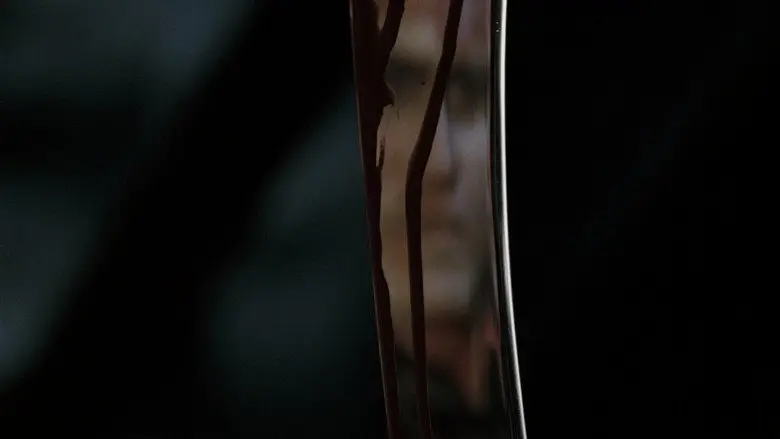
The blade turns revenge into routine
The approved razor frame is almost empty: a hand, a narrow blade, and a line of blood. That economy is the clue. The razor is not presented as a heroic weapon or a mysterious object. It is a tool waiting to be used, and its reflective surface makes the violence look controlled even when the consequences are not.
Todd's barber shop works the same way. A customer sits, a throat is exposed, the chair moves, and the body disappears below the floor. The repeated action gives the murders a grim rhythm. At first Todd believes each killing brings him closer to Turpin; soon the ritual has become larger than its original target.
For MovieWordle players, look for severe close-ups, pale faces, dirty metal, and sudden red. A single razor can identify the film, but the wider pattern is more useful: Sweeney Todd makes ordinary objects feel like parts of a machine.
Ceremony and commerce share the same room
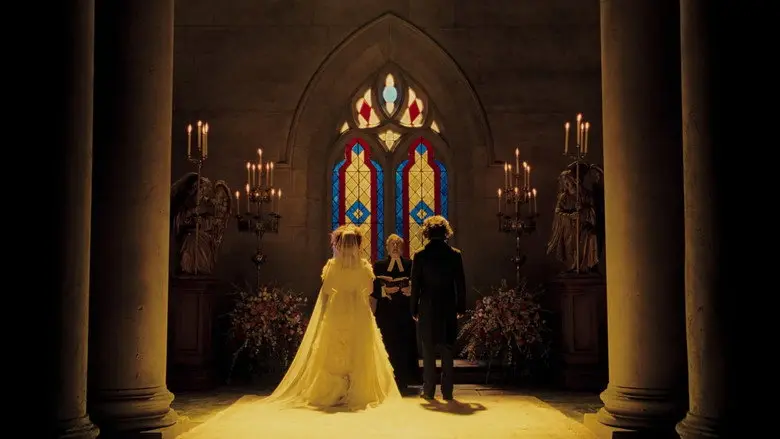
The wedding frame offers a different recognition cue. Warm gold light, stained glass, flowers, and formal clothing create a surface of order. Yet the image places Sweeney and Mrs. Lovett inside a world of ceremonies, contracts, and social power. The film's violence grows from damage respectable people are able to hide.
Judge Turpin uses legal and religious authority to control Lucy and Johanna. Todd responds by turning his own room into a private court, while Mrs. Lovett converts the aftermath into meat pies. The sequence joins marriage, punishment, and business, each becoming a way to possess another person.
The warm church does not mean safety, just as the dark shop is not the only place where cruelty exists. The recognizable palette—soot, blue-gray shadow, candlelight, and sharp red accents—keeps shifting between romance and horror.
The chair is a throne that cannot hold anyone
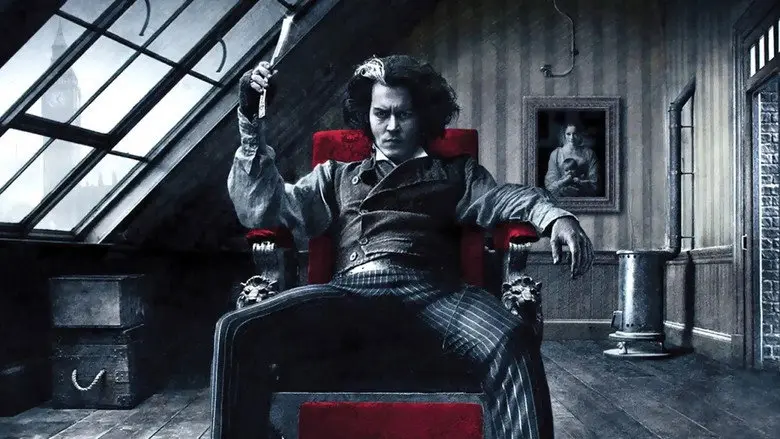
The red chair is the film's most concentrated object. It gives Todd a position of control, but it also fixes him inside the ritual he has built. Customers arrive beneath him, the chair tilts backward, and the hidden chute carries the result away. He appears to rule the room, yet the room has made him repetitive.
This is the film's larger theme: revenge promises to restore a damaged identity, but it can replace that identity with a role. Todd becomes the barber who kills, Mrs. Lovett the baker who needs bodies, and Tobias is pulled into the logic of concealment.
The final revenge completes the pattern
Todd eventually kills Turpin, but the victory arrives too late to restore Lucy or Johanna. He has already killed the beggar woman without recognizing her as Lucy, and Mrs. Lovett's lie about Lucy's fate has helped sustain the entire cycle. When Todd discovers the truth, he throws Lovett into the oven, and Tobias kills Todd.
The plot closes through recognition rather than triumph. Todd reaches the person he wanted to punish, then discovers that his revenge erased the person he wanted to recover. The chair, blade, and bakery turned grief into repetition.
Conclusion
The clearest Sweeney Todd explained reading follows the objects: a razor, a wedding altar, a red chair, and an oven. They belong to different parts of daily life, but the film makes them participate in the same cycle of control. Those cues make the approved frames useful after the game because they point to a visual world where ceremony and violence are never far apart.
Keep playing
Ready for another film? Browse the MovieWordle 6 Frames archive and choose a recent puzzle to solve.