
FRAME BY FRAME · ISSUE 16
Sleepy Hollow Visual Analysis
1999 · Fantasy / Horror / Thriller / Mystery · Directed by Tim Burton
Spoilers below, including the ending.
Tim Burton's 1999 Sleepy Hollow explained through its approved frames is a story about evidence losing its authority. Ichabod Crane arrives with instruments, diagrams, and a faith in rational procedure. Sleepy Hollow answers him with fog, old trees, buried violence, and a Headless Horseman whose supernatural appearance is tied to a very human history. The film's visual identity lies in that collision between investigation and nightmare.
The town makes architecture feel guilty
The first useful clue is not the Horseman but the shape of the town around him. Buildings lean, roofs sharpen the sky, and bare branches make every view look like a witness statement. An approved frame of a stone house tilting toward the clouds turns architecture into a body under pressure. Its windows are small, its roof is irregular, and the gray light gives no comforting sense of time.
That design makes Sleepy Hollow feel closed even when the landscape is open. Ichabod is sent to investigate murders, but the town does not behave like a crime scene that can be stabilized. The houses hold secrets, the woods erase tracks, and the weather makes visibility conditional. For players, the combination of crooked verticals, wet stone, and blue-gray atmosphere is more diagnostic than a generic “gothic” label.
Evidence meets the forest
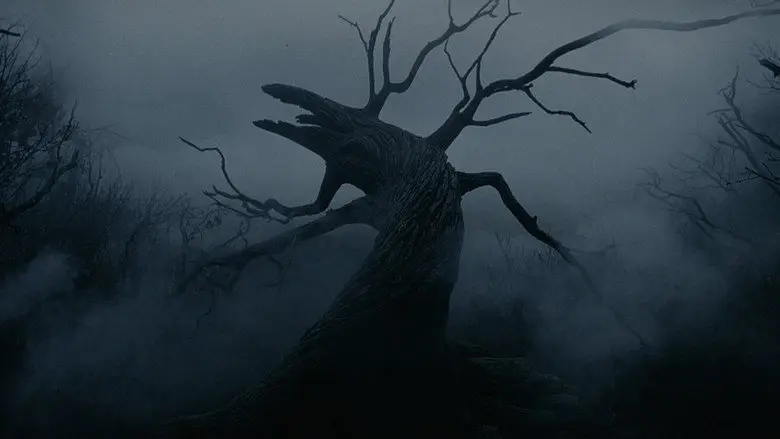
The forest frame gives the film its central spatial problem. A single tree twists upward like a figure trying to escape its own roots, while fog removes the depth behind it. The image is still, but it feels active because the branches point in several directions and the ground offers no clear path.
Ichabod's rational tools are useful in ordinary circumstances: he measures, records, and tests. In this landscape, measurement cannot guarantee safety. The film does not reject evidence altogether; it shows that evidence can be incomplete when the past has been deliberately hidden. A footprint, a wound, or a witness may be accurate and still fail to explain who is controlling the violence.
The approved frame also helps identify the film after a round. Sleepy Hollow is not only a period mystery. Its clues combine a recognizable village, skeletal trees, low visibility, and a palette that keeps daylight close to night. That atmosphere carries as much information as the plot.
Firelight keeps truth partial
An additional approved still shows Katrina Van Tassel beside a fireplace, holding an illustrated book while a candle burns at the edge of the table. The warm interior seems safer than the forest, but the book and candle make knowledge fragile. The page is visible only because a small flame isolates it from the surrounding dark.
This is how the film handles revelation. Characters possess fragments: family histories, old drawings, local rumors, and memories of violence. The images do not assemble into certainty until the final act, and even then the truth is entangled with guilt. Firelight gives the viewer a face and an object, but it does not illuminate the whole room.
Sleepy Hollow explained: who controls the Horseman?
The Headless Horseman is a real supernatural killer within the film, but he is being controlled through the stolen skull by Lady Van Tassel. She uses the Horseman to avenge her mother's death and remove the people who stand between her and power. Katrina's stepmother is therefore both a witch and a human conspirator: the supernatural threat gives her private revenge the scale of legend.
Ichabod and Katrina recover the skull and return it to the Horseman's body. Once the object that binds him is restored, the Horseman takes Lady Van Tassel away and the killings end. The ending does not make rational investigation victorious in a simple sense. Ichabod survives because he learns to connect material evidence with buried history, while Katrina's knowledge of the old world helps him read what instruments alone could not.
Conclusion
The best Sleepy Hollow explained reading follows the film's unstable evidence: a crooked house, a tree hidden in fog, a candlelit page, and a skull that turns vengeance into a visible force. Burton makes the murder mystery recognizable through atmosphere first, then lets the ending show that the most frightening secret was never only the Horseman. It was the person who knew how to point him at the living.
Keep playing
Ready for another film? Browse the MovieWordle 6 Frames archive and choose a recent puzzle to solve.