
FRAME BY FRAME · ISSUE 29
Shutter Island Visual Analysis
2010 · Drama / Thriller / Mystery · Directed by Martin Scorsese
Spoilers below, including the ending.
Martin Scorsese’s 2010 Shutter Island turns a detective investigation into a test of how much a viewer wants an explanation to hold. U.S. Marshal Teddy Daniels arrives at Ashecliffe Hospital to investigate a missing patient, but the island’s weather, locked institutional spaces, and uneasy conversations make every apparent clue feel provisional. This Shutter Island explained guide follows the film’s unstable point of view before addressing what the lighthouse revelation and final exchange mean.
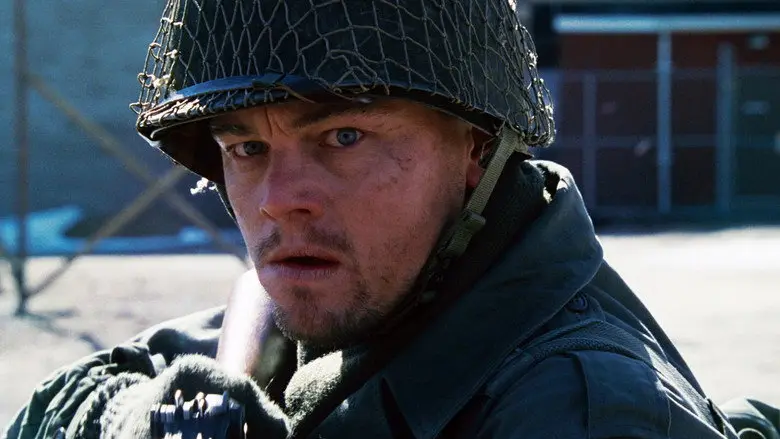
The investigation gives the viewer a role before it gives us the truth
Teddy’s status as a marshal supplies an immediate grammar for the film. He has a case, a partner, questions, and a location that appears to be withholding evidence. The island hospital amplifies that grammar with wardens, doctors, files, gates, and rooms that look built to keep people from reaching one another. The film encourages the audience to treat suspicion as competence.
The approved close view of Teddy captures that starting point. He is dressed for work, alert, and framed as someone looking outward for danger. What the image cannot settle is whether the role he occupies is a secure fact or part of the story he needs to inhabit. Shutter Island keeps that uncertainty alive by making the detective frame persuasive long before it makes it reliable.
The island looks like a place that contains too much
The lighthouse shot makes the film’s geography feel compact and theatrical: a dark island mass, surrounding water, a single light burning at its top. It is a potent MovieWordle clue because it condenses the film’s atmosphere without explaining the plot. The visible elements are simple—rock, sea, sky, building, light—but their separation makes the place feel isolated and guarded.
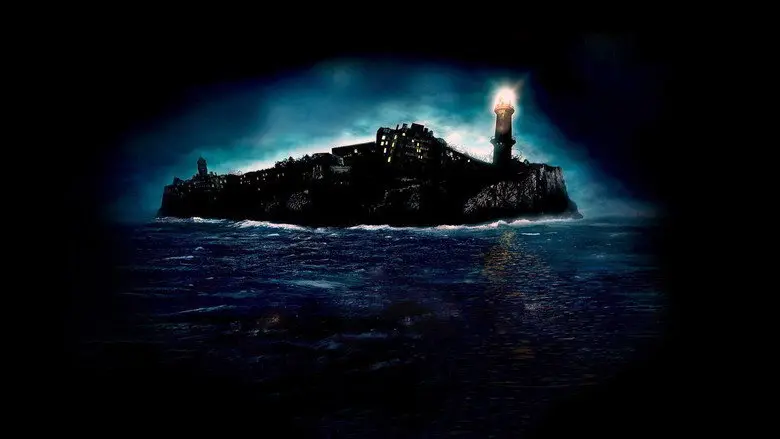
Scorsese repeatedly uses the island’s boundaries to make ordinary inquiry feel claustrophobic. Boats arrive through rough water; storms disrupt movement; rooms have restricted access. This does not prove one theory by itself. It makes the audience experience the conditions under which Teddy’s theories become increasingly attractive: if the world is sealed, every gap can start to look like a conspiracy.
The film’s visual cues switch between intimacy and alarm
For players, look for a saturated, period-thriller surface made unstable by sudden dream images and crowded institutional interiors. An elegant room filled with lamps, rugs, and furniture can shift into a scene of dread because the composition leaves Teddy small or stranded within it. A close face can appear ordinary until the edit connects it to a memory that does not behave like evidence.
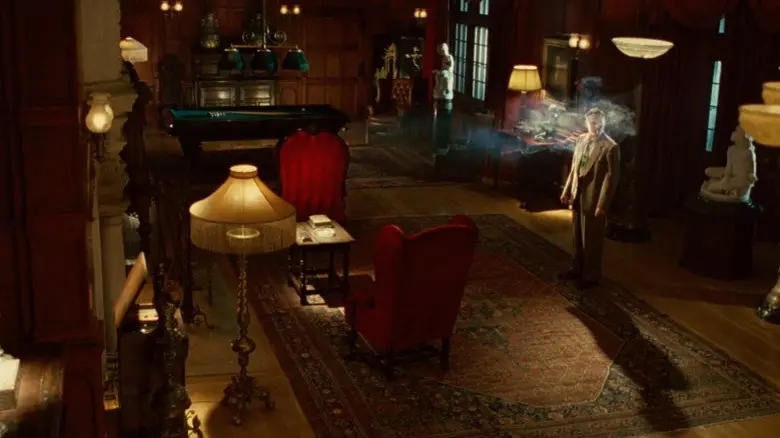
That movement between scale is the film’s most useful visual system. The investigation makes Teddy scan a room for clues; the dream material makes the room answer with images he cannot place. On rewatch, it is worth noticing when the film gives him clear sightlines and when smoke, rain, fire, or framing interrupts them.
Shutter Island explained: what the lighthouse reveals
At the lighthouse, Dr. Cawley tells Teddy that he is Andrew Laeddis, a patient at Ashecliffe, and that the marshal investigation has been an elaborate therapeutic role-play. According to Cawley, Andrew killed his wife, Dolores, after she drowned their children; the constructed case has allowed doctors to see whether he can face that reality rather than retreating into the Teddy Daniels identity.
The revelation reorganizes details the viewer has already seen. Teddy’s name, the missing-patient case, his wartime memories, and the island’s secrecy can be read as parts of a story Andrew has assembled to avoid grief and guilt. The film does not ask us to treat the hospital as uncomplicatedly benevolent—the methods are invasive, and the stakes are grave—but it gives the lighthouse scene a coherent account of the investigation’s contradictions.
The final line is a choice, not a second twist
After the apparent breakthrough, Andrew speaks lucidly with Dr. Sheehan. The next morning, though, he calls Sheehan “Chuck” and returns to the marshal story. The important question in the final exchange is whether this is a relapse or a decision. Andrew asks whether it is worse “to live as a monster, or to die as a good man,” then walks toward the procedure that Cawley had warned would follow another failure.
The film does not provide an objective confirmation of Andrew’s inner state at that instant. But the line supports the interpretation that he understands the truth and chooses the identity of Teddy, and the consequences attached to it, rather than continuing to live with what he has done. That ambiguity is emotionally focused, not a clue that erases the lighthouse revelation.
There is a useful distinction on rewatch. The earlier scenes ask whether Teddy can expose a hidden system; the last scene asks whether Andrew can endure knowledge of himself. Those are not the same mystery. The film’s alarm signals—missing files, guarded patients, restricted rooms, evasive answers—remain dramatically effective even after the reveal, because they describe the pressure of a mind arranging evidence around its own blind spot.
This is also why the island does not become merely a false setting once the case is reframed. Ashecliffe is still a locked institution with authority over Andrew’s body and future. The film lets the viewer feel both the relief of a coherent explanation and the dread attached to the treatment awaiting him. Cawley’s account organizes the plot; it does not make the moral discomfort disappear.
Conclusion
The strongest Shutter Island explained reading holds two things together: the lighthouse makes Andrew Laeddis’s history the film’s organizing explanation, while the final line keeps his last choice open to interpretation. The helmeted marshal, the isolated lighthouse, and the crowded rooms are more than mood. They show how a detective story can become a shelter from a truth its protagonist cannot bear to name.
Keep playing
Ready for another film? Browse the MovieWordle 6 Frames archive and choose a recent puzzle to solve.