
FRAME BY FRAME · ISSUE 5
Saw Visual Analysis
2004 · Horror / Crime / Mystery · Directed by James Wan
Spoilers below, including the final reveal.
James Wan’s 2004 Saw turns confinement into a visual system. Its central bathroom is not only a place where two men are trapped; it is a room arranged around rules, objects, and restricted movement. The viewer is asked to inspect the floor, the pipes, the doors, and the distance between bodies because the space keeps promising that one overlooked detail may matter.
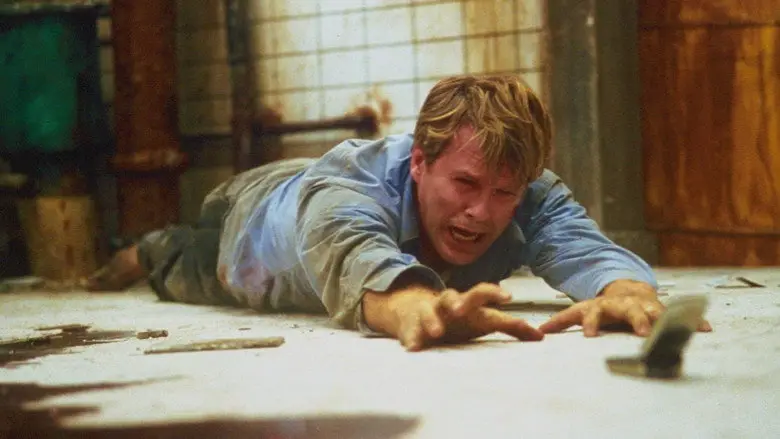
That is the useful connection between the approved MovieWordle frames. A man crawling across the bathroom floor, a seated figure beside the toilet, and two bodies facing each other in cold blue light are not three separate symbols. They show how Saw makes a dirty, limited room carry the pressure of a much larger moral argument.
The bathroom makes movement meaningful
The room is frightening because it is small enough to understand. The walls, tiles, pipes, and fixtures give the viewer a rough map, but that map never becomes freedom. Every attempt to move is measured against a body, a chain, a locked door, or an object that may be part of the test.
The crawling frame makes that geometry immediate. The man is low to the floor, surrounded by hard surfaces and limited routes. The image does not need to show the entire mechanism of the trap. It makes the body’s position feel like a problem the room has already designed.
This is why the film’s setting stays memorable after its shocks. The bathroom is not a neutral container for violence. It is a machine for turning small decisions into visible consequences.
Objects become rules before they become clues
Saw repeatedly asks the audience to look at ordinary objects with suspicion. A toilet, a tape, a light switch, or a length of metal can be either background or instruction. The film delays the difference. That delay gives the room its nervous texture: the viewer is always scanning for a function that has not yet been explained.
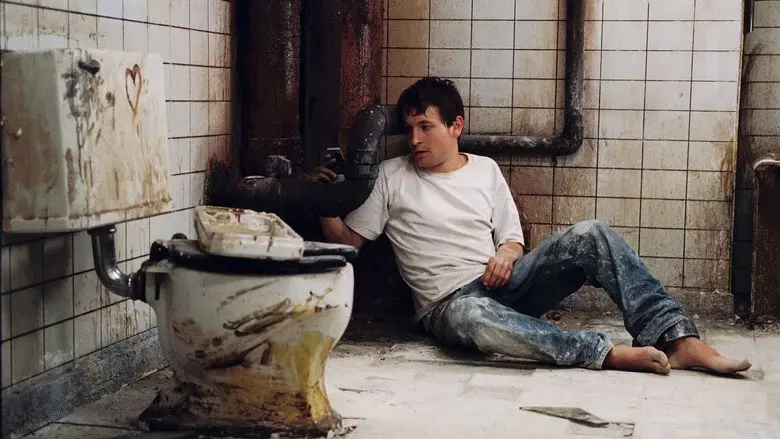
The seated-bathroom frame is useful precisely because it is not a clean hero image. The tiles are stained, the fixtures are close, and the character looks reduced by the room’s scale. A player can recognize the film through that combination of industrial grime, harsh overhead light, and bodies forced into uncomfortable proximity.
Cold light keeps the moral argument physical
The film’s blue-green bathroom light creates a hard, unhealthy atmosphere, but its deeper function is practical. It separates faces from the background without making the room feel open. Metal glints, skin looks drained, and the limited palette keeps attention on bodies that cannot get away from one another.
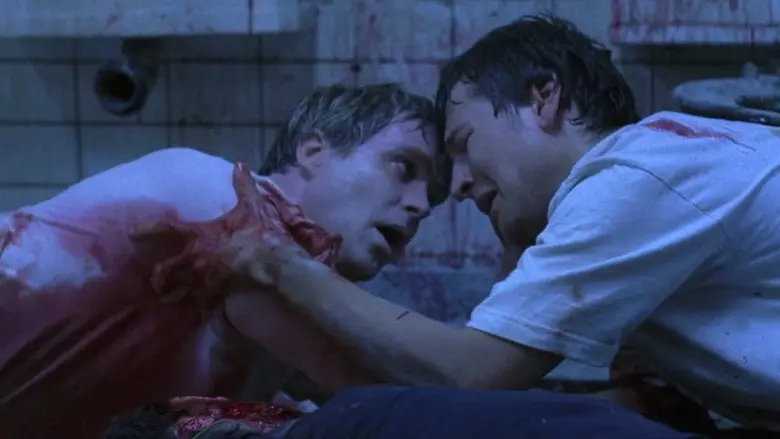
The confrontation frame turns moral conflict into blocking. The men share the same physical danger, yet their positions imply competing accounts of what should happen next. For a guessing round, look for tiled enclosure, sickly blue light, improvised machinery, and people arranged as if the room has assigned them roles.
Saw ending explained: who was in the room the whole time
The figure lying motionless on the bathroom floor is John Kramer, the man revealed as Jigsaw. The film has allowed him to function as part of the room’s background while Adam and Lawrence search for an escape. That is the plot reveal. Its visual force comes from the way the bathroom has trained everyone, including the audience, to separate “person” from “object” too quickly.
The still body had been present for the entire ordeal, but the camera and the characters treated it as inert. When Kramer rises and leaves, the bathroom’s stillness becomes retrospectively active: what looked fixed had been watching, waiting, and controlling the pace of discovery. The ending does not abandon the film’s visual rules; it applies them to the viewer’s own attention. What looked inert was never outside the game, and the room’s objects were never merely background.
The reveal also changes the scale of the story. The bathroom is no longer only a trap built for the two men in it; it is a stage on which an unseen author has been testing what they notice. That does not make every earlier object a coded message, but it makes the room’s visual indifference feel deliberate. The final movement out of the bathroom leaves the rules unresolved, which is why the image stays unsettling after the explanation arrives.
Conclusion
Saw is memorable because it makes confinement legible. Its bathroom, objects, blue light, and compressed blocking turn a simple room into a system of tests. The approved MovieWordle frames carry that identity without reproducing the film’s most graphic moments: each one shows a body negotiating a space that has already decided the terms.
Keep playing
Ready for another film? Browse the MovieWordle 6 Frames archive and choose a recent puzzle to solve.