
FRAME BY FRAME · ISSUE 14
Psycho Visual Analysis
1960 · Horror / Thriller / Mystery · Directed by Alfred Hitchcock
Spoilers below, including the ending.
Alfred Hitchcock's 1960 Psycho is a film of surfaces that keep changing their meaning. A motel room can look plain, a hand can look harmless, and a newspaper can seem like background detail; then editing and context turn each object into evidence. For MovieWordle players, the strongest recognition cues are the black-and-white textures and the way ordinary domestic items become part of a system of concealment.
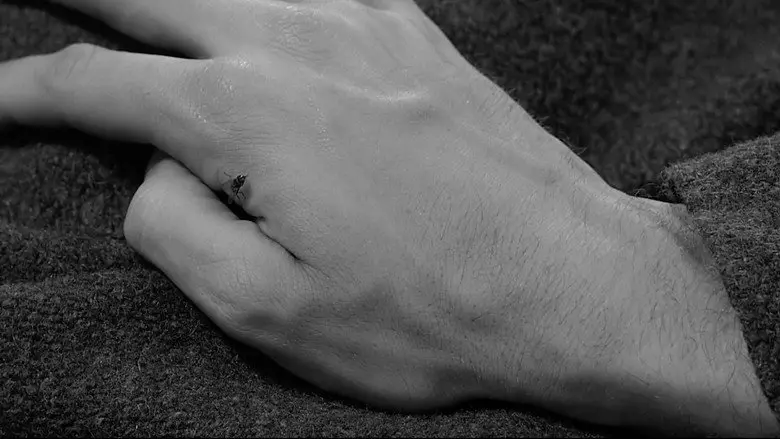
Black-and-white detail makes the ordinary suspicious
The approved hand frame is almost abstract. Skin, carpet, and a small dark mark fill the image, with no wide setting to explain the moment. That close distance is characteristic of Psycho: the film repeatedly makes the viewer inspect a fragment before understanding the larger event.
The monochrome image also keeps the hand from reading as a decorative character detail. It is a physical object, a possible trace, and a reminder that the body can become evidence. The film's famous shocks work partly because they arrive through simple materials—water, metal, fabric, paper, and skin—rather than through a permanently heightened fantasy world.
For the game, look for high-contrast black and white, severe close-ups, and spaces that feel functional rather than ornate. A frame that treats a hand, a doorway, or a shower curtain as a problem to be studied is more likely to belong to Psycho than to a conventional mystery.
The motel is a place of observation and concealment
Marion Crane arrives at the Bates Motel after taking money from her employer and leaving Phoenix. The plot gives the motel a practical purpose: it is a place to stop. Hitchcock makes it visually unstable by dividing attention between the rooms, the office, the house on the hill, and Norman Bates's habit of watching from behind walls and windows.
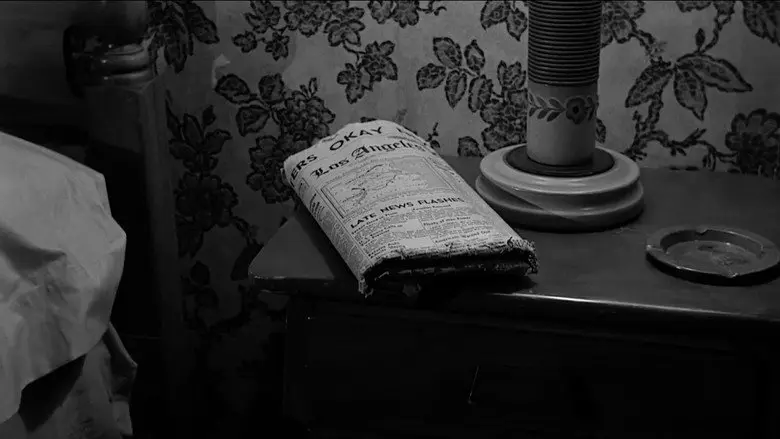
The newspaper frame shows how much information the film can hide in a still life. A folded paper sits beside a lamp and ashtray, surrounded by floral wallpaper. The objects suggest routine, but they also imply a world of records, money, and private reading. In Psycho, concealment is not limited to a secret room. It is built into what people choose to display and what they keep out of view.
That is why the motel remains such a useful recognition setting. It is open to travelers, yet its rooms encourage isolation. Its plainness is not neutral; it gives the film a surface behind which identity can be rearranged.
Psycho ending explained, briefly
The final explanation reveals that Norman's “mother” is a personality he has adopted, and that Norman himself committed the murders while acting as her. The woman seen in the house is not a living accomplice. After Norman is arrested, a psychiatrist describes the split, while the film returns to Norman's stillness and the voice he hears as Mother.
The plot answer is therefore clear, but the film does not turn the explanation into a tidy moral reset. The final voice-over gives viewers a framework for the crimes while the image of Norman sitting motionless keeps the human body and the constructed persona uncomfortably close. The secret is explained; the unease remains.
Why these objects are useful after the game
The hand and the newspaper do not reproduce the film's most famous image, but they preserve its method. One isolates the body as a clue. The other makes an ordinary room feel watched and informationally dense. Together they point toward Hitchcock's larger strategy: suspense grows when the viewer knows that a harmless surface may already contain the next piece of the crime.
Conclusion
The most useful Psycho explained reading begins with attention to objects. Black-and-white contrast, close framing, the motel's plain rooms, a hand, and a folded newspaper all train the viewer to distrust surfaces. The approved MovieWordle frames are strong because they make that visual method recognizable without giving away every reveal.
Keep playing
Ready for another film? Browse the MovieWordle 6 Frames archive and choose a recent puzzle to solve.