
FRAME BY FRAME · ISSUE 19
Poltergeist Visual Analysis
1982 · Horror · Directed by Tobe Hooper
Spoilers below, including the ending.
The central idea in Poltergeist explained is simple: the safest-looking room in a suburban house can become a doorway. Tobe Hooper's 1982 film begins with the Freeling family in a bright California home, where Carol Anne's conversations with the television seem strange before the house itself starts to move, pull, and swallow. The approved frames make that reversal visible through bedrooms, screens, and objects that should have stayed still.
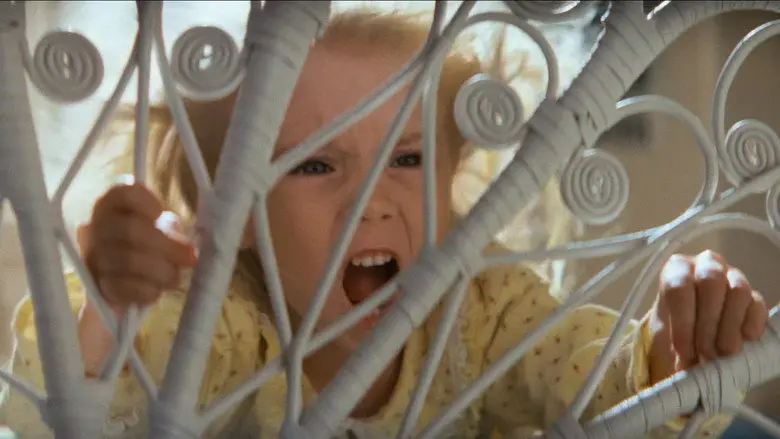
The family home turns against its own comfort
The child-bedroom frame contains the film's central contradiction. Carol Anne is surrounded by a white bed, soft fabric, and a familiar room, but the bed frame has become a barrier. Her hands grip the metal while her face remains caught in an ordinary childhood space.
The Freelings are not exploring a haunted castle; they are watching television and moving through a home designed to feel interchangeable with its neighbors. The supernatural threat is effective because it enters through ordinary routines. A chair slides, a tree attacks through the window, and the bedroom becomes a space that no longer protects the child inside it.
For MovieWordle players, the useful cues are the contrast between suburban daylight and sudden blue-white light, domestic furniture used as a trap, and a family group forced to look at the same room differently. Poltergeist is recognizable when comfort remains visible even after it has stopped being reliable.
The television is a threshold, not just a prop

The television frame turns a living-room appliance into a visual opening. Its screen shapes the room while surrounding space falls into shadow. The set does not merely show another place; it seems to connect the family to something that can answer back.
Carol Anne's phrase, “They're here,” gives the screen a second function. It is a source of entertainment and a surface through which the dead can appear. The film does not need to explain every rule of the other side for the image to work. The television is already familiar, so its transformation feels immediate.
The house's disturbances follow the same pattern. Walls, doors, pools, closets, and ceilings become active surfaces. The haunting is less about one ghost than about the loss of a stable boundary between rooms, bodies, and images.
The clown makes the threat personal
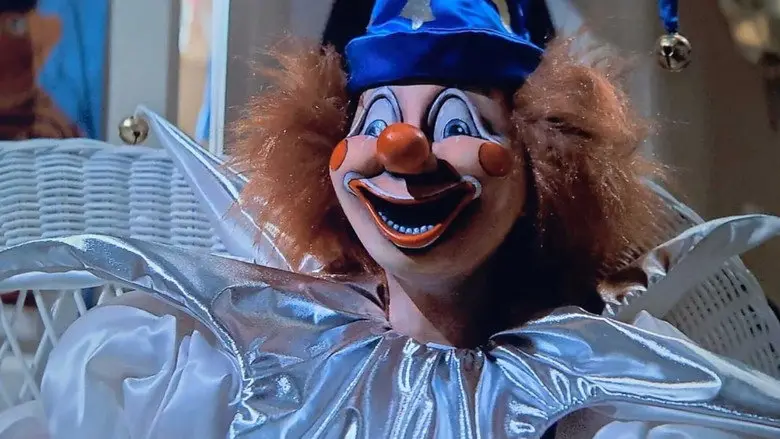
The clown frame identifies another part of the film's method: it gives the supernatural a childish shape before turning that shape into danger. The toy is colorful, smiling, and visibly artificial. Its fixed expression makes it difficult to read as a person, yet the bedroom places it inside a child's emotional world.
The clown is more than a jump-scare object. It shows how the house can weaponize the things that are supposed to comfort a child. The same logic applies to the television and bed: familiar objects become threats when their function is reversed.
The ending closes the house, not the idea
The Freelings rescue Carol Anne from the other side, but the house is destroyed when the ground beneath it gives way. The film connects the haunting to a cemetery that was moved without moving the bodies, turning the suburban development into a place built over disturbed remains. The family escapes to a motel, where even the television is kept outside their room.
The ending provides a plot solution without restoring complete trust. The house is gone, but the family has learned that ordinary spaces can conceal histories hidden beneath the surface. That is the lasting recognition cue of Poltergeist: the supernatural arrives through the domestic world because the domestic world was never as secure as it looked.
Conclusion
The strongest Poltergeist explained reading follows the film's reversals. A bed becomes a cage, a television becomes a threshold, and a clown becomes a threat. The approved frames work because they preserve that visual argument: horror is not somewhere far away. It is waiting inside the room the family thought it knew.
Keep playing
Ready for another film? Browse the MovieWordle 6 Frames archive and choose a recent puzzle to solve.