
FRAME BY FRAME · ISSUE 11
Misery Visual Analysis
1990 · Drama / Thriller · Directed by Rob Reiner
Spoilers below, including the ending.
Rob Reiner's 1990 Misery turns a recovery room into a place where care, reading, and control cannot be separated. Paul Sheldon is injured and dependent; Annie Wilkes appears to provide the help that keeps him alive, then makes that dependence the condition of his captivity. This Misery ending explained guide follows the film's domestic objects and approved MovieWordle frames rather than treating the room as mere background.

Care is presented as a system of control
The frame of red capsules beside a partly eaten meal is small, but it gives the film's power structure a physical form. Food, medicine, and routine are all necessary to Paul after the crash. In Annie's house, they are also things she can distribute, withhold, and explain on her own terms.
That is why the setting remains tense even when no one is moving. Lace, cutlery, a plate, and a prescribed dose belong to domestic care. The film makes those objects uncomfortable because Paul cannot treat them as neutral. Every ordinary gesture carries the question of who decides what happens next.
The novel makes the room a workplace as well as a prison
An approved frame shows a man reading a copy of Misery. The visible book matters because Annie's attachment to Paul's fictional world is not casual fandom. It gives her a claim over the writer, the character, and eventually the work he is required to produce.
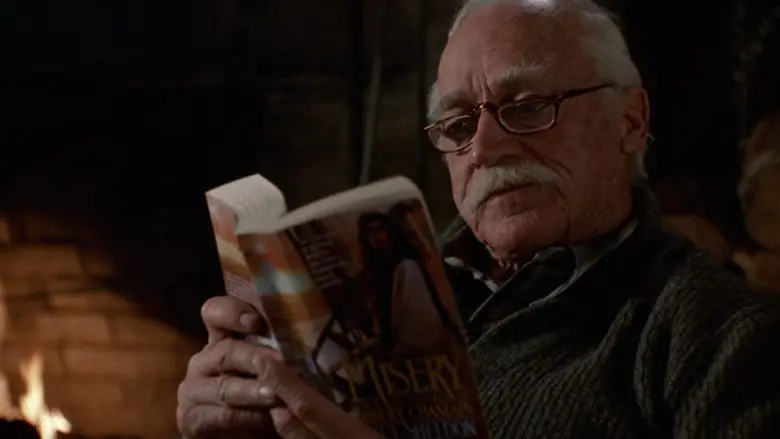
The writer's room is therefore not only a hiding place or a sickroom. It becomes a pressured workplace. Paul must write under surveillance, and the act of writing becomes part of his strategy for staying alive. For MovieWordle players, the book image, the controlled domestic detail, and the wintery isolation behind the room are more useful together than any single plot point.
The bedroom is full of objects that deny freedom
The third frame widens the room: a woman lies in bed among quilts, framed photographs, a lamp, records, and a large soft-drink cup. The image is crowded with signs of comfort, but the arrangement feels less restful than possessive. It is a home made so specific that an outsider has little room to move inside it.
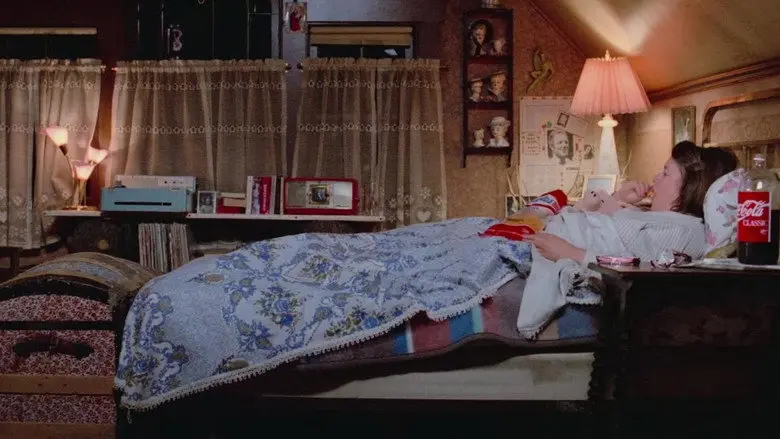
That contrast gives Misery its particular visual pressure. The danger is not an empty gothic house; it is a lived-in domestic space where every object already belongs to someone else. The room's warmth and clutter make Paul's confinement more immediate, because he is not simply locked away. He is absorbed into a private system that insists it is taking care of him.
Misery ending explained: survival does not erase the room
Near the end, Paul hides a weapon and fights Annie when she returns for the completed manuscript. He kills her, is rescued, and later appears in public after finishing another book. Those are the plot facts. The final unease comes from the fact that recovery does not work like a reset. Paul has escaped the house, but the strain of writing and being watched has become part of how he sees the world.
The ending gives him survival, not an uncomplicated restoration of authorship. That is consistent with the film's domestic imagery: medicine, meals, a manuscript, and a bed have all become tools in someone else's story before Paul can use them again as his own.
Conclusion
The most useful Misery ending explained reading is that Annie's control works by turning care into a claim of ownership. The pills, paperback, and crowded bedroom make that claim visible long before the final confrontation. They also make the film a fair puzzle: its horror has the unmistakable texture of a private room that has become a prison.
Keep playing
Ready for another film? Browse the MovieWordle 6 Frames archive and choose a recent puzzle to solve.