
FRAME BY FRAME · ISSUE 22
Memento Visual Analysis
2000 · Thriller / Mystery · Directed by Christopher Nolan
Spoilers below, including the ending.
Christopher Nolan’s 2000 Memento makes memory feel less like a private archive than a fragile set of instructions. Leonard Shelby cannot make new lasting memories, so he depends on tattoos, Polaroids, notes, and habits to direct the next version of himself. This Memento explained guide uses the approved MovieWordle frames to follow that system before the ending shows how Leonard can deliberately turn an uncertain clue into a future command.
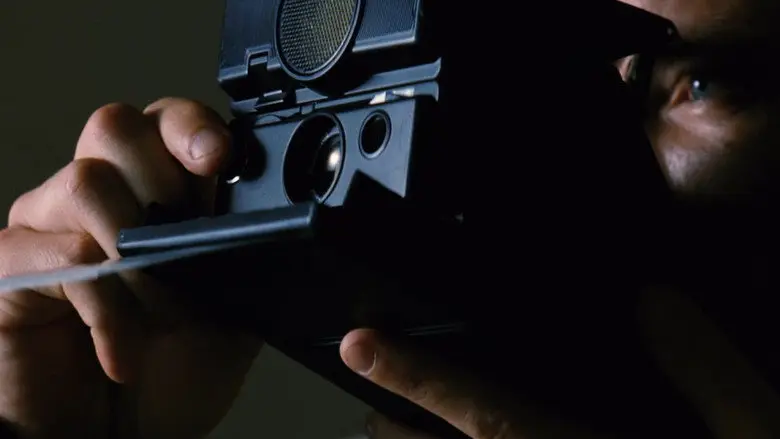
Memento makes evidence a physical object
The first thing to notice is how often the film asks Leonard to handle an object before he can understand a person. He photographs a room, reads writing on his body, checks a note, or studies a name. Those acts are not background detective business. They are the replacement structure for a memory he cannot trust himself to keep.
The approved Polaroid frame captures that pressure without exposing the ending. A camera held close to Leonard’s face makes the act of recording look urgent and improvised. The resulting picture will seem solid, but it cannot tell him why he chose the moment or what has happened just outside its edges.
A tattoo is durable, not automatically true
An approved close-up of writing on Leonard’s wrist makes the film’s visual logic plain. A tattoo cannot be mislaid, and it is harder to alter than a scrap of paper. Yet it still depends on a decision made by an earlier Leonard. The body becomes a ledger, but not an impartial one.
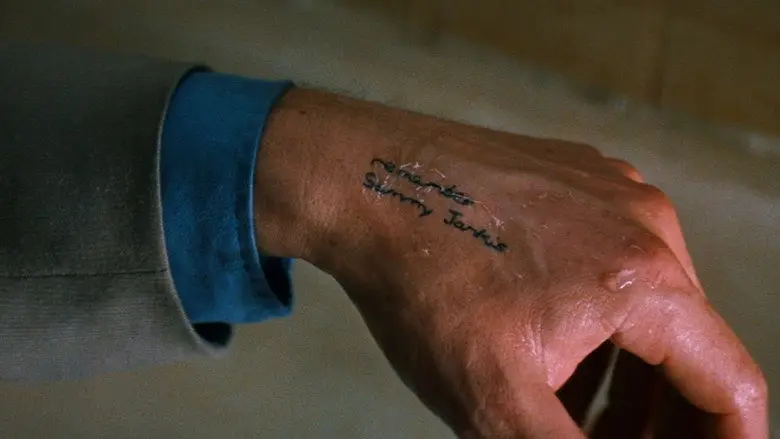
That distinction is what makes the film more than a backwards puzzle. Memento does not say that every record is useless. Leonard’s system lets him act. It asks whether an instruction can remain accountable once the person who wrote it has lost the context for doing so.
This is also why the film resists a simple divide between memory and proof. Leonard’s notes are often useful, and other characters can lie. But the record has a special authority because it looks like Leonard speaking to himself. When he obeys it, he is not merely trusting a stranger; he is trusting an earlier self whose motives have become inaccessible. The tension is personal before it is procedural.
Faces, rooms, and photographs never arrive with enough context
The approved frame of Teddy standing in a damaged room is a useful recognition cue because it gives the viewer a face without a settled role. A man can be close, helpful, threatening, or all three depending on which portion of Leonard’s story is available. The film’s fractured chronology makes that uncertainty a viewing experience rather than a simple plot complication.
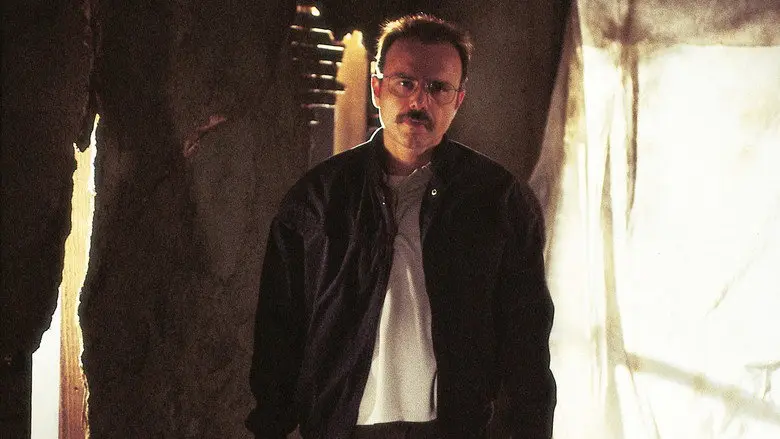
For MovieWordle players, the pattern is specific: cramped motel and house interiors, flash photography, notes that must be read, and faces placed against bright windows or deep shadow. The images identify a thriller in which evidence is always visible but never self-explanatory.
Memento ending explained: Leonard writes a future target
At the end, Teddy tells Leonard that the man responsible for the attack has already been found and killed, and that Leonard’s continuing pursuit has been redirected toward new targets. Leonard cannot preserve that disclosure in the usual way. Instead, he chooses to write information that will lead his future self to Teddy.
The crucial fact is not that Teddy becomes unquestionably reliable. The film does not give the viewer a fully secure authority who can settle every earlier claim. What it shows is Leonard deciding to create an evidentiary trail that his later self will treat as a discovery. He turns uncertainty into purpose by making a clue he will be unable to remember planting.
The final choice is therefore both an act of agency and a trap. Leonard has a method for continuing, but it can no longer guarantee that the mission it produces is just. The film’s reverse construction lets the viewer feel the seduction of certainty at the same time it shows the cost of manufacturing it.
Natalie and Teddy matter to this ending because both are filtered through that unstable method. Each can supply information, redirect Leonard, or claim a role in his story, but no conversation stays available to him in full. The article therefore does not need to settle who is “really” right in every disputed moment. The sharper problem is that Leonard’s system gives temporary statements the force of permanent instructions.
The film’s form keeps that problem active rather than explaining it away. One strand moves backward, another moves forward, and the audience repeatedly has to revise an earlier impression after learning what preceded it. That revision is not a game played at the viewer’s expense. It makes the audience share Leonard’s dependency on partial evidence, while preserving enough distance to see how urgently he wants that evidence to settle into a story.
The result is a thriller that treats checking as an emotional act. Leonard checks a photo because he needs a reason to proceed; he checks a tattoo because he needs to believe he has already made the difficult decision. Each ritual gives him momentum. The ending makes that momentum troubling by showing that he can create the instruction that will later feel like an unavoidable fact.
How to replay Memento after the reveal
On a rewatch, separate three questions whenever Leonard reads a record: what does it say, when was it made, and who benefits if he follows it? The approved Polaroid, tattoo, and uncertain face support that approach without functioning as a spoiler gallery. They show why the film’s clues have such a particular texture: records look stable because Leonard needs them to, not because they can explain themselves.
Conclusion
The strongest Memento explained reading is that memory aids can preserve a fact while losing the responsibility attached to it. Nolan builds the film from photographs, ink, and incomplete faces, then lets Leonard use those materials to give himself a future he cannot question. The ending is unsettling because the record looks like proof precisely when it has become a choice.
Keep playing
Ready for another film? Browse the MovieWordle 6 Frames archive and choose a recent puzzle to solve.