
FRAME BY FRAME · ISSUE 27
Martyrs Visual Analysis
2008 · Drama / Horror / Thriller · Directed by Pascal Laugier
Content note: this article discusses the film’s violence and ending without graphic detail. Spoilers below.
Pascal Laugier’s 2008 Martyrs is built from images that do not settle into one stable genre. It begins with a damaged survivor and the aftermath of violence, then moves through domestic spaces, institutional control, and finally a question about what suffering might reveal. This Martyrs ending explained guide stays with the film’s visible shifts in light, scale, and point of view rather than treating its extremity as a shortcut to significance.
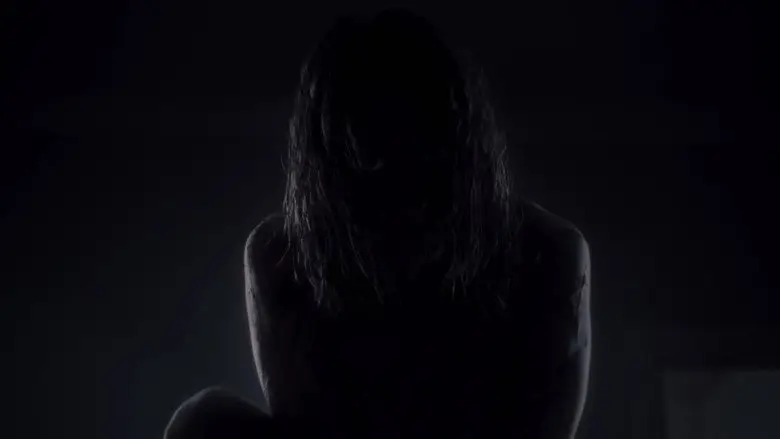
The film makes certainty feel dangerous
The early movement of Martyrs gives the viewer a forceful reason to follow Lucie’s certainty. She carries an unhealed past into an apparently ordinary house, and the film’s first turn makes that certainty seem briefly vindicated. But the story does not let that answer stabilize the world. Each subsequent discovery changes what the house, the people inside it, and Lucie’s memories can mean.
That instability is central to the film’s theme-led structure. Martyrs is interested in the urge to turn pain into a proof: a private explanation, a moral justification, or a system that promises access to hidden knowledge. It keeps asking what happens when people with power decide that another person’s suffering can serve their need for an answer.
The selected dark-room frame is useful because it describes a body isolated by the image, not an abstract claim about darkness. The figure is visible only in partial silhouette, with the room offering little context. Across the film, that withholding becomes a recognition cue as well as a moral pressure: characters are repeatedly seen without being allowed safety, privacy, or an equal point of view.
Domestic space becomes an apparatus
The house does not remain a familiar refuge. Rooms and corridors become places where information is withheld, doors divide who can see whom, and apparently normal objects acquire a threatening charge. The film’s visual strategy is less about decorating a gothic location than about making ordinary interiors feel governed by rules the viewer has not yet been told.
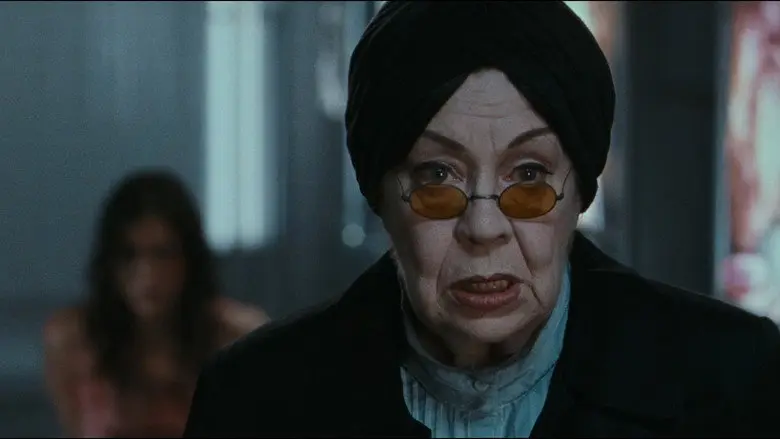
The image of Mademoiselle is a particularly sharp MovieWordle clue. Her dark clothes, amber-tinted glasses, and controlled expression create a visual contrast with the raw, unstable images around her. What is visible is composure. In the film’s wider system, that composure marks the difference between people subjected to the institution and the person who speaks for it.
This is why the film’s later ideas cannot be separated from its spaces. The group behind the violence does not present itself as chaotic; it organizes, records, and rationalizes. The horror lies partly in that administrative calm. A room can look tidy while its purpose is indefensible.
Recognition cues: glare, grain, and divided faces
For MovieWordle players, Martyrs has an unusually fractured visual surface. One approved frame resembles damaged or low-resolution footage; another places two distressed faces against black; a third uses a harsh round glare in an almost empty dark field. These are not interchangeable horror images. Together they point to a film that shifts from subjective disturbance to controlled confinement, often refusing a comfortable amount of visual information.
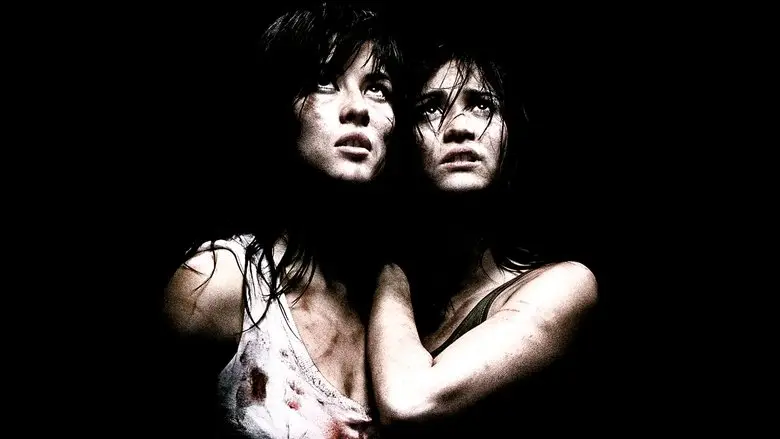
The paired-face image supports the article’s central concern without requiring a frame-by-frame tour. Both faces are visible, pressed close together, while the black surrounding them removes any ordinary setting. The film repeatedly turns looking into a problem: who is seen, who is believed, and who is made to bear the meaning that someone else wants to extract.
Martyrs ending explained: the film refuses to turn testimony into proof
In the final movement, Anna survives the group’s ordeal long enough for Mademoiselle to ask what she has seen. Anna whispers an answer. The film does not share those words with the audience. Mademoiselle then withdraws, tells her associates to keep doubting, and kills herself before the police arrive.
The plot fact is deliberately spare: Anna says something; Mademoiselle reacts; the content remains withheld. The interpretation is less certain. Mademoiselle may take Anna’s words as confirmation, despair, a challenge, or something impossible to use. What the film does not allow is the institution’s preferred outcome: a clean piece of knowledge that can justify the harm done in its name.
That withholding matters because the organization has spent the film trying to make suffering yield an answer. The ending turns the final witness into the only person who knows what she said, then denies the viewers and the group a stable translation. The question survives; the apparatus built to answer it does not receive a usable conclusion.
Conclusion
The best Martyrs ending explained approach separates what the film shows from what it leaves open. Anna speaks; Mademoiselle hears her; the audience does not receive a final doctrine. Laugier’s images make the absence of certainty feel deliberate: a dark room, a composed authority figure, and two faces cut loose from a setting all return us to the question of who is allowed to turn another person’s experience into meaning.
Keep playing
Ready for another film? Browse the MovieWordle 6 Frames archive and choose a recent puzzle to solve.