
FRAME BY FRAME · ISSUE 28
Inception Visual Analysis
2010 · Adventure / Action / Science Fiction · Directed by Christopher Nolan
This guide stays mostly spoiler-light; a brief ending note is clearly marked.
Christopher Nolan’s 2010 Inception is easy to recognize before anyone explains its rules. A maze appears like an illuminated circuit. A city street becomes a corridor for a motorcycle chase. A room tilts until the floor becomes a wall. These are not isolated spectacles. They establish a visual grammar in which an idea can alter the space around it, while the people inside that space must continue to move as if its rules still apply.
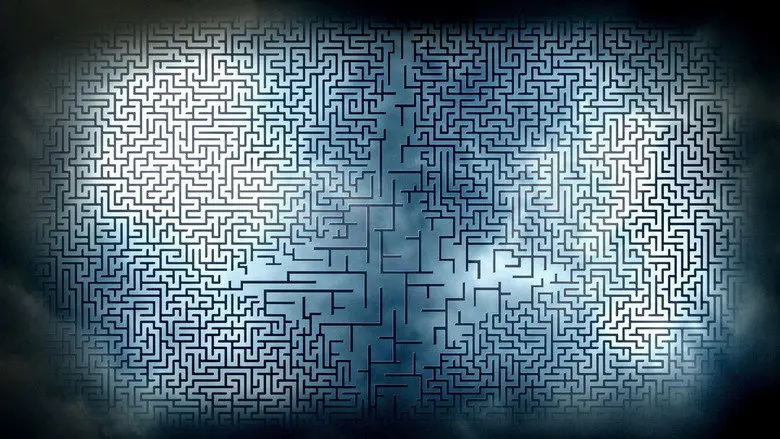
A dream in Inception has to be designed, not merely imagined
The maze image is a concise route into the film’s basic tension. Its bright lines form a pattern that looks both deliberate and difficult to navigate. In Inception, dreams are not treated as soft, private symbolism. They are built environments with entry points, boundaries, and vulnerabilities. That makes architecture part of the story’s action vocabulary.
The film repeatedly lets the audience read a location twice: first as a place where a character can move, then as a constructed system whose rules may be changed. A stairwell, a hotel corridor, and a city block all gain force because they are recognizable spaces before they become unstable ones.
Movement is the film’s most useful recognition cue
The approved chase frame places a motorcycle in wet traffic while tall buildings recede into a pale distance. It is a grounded image, but it carries the forward pressure that runs through the film: characters are rarely allowed to stop and explain the architecture around them. They have to cross it.

For MovieWordle players, look for that mixture of familiar city materials and unfamiliar momentum. Inception often gives a scene a simple task—drive, fall, cross a room—then complicates it by separating the body’s movement from the surrounding physics. The images stay legible even when the rules do not.
The film makes impossible space look functional
The rotating hallway is its clearest physical image of dream logic. Furniture, people, and light fixtures remain visible, so the room still reads as a room; gravity is what has become negotiable. That choice matters. The sequence works because the film keeps concrete objects in frame while changing the relationship between those objects and the floor.
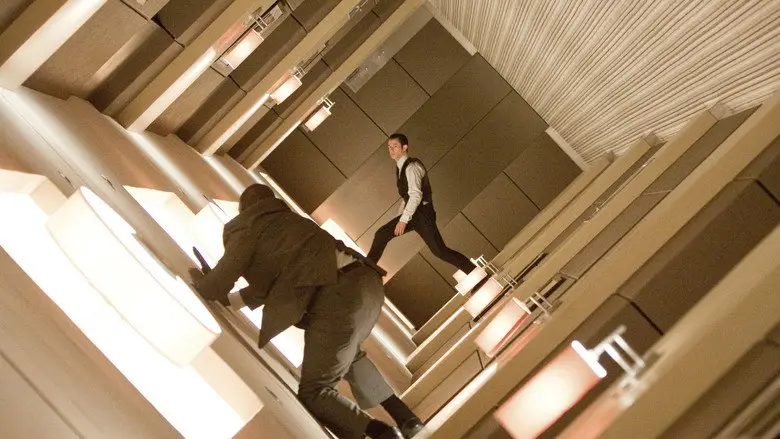
This is also the film’s visual approach in miniature. Rather than replacing ordinary life with an abstract dreamscape, it makes ordinary surfaces unreliable. The result is a useful post-game rewatch path: follow doorways, tables, elevators, and thresholds, then notice when the camera or body position makes them behave differently.
A brief note on the ending
Spoilers: the final shot leaves the top spinning as Cobb walks away. The film cuts before it gives a definitive on-screen answer about whether the object falls. What is certain within the scene is that Cobb chooses not to wait and watch it. The image closes on a question about attention, not a mechanical solution the film states outright.
Conclusion
Inception is memorable because its dream architecture never becomes decoration. The maze, the rain-soaked chase, and the rotating corridor all make its central visual idea tangible: a constructed world can still feel solid enough to trap, persuade, or move through. For a MovieWordle rewatch, start with the objects that anchor each scene, then track the rule that quietly changes around them.
Keep playing
Ready for another film? Browse the MovieWordle 6 Frames archive and choose a recent puzzle to solve.