
FRAME BY FRAME · ISSUE 4
Halloween Visual Analysis
1978 · Horror / Thriller · Directed by John Carpenter
Spoilers below, including the final confrontation.
John Carpenter’s 1978 Halloween makes an ordinary suburb feel dangerous by changing how distance works. The streets are familiar, the houses are open to view, and the light is often clean enough to show exactly where a person is standing. Yet that visibility never feels protective. A figure can remain at the edge of a frame, disappear behind a doorway, or cross a yard without the image giving Laurie Strode enough information to feel safe.
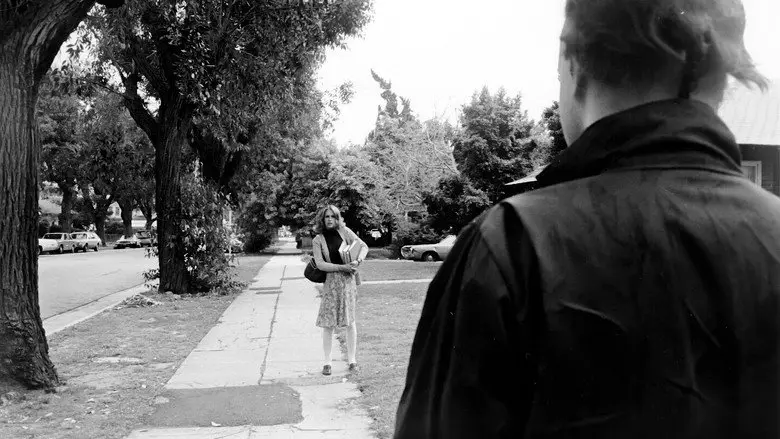
That is the film’s most useful visual idea after a MovieWordle round. The approved frames are clues rather than a six-part explanation: a watcher across a suburban street, a masked figure among trees, and a man standing near a doorway all belong to the same system of looking, waiting, and suddenly being seen.
The suburb is part of the threat
Halloween does not need an unusual landscape to create fear. Its lawns, sidewalks, porches, and bedrooms are legible precisely because they are everyday spaces. The danger comes from the fact that these spaces are connected by open sightlines. A window can show a neighbor’s house, but it can also turn the person inside into a visible target.
The distant-watcher frame captures that unease without requiring a recognizable face. A person occupies one side of the image while the suburban route between them remains exposed. Nothing in the still proves what the watcher intends; the tension comes from the imbalance of knowledge. Someone may be looking, and the person being watched may not know it yet.
The mask turns a person into a moving absence
Michael Myers is visually effective because the mask does not give the viewer a rich expression to read. It flattens the face into a pale surface and makes the body’s stillness more important than its emotion. When the figure appears among trees, the background does not explain him; it gives him places to merge with and emerge from.
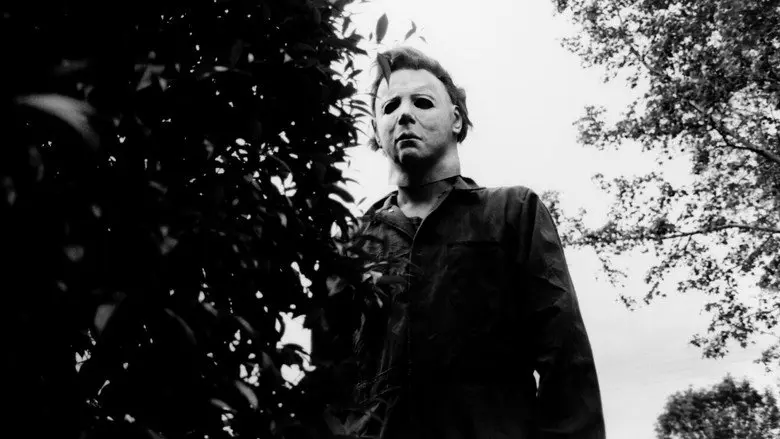
For players, that is a strong recognition cue. A pale mask, a dark figure, and a quiet residential background can identify Halloween before the frame supplies a famous scene. The clue works because it preserves the film’s relationship between the ordinary and the intrusive.
Doorways make safety feel temporary
Carpenter repeatedly uses thresholds to make a room’s safety conditional. A doorway can frame Laurie in bright interior light while leaving the space beyond her unreadable. It can also hold Michael as a vertical silhouette, making him appear less like a person entering the scene than a shape the house has allowed to appear.
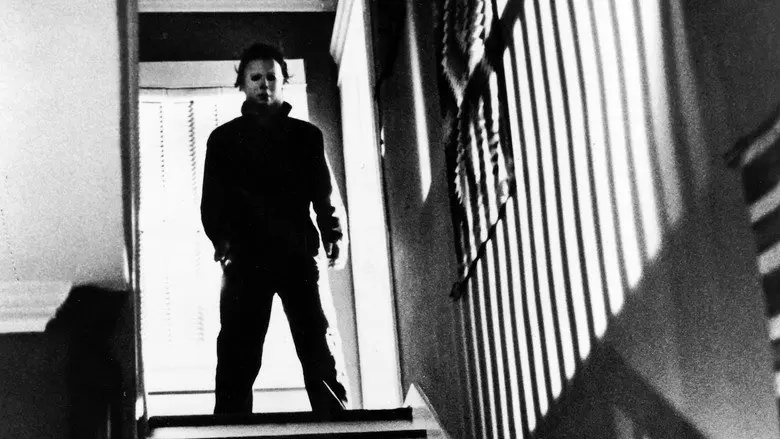
The selected frames therefore point to a practical rewatch question: what does the image allow you to see, and what does it keep just beyond confirmation? Halloween builds suspense in that gap. The viewer is often given enough information to worry, but not enough to act.
Halloween ending explained: why the final confrontation stays open
The final confrontation brings Laurie and Michael together in the spaces the film has been teaching us to watch: a bedroom, a closet, a hallway, and the dark outside a house. Laurie survives by using those boundaries rather than pretending they are safe. She hides, runs, and keeps looking when Michael seems to vanish. Dr. Loomis shoots Michael, but the body is gone when he checks the spot, so the film refuses to turn survival into a complete victory. The missing body is a plot fact, not proof of one supernatural explanation. It keeps Michael’s threat attached to the neighborhood’s ordinary spaces instead of locking it inside a single scene. The ending therefore leaves the viewer with a changed map: every porch, window, and patch of darkness can still contain a watcher. That open threat is why the final minutes feel like an extension of the film’s visual grammar rather than a tidy solution.
The sequence also protects Laurie’s point of view. She does not defeat an explained mythology; she buys time by reading the room faster than the threat can close it. That practical attention is consistent with the film’s earlier distant views, where noticing a shape is useful even when it does not provide an answer.
A spoiler-light rewatch guide
On a rewatch, track the masked shape at the edge of a street and the doorway that divides light from darkness. Those are the same signals that make the approved frames fair, difficult clues.
Conclusion
Halloween remains effective because it makes the familiar visible in a new way. Its suburban spaces, blank mask, and patient thresholds turn looking into a source of danger. That is why a few restrained MovieWordle frames can evoke the whole film: each one shows an ordinary place waiting for an intrusion.
Keep playing
Ready for another film? Browse the MovieWordle 6 Frames archive and choose a recent puzzle to solve.