
FRAME BY FRAME · ISSUE 25
Fight Club Visual Analysis
1999 · Drama / Thriller · Directed by David Fincher
Spoilers below, including the ending.
David Fincher’s 1999 Fight Club is often remembered for its violence and its slogans, but its visual pressure comes from a different source: a narrator who cannot trust the boundary between what he sees and what he has made. This Fight Club explained guide follows the film’s close-ups, smoky interiors, crowds, and isolated rooms before explaining the reveal and final scene.
Fight Club keeps putting people beside versions of themselves
The early scenes make the narrator’s life look over-arranged and emotionally empty. Support groups, catalogued furniture, office routines, and insomnia all give him places to stand without giving him a stable sense of self. Marla Singer interrupts those routines because she reflects the fraud he believes he sees in everyone else.
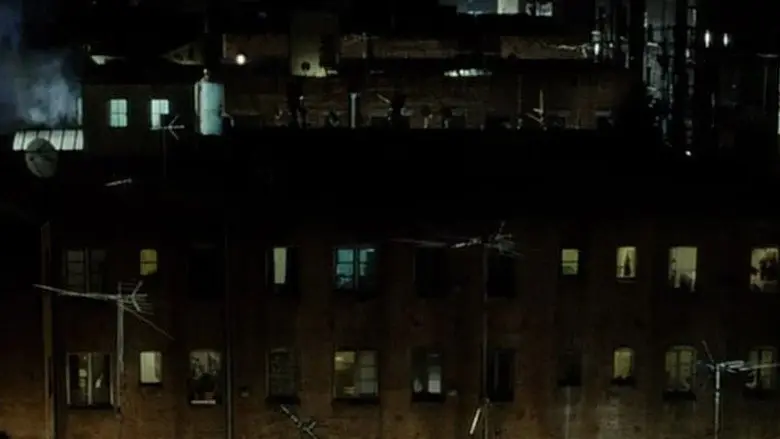
The approved night-building frame is a useful recognition cue. Its scattered lit windows, heavy shadow, and worn exterior belong to the film’s deliberately grimy, compressed atmosphere. It shows how Fight Club makes a private room or residence feel exposed to a larger, unstable system rather than like a refuge from it.
The film’s visual world treats control as something staged
The film moves through basements, bars, offices, airport spaces, and decaying rooms, but it rarely makes those locations neutral. Each one becomes a site where a role is performed. The narrator attempts to manage life through possessions and routines; Tyler Durden offers an opposite performance of freedom; Project Mayhem turns performance into a collective command.
That visual argument matters more than a checklist of quotes. For MovieWordle players, look for chemically sickly light, tight close-ups, smoke, worn surfaces, and a figure positioned as if the room has become a private stage. The stills do not have to reveal the twist to carry the film’s argument about self-invention.
The difference between the narrator’s tidy consumer spaces and the house associated with Tyler is part of that argument. Neither environment supplies freedom on its own. One offers order without intimacy; the other converts disorder into a performance of authenticity. As the film moves between them, it makes the narrator’s wish to hand control to someone else feel tempting before it becomes dangerous.
The camera’s restless proximity reinforces the point. Bodies crowd one another in meetings and basements, while the narrator’s solitary spaces feel airless rather than calm. Even when a room is full, the framing keeps people at an emotional distance. That tension gives the film a recognition texture beyond its most famous images: crowded environments, harsh surfaces, and a point of view that is always trying to make a role feel like a self.
Marla is not merely evidence in someone else’s story
The film’s reveal can tempt a viewer to reduce Marla to a plot device. But she remains the person most visibly affected by the narrator’s divided life. Her exchanges with him are unsettling because she is responding to actions he has not integrated into one identity. The film does not grant her a full explanation until the narrator begins to understand what Tyler is, and the delay is part of the harm the story tracks.
This keeps the recognition cues grounded. Marla is not a coded clue that must be solved; she is part of a visual system in which people are repeatedly forced to react to a version of the narrator they cannot name.
Fight Club ending explained: Tyler is the narrator’s split identity
The ending reveals that Tyler Durden is not a separate person. He is an identity created by the narrator, who has been carrying out Tyler’s actions and building Project Mayhem while unable to recognise the connection. Once he understands this, he tries to stop the plan and then shoots himself through the mouth, an act that ends Tyler’s hold over him without being presented as a simple cure.
In the final scene, the narrator holds Marla’s hand as buildings collapse outside the window. The plot fact is that the project’s destruction proceeds despite his attempt to intervene. The interpretation should remain cautious: the film does not offer a settled portrait of recovery. It gives him a moment of recognition and connection, then leaves him inside the consequences of actions he has only begun to own.
That final image also prevents the reveal from becoming a private solution to a private problem. The narrator has recognised Tyler as part of himself, but the plan has already moved through other people and institutions. Marla’s presence gives the moment a human scale: she has not experienced the story as an ingenious identity puzzle, and the narrator’s recognition does not erase what she has been made to endure.
The final scene is therefore deliberately incomplete. It gives the narrator a break in the internal pattern without claiming that a single moment of clarity can undo the plan’s public effects. The buildings falling outside the window make that imbalance concrete. A personal revelation has arrived too late to remain personal, and the film leaves the viewer with connection, damage, and uncertainty held in the same image.
How the final image reframes the game’s dark interiors
On a rewatch, the useful question is not “Which frame proves Tyler was imaginary?” The film is more precise than that. Ask instead which scenes make the narrator feel most certain that someone else is in control, and which leave a gap between his account and another character’s reaction. The dim buildings and enclosed rooms are clues to that unstable point of view long before the plot explains it.
Conclusion
The best Fight Club explained reading sees the final scene as a reckoning, not a clean escape. Fincher’s cramped spaces, hard light, and divided conversations build toward a reveal about control that the narrator has avoided. The falling buildings make the stakes visible, while Marla’s presence keeps the ending tied to another person rather than to a private puzzle.
Keep playing
Ready for another film? Browse the MovieWordle 6 Frames archive and choose a recent puzzle to solve.