
FRAME BY FRAME · ISSUE 12
Edward Scissorhands Visual Analysis
1990 · Fantasy / Drama / Romance · Directed by Tim Burton
Spoilers below, including the ending.
Tim Burton's 1990 Edward Scissorhands is built from a visual contradiction: a handmade outsider is placed inside a suburb that looks perfectly standardized. The film's pastel houses, black clothing, snow, and exaggerated silhouettes make the story recognizable before the plot catches up. For MovieWordle players, the useful question is not simply "Is this a Tim Burton film?" It is how a frame makes sweetness and exclusion occupy the same space.
How the suburb becomes a visual clue
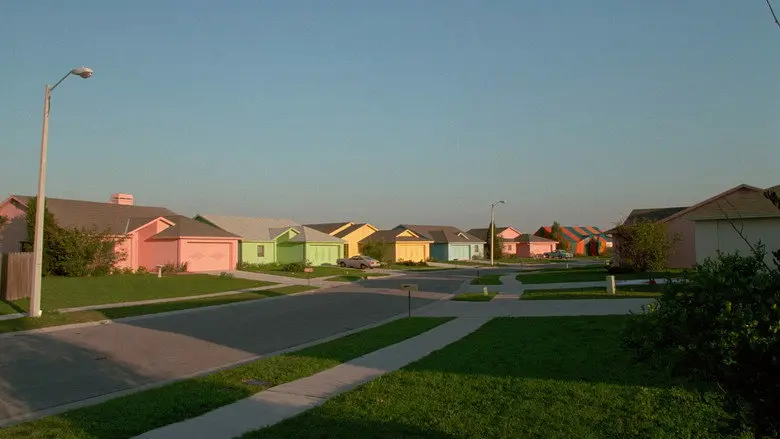
The approved neighborhood frame shows a broad street of detached houses in pink, yellow, green, and blue. The road is empty, the lawns are clipped, and the houses repeat a familiar shape. That repetition makes the setting feel safe at first, but it also gives the place the quality of a display model. The suburb is a social machine: everyone has a place, a color, and a routine.
Edward is memorable because he does not fit that system. His black leather clothing and sharp hands would look dramatic anywhere, yet against these soft colors they become an immediate shape of difference. The contrast is practical recognition information. If a frame combines candy-colored suburbia with a gothic figure or an unusually sculpted object, Edward Scissorhands should be high on the list.
The film's fantasy is therefore not separated from ordinary life. It is inserted into a recognizable American neighborhood, where curiosity quickly becomes gossip and enthusiasm can turn into ownership. The artificial palette keeps that social pressure visible without requiring a speech about it.
Edward's hands turn touch into craft and danger
Edward's scissor hands are a simple premise with several visual consequences. They prevent ordinary touch, but they also make him exceptionally good at cutting, shaping, and decorating. The film repeatedly turns the same physical feature into a gift for the neighborhood and a source of fear when a situation becomes difficult.
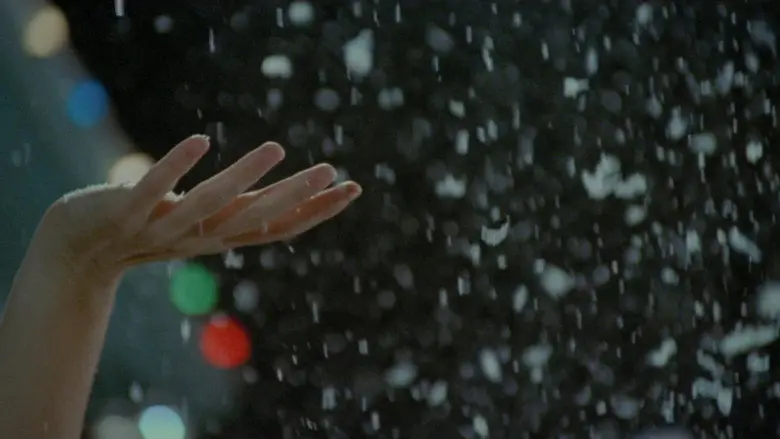
The snow frame is especially useful because it reduces the character to a hand, falling flakes, and soft colored lights. Nothing in the image explains the entire plot. Instead, it offers the film's central visual relationship: a sharp object can produce something delicate, and beauty can be tied to loss. The image is a guessing cue because the unusual hand is visible, but it is also evidence for the film's larger interest in making and touching.
That distinction matters after the game. Edward's topiary figures and haircuts are not just quirky set dressing. They are the forms through which he can participate in a community. The same skill that makes him welcome also makes him seem useful, and the difference between affection and usefulness never stays stable.
Edward Scissorhands ending explained, briefly
At the end, Edward refuses to let Kim remain with him after Jim's attack. He returns to the mansion, and Kim later tells her granddaughter that Edward is still alive, cutting ice sculptures so that snow falls over the town. The plot facts are clear; the emotional meaning is deliberately more open.
The final snowfall turns Edward's isolation into a memory that still shapes Kim's life. He has not been absorbed into the suburb, and Kim has not forgotten him, but their separation becomes the condition under which his work can continue. The scene preserves the film's central tension: Edward can make something beautiful from his difference, yet the ordinary world is not built to make room for him.
Conclusion
The best Edward Scissorhands explained reading begins with the film's surfaces. Pastel houses, black clothing, a visible blade, and snow are not decorative extras; they are the recognition system. The approved MovieWordle frames point to a story about craft, touch, and belonging without reducing Edward to a monster or a mascot.
Keep playing
Ready for another film? Browse the MovieWordle 6 Frames archive and choose a recent puzzle to solve.