
FRAME BY FRAME · ISSUE 26
Edge of Tomorrow Visual Analysis
2014 · Action / Science Fiction · Directed by Doug Liman
Spoilers below, including the ending.
Doug Liman’s 2014 Edge of Tomorrow makes repetition physical. Its invasion scenes do not use the time loop as a neat puzzle box; they turn every reset into a new piece of tactical information, and every improvement into another reminder that Major William Cage can die again. This Edge of Tomorrow ending explained guide follows the film’s visible system of rehearsal, scale, and return before addressing why Cage wakes in a changed timeline.
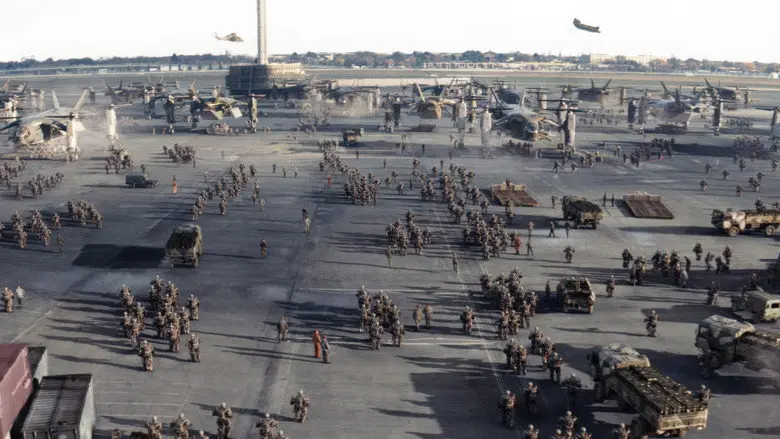
The film turns a beach landing into a repeatable problem
The film begins by stripping Cage of the status that has kept him away from combat. He is sent toward the invasion of France with little practical preparation, then dies during the landing and wakes to relive the same stretch of time. From that point, the story’s basic unit is not a day but a trial: Cage can observe a detail, fail, restart, and attempt a different route.
That structure is why the staging-area frame matters in MovieWordle. Rows of equipment, troops, and vehicles make the scene look orderly from a distance, but the film repeatedly reveals how little that order guarantees once the landing starts. The wide view supplies a recognition cue—military mass arranged on an airfield—while the plot keeps narrowing the question to what one person can learn before the same disaster arrives.
The loop also changes the usual action-movie meaning of competence. Cage does not become capable because a montage declares him capable. He becomes useful by retaining the failures that everyone else has forgotten. A route through a field, the timing of an attack, and an encounter that was fatal in one iteration become usable knowledge in the next.
Rita gives the loop a human limit
Rita Vrataski is not simply the film’s expert guide. She understands Cage’s situation because she once had the same ability, and she knows that the advantage is temporary and isolating. The film lets their training become increasingly efficient, but it does not make their relationship automatic: Cage remembers each version of their encounters while Rita must meet a stranger again.

The close view of Rita makes a useful counterweight to the film’s large military images. Her gear and focused expression are visible, practical signs of a soldier rather than a symbolic shortcut. In the wider film, that practical focus keeps the time-loop premise from becoming weightless. Training can make Cage quicker and more informed, but it cannot produce one painless version of a relationship or a mission.
The visual clue is controlled chaos
For players trying to identify Edge of Tomorrow, the approved frames offer a compact route in: military crowds gathered before deployment, an exhausted soldier in uniform, a determined woman in combat gear, and powered exosuits amid smoke and debris. The film combines conventional war-film scale with shapes that do not belong to a conventional war film—the rigid frames of the suits and the rapid, unstable movement of the Mimics.
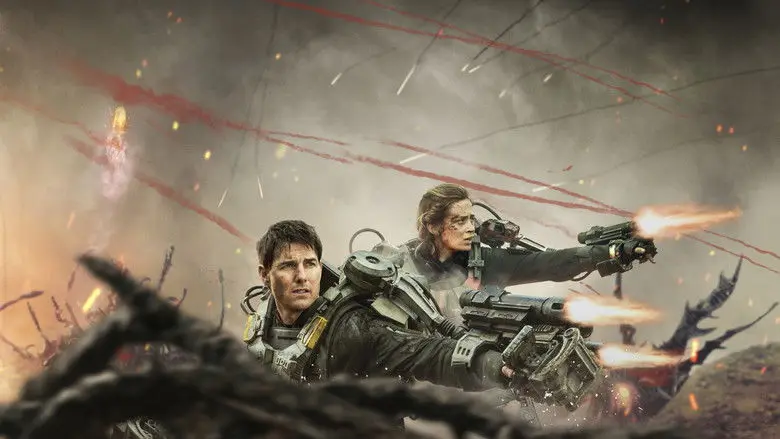
The battle frame is especially useful because it holds two scales at once. Cage and Rita are close enough to read as people, while the surrounding smoke, fire, and machinery deny them a stable battlefield. That tension is the film’s visual signature: action keeps arriving as a catastrophe too large to understand in one pass, then the loop gives Cage permission to look again.
The earlier London river image completes that recognition system. It offers a calm, open horizon and a familiar bridge, which makes it a useful reminder that the film does not begin inside combat. It moves Cage from controlled public messaging toward a war whose geography he must eventually memorize. The progression from river, to base, to beach, to Paris is practical rather than decorative: each place becomes legible only after he has failed inside it.
That attention to spatial sequence keeps the action scenes unusually clear. The film rarely asks the viewer to admire destruction as an end in itself. A wrecked route is information; a missed turn becomes a future shortcut; a dangerous gap in a formation becomes something Cage can warn another person about. The spectacle has a learner inside it.
Edge of Tomorrow ending explained: the last reset is different
By the final mission, Cage no longer has the ordinary protection of the loop. After a blood transfusion, he believes that death will be permanent, so the assault on the Omega in Paris has a different charge from his earlier attempts. He and Rita reach the Omega; Cage kills it with explosives and is covered in its blood as he dies.
The last image of Cage waking is not presented as a new routine reset to the same morning. He wakes earlier, before the chain of events that sent him into combat, and a news report establishes that the Mimics have been defeated. The cleanest plot-level explanation is that contact with the dying Omega’s blood triggers a final, larger reset after the Omega has been destroyed. Cage retains what he has learned; the rest of the world does not share his memory of the route that got there.
That answer does leave an emotional asymmetry. Cage can find Rita again, but she has not lived the history the audience has watched. The ending is happy in its outcome, not because it restores an identical relationship. Its last smile acknowledges the oddness of a victory only one person can fully remember.
What to notice on a rewatch
Watch how the film changes the value of repeated imagery. A helicopter ride, a military base, and a beach can first appear as exposition, then become landmarks in Cage’s private map. Also notice the way the film alternates aerial or wide battlefield views with close shots of faces that must make decisions inside them. The large picture is rarely enough; Edge of Tomorrow gets its momentum from the next specific choice.
Conclusion
The strongest Edge of Tomorrow ending explained reading is a practical one: Cage kills the Omega, dies in contact with its blood, and wakes in an earlier timeline where the invasion has already ended. The movie earns that strange final reset by making each earlier loop feel costly. Its military scale, exosuits, and recurring staging points are not just visual hooks; they are the terrain Cage has learned to read.
Keep playing
Ready for another film? Browse the MovieWordle 6 Frames archive and choose a recent puzzle to solve.