
FRAME BY FRAME · ISSUE 15
Corpse Bride Visual Analysis
2005 · Fantasy / Animation / Romance · Directed by Mike Johnson, Tim Burton
Spoilers below, including the ending.
Tim Burton and Mike Johnson's 2005 stop-motion film Corpse Bride explained is easiest to recognize through its split world. Victor is trapped between a gray, anxious village and a colorful afterlife where the dead dance, argue, and remember how to live. The film's romance matters, but its visual system comes first: vows create obligations, while movement and music reveal which world still has room for change.
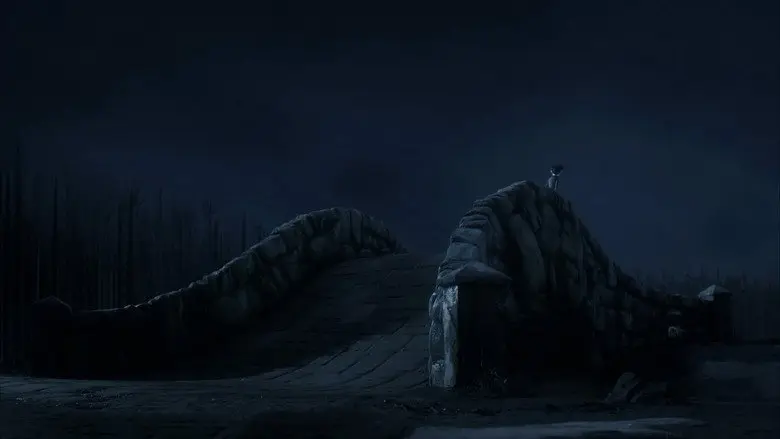
Two worlds, one anxious promise
The opening world is built from narrow silhouettes, formal clothes, and cold blue-gray space. Victor and Victoria are being prepared for a marriage arranged by their families, yet neither looks at home inside the ceremony. The village treats marriage as a contract that can repair status and money. Its rigid rooms and rehearsed manners make the promise feel like a performance before Victor has learned how to speak it.
An approved frame of a stone bridge captures that pressure without showing a character. The bridge rises over a dark, empty ground and disappears into trees. It is a threshold, but not a welcoming one: the route forward is visible while the destination remains obscured. For MovieWordle players, the combination of gothic architecture, blue-black night, and handcrafted texture points toward Corpse Bride before any face appears.
The film's afterlife reverses the emotional temperature. The dead inhabit a crowded underground bar filled with color, music, and loose-limbed motion. Their bodies are damaged, but their social world is more generous than the living town's polished surface. Burton's contrast is not simply “gray living versus bright dead.” It asks which community allows people to admit fear, desire, and regret.
The skeletons make death feel social
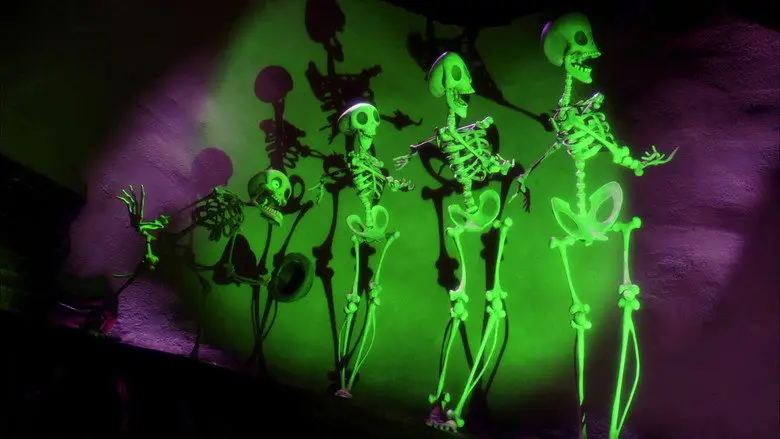
The skeleton ensemble is one of the film's strongest recognition cues. Several figures lean, gesture, and play instruments together under green light, so death appears as a group activity rather than a silent final state. The frame is macabre, but it is also theatrical and funny. Bones become expressive stop-motion puppets, and the visible joints remind us that every movement is made by hand.
That liveliness changes how Emily's claim on Victor reads. She is not only a ghost demanding a husband. She is a person whose unfinished story has been given a community that can hear it. Her wedding vow is legally and emotionally powerful within the film, but the afterlife characters also understand that a promise made in confusion cannot become a permanent sentence.
The movie keeps returning to objects that carry promises: a ring, a veil, a piano, a bouquet, and the wedding rehearsal itself. Each object looks ceremonial in the living world and improvisational below ground. The shift makes the central conflict legible without requiring a mythology lesson. The question is not whether the dead are real; it is whether a vow can be honored without trapping the people who made it.
Corpse Bride explained: why Emily lets Victor go
Victor accidentally marries Emily in the forest while practicing his vows. When the living wedding is restored, Emily brings him to the underworld, but she eventually recognizes that his love belongs with Victoria. Lord Barkis's betrayal exposes the violence behind the original social arrangement, and Emily refuses to repeat that pattern by forcing Victor to remain hers.
At the end, Emily releases Victor. Her body rises into a cloud of blue butterflies, a transformation that turns grief into movement rather than punishment. The plot fact is simple: Victor and Victoria can marry, and Emily's spirit is freed. The interpretation is gentler. Emily's final act makes love an act of relinquishing ownership, which is the opposite of the possessive vow that first binds Victor to her.
Conclusion
The clearest Corpse Bride explained reading follows the film's thresholds: a bridge, a wedding rehearsal, a forest, and a dance floor. The living world mistakes ceremony for security; the dead world discovers that memory can still change. The blue-black architecture and glowing skeletons make that argument visible, giving players a distinctive path to the film even before the bride appears.
Keep playing
Ready for another film? Browse the MovieWordle 6 Frames archive and choose a recent puzzle to solve.