
FRAME BY FRAME · ISSUE 7
Carrie Visual Analysis
1976 · Horror / Thriller · Directed by Brian De Palma
Spoilers below, including the ending.
Brian De Palma’s 1976 Carrie is a horror film about humiliation becoming visible. Its images move between cramped domestic spaces, watchful school corridors, mirrors, saturated color, and sudden bursts of movement. That makes a Carrie ending explained article most useful when it connects the final blood-soaked image to the film’s earlier visual rules rather than treating the prom as an isolated shock.
Carrie’s visual world turns private shame into spectacle
The film repeatedly places Carrie White where other people can look at her. At home, religious objects and narrow rooms make her body feel monitored. At school, groups form around her, and the camera often turns ordinary social space into a stage. The pressure is not only that Carrie is bullied. It is that humiliation keeps becoming a public event.
De Palma’s visual design gives that pressure a physical shape. Mirrors divide Carrie’s image. Doorways and locker-room lines separate her from the group. Slow motion can stretch a moment of attention until it feels cruel. The effect is uncomfortable because the camera understands how a crowd watches, even when the crowd pretends it is only joking.
Mirrors, split attention, and the recognition cues in Carrie
One approved frame shows two young women reflected in a mirror. It is a strong MovieWordle clue because the mirror creates a social image before the viewer knows the full context. Carrie’s world is full of doubled positions: the person she feels herself to be, the person classmates decide she is, and the frightening version of herself that others begin to imagine.
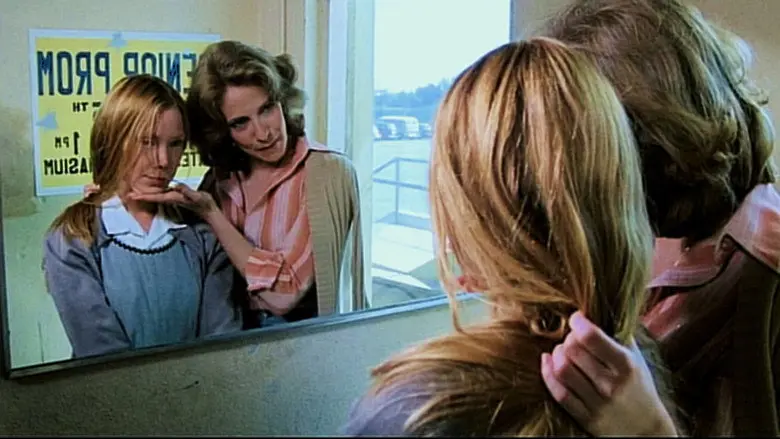
The frame does not prove a hidden symbol or a single authorial intention. It does show how Carrie uses reflective surfaces and divided compositions to make identity unstable. For players, the useful pattern is a 1970s social setting made unnerving by mirrors, isolated faces, and a palette that can shift from pale restraint to violent red.
The prom changes from fantasy to punishment
Carrie’s prom sequence begins with a fragile promise of belonging. The dress, the flowers, the stage, and the applause briefly give her a place inside the school’s public ritual. An approved frame of Carrie holding flowers captures that tension: she appears centered and celebrated, but the image is already too composed to feel safe.

The shift arrives through editing, point of view, and color. The audience knows more than Carrie does, so the bucket of pig’s blood becomes a threat before it becomes an event. When it falls, the prom’s ceremony collapses into a hostile spectacle. Carrie’s telekinetic retaliation is frightening because it is both deliberate and uncontrolled: she finally controls the room, but she has no stable way to leave it.
Carrie ending explained: why the final image is not simple closure
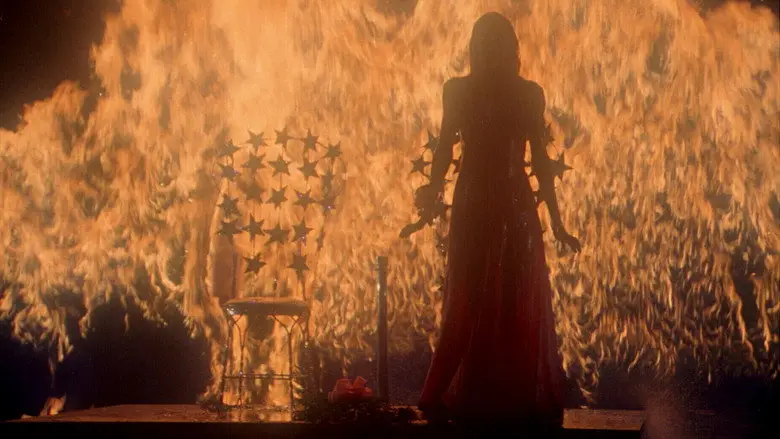
Carrie kills many of the people inside the gym, returns home, and is killed by her mother. The final confrontation ends with Carrie’s house collapsing in flames, and Sue Snell later dreams of placing flowers at the site. Those are the plot facts. The emotional meaning is less tidy.
The ending does not present Carrie as a monster who has been removed from the world. It shows a chain of cruelty in which adults, classmates, and institutions repeatedly fail to stop violence before it becomes irreversible. Carrie’s mother turns religious devotion into control, the students turn embarrassment into entertainment, and the school’s attempt at kindness arrives too late to undo the damage.
Sue’s nightmare keeps the ending open without making it ambiguous in a puzzle-box sense. She carries guilt because she tried to help, but she also knows that sympathy after catastrophe cannot restore the person who was humiliated in public. The flowers are an image of mourning, not proof that Carrie will return.
How the six frames preserve the film’s identity
The approved set works because it includes both social recognition and horror escalation. The mirror frame points to divided identity. The prom image shows public approval becoming precarious. The fiery silhouette carries the film’s final movement from shame to destruction without reproducing every step of the climax.
Taken together, those cues make Carrie recognizable through contrast: ordinary teenage spaces, severe domestic ritual, centered figures, and color that suddenly turns punitive. A good rewatch follows how often the film makes Carrie visible before it lets her act.
Conclusion
The strongest Carrie ending explained reading is not that telekinesis created a villain. It is that a culture of watching, judging, and controlling leaves Carrie with no safe place to put her fear. De Palma’s mirrors, stages, saturated reds, and split points of view make that collapse visible long before the house burns.
Keep playing
Ready for another film? Browse the MovieWordle 6 Frames archive and choose a recent puzzle to solve.