
FRAME BY FRAME · ISSUE 17
Beetlejuice Visual Analysis
1988 · Fantasy / Comedy · Directed by Tim Burton
Spoilers below, including the ending.
Tim Burton's 1988 Beetlejuice explained through its approved frames is a story about a house that refuses to have only one owner. Adam and Barbara Maitland die, remain attached to their home, and discover that the living Deetz family can occupy the rooms without understanding the rules. The afterlife is not a distant realm in this comedy; it presses against wallpaper, furniture, and the front door. Space becomes the film's main joke and its clearest recognition cue.
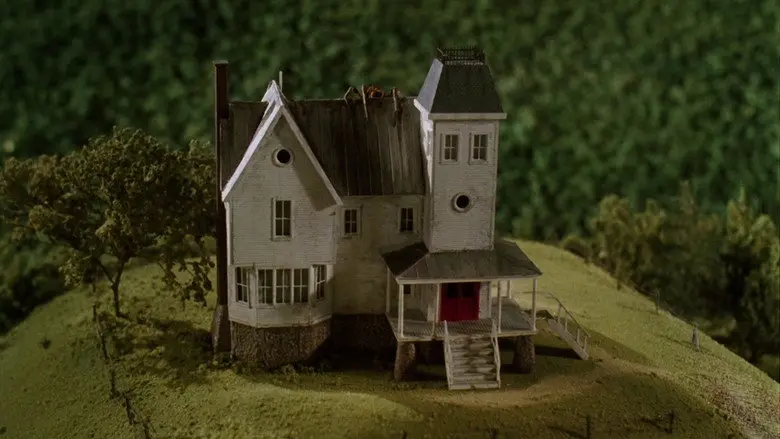
The model house is already a stage
The approved miniature-house frame looks harmless at first: a white building, a red door, trimmed greenery, and a carefully arranged hill. Yet the model announces the film's central idea. The Maitlands' home is something they can build, inspect, and control, but it is also a stage that can be rearranged by someone else.
That double status makes Beetlejuice easy to spot in a guessing game. The film combines suburban domestic detail with obviously handmade distortion. A normal doorway can become a portal; a staircase can turn into a trap; a model landscape can contain a full-size haunting. Burton's fantasy begins with the familiar scale of a house and then keeps changing who is allowed to define it.
Adam and Barbara's problem is therefore more specific than “ghosts versus humans.” They know the rooms, but they do not know how to make the new residents leave. The Handbook for the Recently Deceased offers instructions without giving them practical authority. Rules exist, yet performance and confidence often matter more than obedience.
Color makes the afterlife impossible to ignore
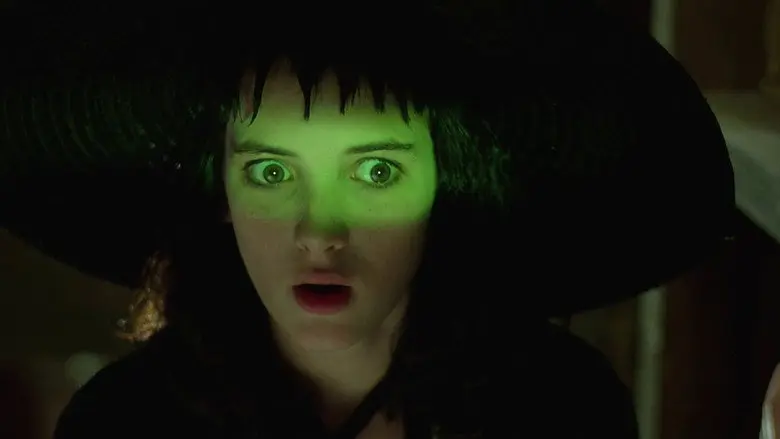
Another approved frame shows Lydia under a saturated green light, her face startled and sharply isolated. The color does not simply signal “supernatural.” It makes the room feel like a stage light has found its performer. Lydia is the character most willing to look at the strange world directly, so the film often places her at the point where domestic space becomes spectacle.
The same logic governs the waiting room, the sandworms, and the dinner-party possession sequence. Beetlejuice uses theatrical entrances and abrupt color shifts to turn fright into social embarrassment. Characters are not only threatened; they are made to perform in front of other people. That is why the film's comedy does not cancel its horror. Both depend on the shock of a body appearing in the wrong role.
The visual cues are practical for players: miniature architecture, red doors, striped or saturated costumes, green supernatural light, and a house whose boundaries never stay stable. No single color solves the film, but the combination of crafted surfaces and comic intrusion is distinctive.
Beetlejuice explained: why the contract backfires
Beetlejuice is a freelance bio-exorcist who promises to remove the living Deetz family from the house. Lydia summons him, but his help is dangerous because he wants to marry her and gain a permanent connection to the living world. Adam and Barbara eventually work with Lydia to stop him rather than treat his arrival as a solution.
The ending resolves the immediate conflict through a reversal of performance. Lydia wins a sandworm race and escapes, while Beetlejuice is sent to the afterlife waiting room and forced to wait his turn. The plot does not restore the Maitlands to ordinary life or erase the Deetzes' presence. Instead, the house becomes a negotiated shared space, and Lydia finds a way to live with the dead without surrendering her own identity.
The ending's lightness is important. Beetlejuice's contract fails because he treats every relationship as a transaction, while the characters who survive learn to cooperate across the living/dead boundary. The film's supernatural rules remain absurd, but its emotional rule is clear: belonging cannot be purchased through a flashy entrance.
Conclusion
The strongest Beetlejuice explained reading starts with the house as a stage. The miniature model, the red door, and Lydia's green-lit face show a world where scale and identity keep shifting. Burton turns domestic space into comic horror, then lets the ending reward collaboration over possession. Those cues make the film recognizable before the striped suit arrives.
Keep playing
Ready for another film? Browse the MovieWordle 6 Frames archive and choose a recent puzzle to solve.