
FRAME BY FRAME · ISSUE 9
A Nightmare on Elm Street Visual Analysis
1984 · Horror · Directed by Wes Craven
Spoilers below, including the ending.
Wes Craven's 1984 A Nightmare on Elm Street makes sleep frightening because it removes the one thing its teenagers need: a reliable place to stand. Bedrooms, bathrooms, classrooms, and suburban streets keep their familiar shapes, then stop obeying familiar rules. This A Nightmare on Elm Street ending explained guide follows that changing space through the approved MovieWordle frames, and through Nancy's attempt to meet Freddy on terms she can understand.
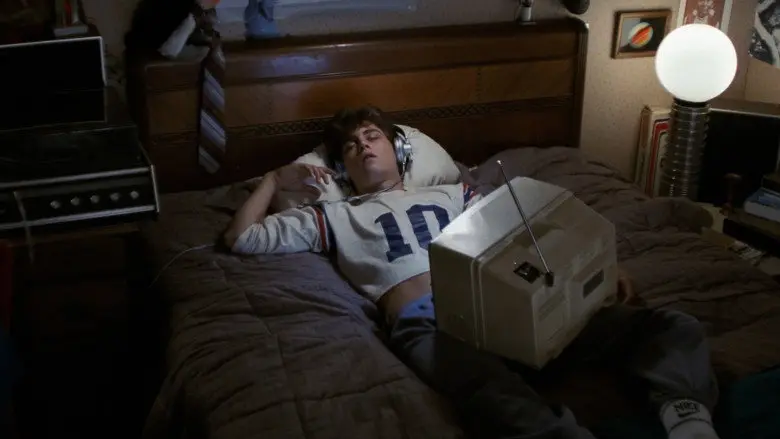
Sleep turns a bedroom into an unstable location
The first selected frame is quiet: a teenager lies on a bed with a television set nearby. It works as a recognition cue because the room is so ordinary. The bed, the lamp, the clutter, and the pale light belong to a recognizable teenage world, yet the sleeping figure cannot check whether the room is safe. In this film, sleep is not a pause in the action. It is the condition that lets danger alter distance, surfaces, and cause and effect.
That is why the film's domestic spaces carry so much of its tension. A bedroom is normally private. Here it is also a threshold. A school corridor can become a dream route; a street can be the last thing a character sees before waking; a wall or ceiling can stop behaving like a wall or ceiling. The visual premise is simple enough for a player to recognize, but it gives the story its unease: nowhere remains reliably separate from the nightmare.
The bathtub frame makes routine feel exposed
An approved frame of a young woman lying in a bath shows how the film treats routine as vulnerable. The tiled room, foam, and pale blue bath support a moment that should feel enclosed and restful. Instead, the camera leaves the body exposed from an angle that makes the tub seem less like a container than an opening.

The image does not need an elaborate symbolic reading to be useful. It shows the film's working method: take an environment with clear everyday rules, then let sleep make those rules provisional. The shower, the bed, the classroom, and the hallway become fair MovieWordle clues because they are not generic horror locations. They are suburban spaces made treacherous by the possibility that a dream can reach them.
Freddy is staged as part of the architecture
The blue corridor frame makes the film's theatrical side unmistakable. Freddy's silhouette is recognizable, but the space around him matters as much as the figure: wet-looking walls, receding lines, a cold wash of blue, and a body placed as if it has stepped onto a stage. The image makes the nightmare feel built, not merely imagined.
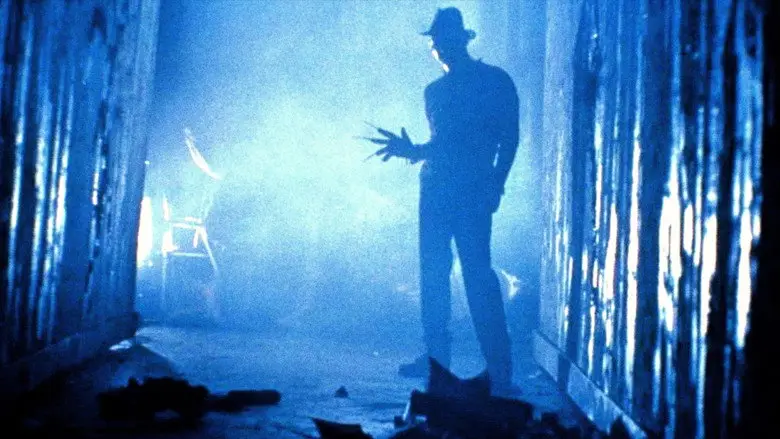
Craven's visual design lets Freddy appear within a world that is both physical and impossible. That tension gives Nancy a practical task. She cannot simply wait for adults to explain what is happening, because the adults' account leaves out the danger she can see. She watches for patterns, prepares traps, and tries to force a confrontation on a waking-world scale. Her growing agency is real, but it never makes the dream world fully legible.
For a MovieWordle round, look for the combination of adolescent domesticity, sleeping bodies, distorted interiors, and a monster framed against space that feels deliberately artificial. A glove or a striped sweater may identify the title quickly, but the rooms explain why the film has a different texture from a conventional slasher.
A Nightmare on Elm Street ending explained: Nancy wins a confrontation, not safety
In the climax, Nancy prepares traps, confronts Freddy, and appears to wake after refusing to give him the fear he needs. Morning light and the ordinary street initially suggest that she has returned to a stable world. The final car ride undoes that confidence: the convertible's roof closes, and the image turns the apparent escape into another nightmare.
The plot therefore does not give a final confirmation that Freddy has been permanently defeated. Nancy has learned how to resist him and has acted on that knowledge, but the last movement refuses to convert her victory into a guarantee. The film restores the appearance of suburban normality only long enough to show that appearance can no longer be trusted.
That ending fits the visual system established by the selected frames. If the bedroom, bathtub, and corridor can all become unstable, a bright street cannot settle the question by itself. The final shock is not a separate trick added after the story. It is the last expression of a film in which safety is always one wake-up away from being withdrawn.
Why the approved frames make fair puzzle clues
The three frames reveal a progression without reproducing the ending. The sleeping teenager establishes the risk of ordinary rest. The bathtub shows a private room opened to threat. The blue corridor gives the nightmare its signature silhouette and artificial depth. Together they point to a horror film where familiar teenage spaces are redesigned by fear.
Conclusion
The clearest A Nightmare on Elm Street ending explained reading is that Nancy achieves knowledge and temporary control, not permanent protection. Craven's bedrooms, bathrooms, and corridors remain persuasive because they retain their ordinary details while losing their ordinary rules. The final image leaves that instability intact.
Keep playing
Ready for another film? Browse the MovieWordle 6 Frames archive and choose a recent puzzle to solve.